
Farah Zahir
Managing Editor, The Oniket Bulletin
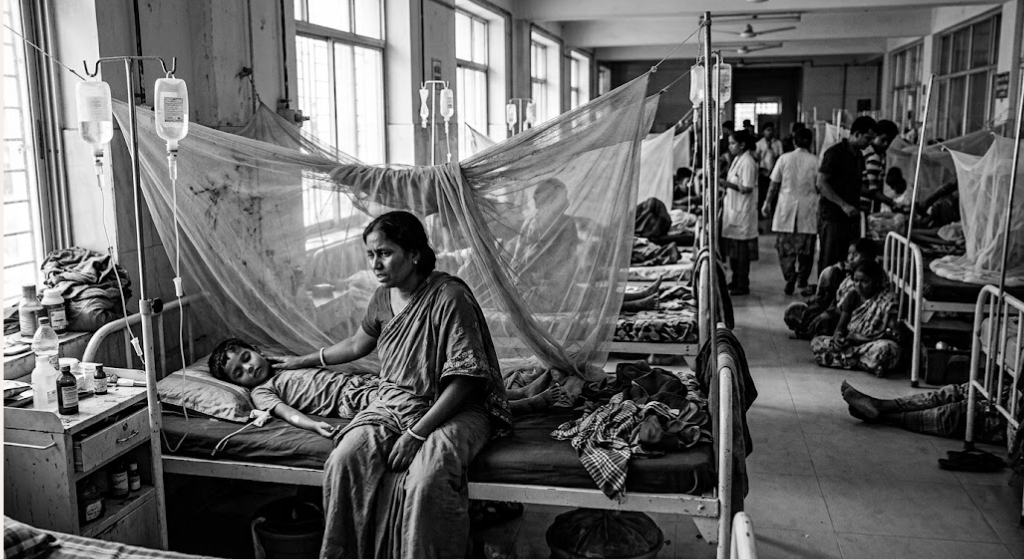
Bangladesh has lived with recurring dengue outbreaks for more than two decades. The disease is no longer confined to Dhaka or to a predictable monsoon season. In 2026, the country had already recorded 90,356 hospitalised cases and 281 deaths as of 6 October, according to the Directorate General of Health Services (DGHS). On 6 October alone, 1,996 patients were hospitalised and 10 people died, the highest single-day death toll recorded this year. September was particularly severe, accounting for 148 deaths.
The question is no longer whether Bangladesh knows how to treat dengue. It does. The more difficult question is why the country continues to face large outbreaks despite years of experience, public spending, mosquito-control programmes and clinical guidelines.
A disease we can manage, but struggle to prevent
There is no specific antiviral treatment for dengue. Medical care focuses on early diagnosis, monitoring warning signs and providing appropriate supportive treatment. WHO notes that timely detection and proper case management can bring the case-fatality rate below 1 percent. Bangladesh has a national clinical management guideline, updated in 2025, and DGHS has established surveillance and reporting mechanisms for dengue.
The larger challenge is transmission. Dengue is spread mainly by Aedes aegypti mosquitoes, which breed in relatively small collections of stagnant water around homes, construction sites, offices, schools and hospitals. Fogging can reduce adult mosquitoes for a limited period, but it does not remove the breeding sources. WHO therefore recommends integrated vector management, combining environmental management, source reduction, larval control, surveillance and measures to reduce human exposure.
This is where Bangladesh’s response has shown its weakest point. Responsibility for dengue management and mosquito control is divided among health authorities, city corporations and other local agencies. The fragmentation becomes more serious outside the major cities, where surveillance, laboratory capacity, trained personnel and vector-control resources can vary considerably.
The geography of death is changing
The 2026 figures demonstrate that dengue is no longer simply a Dhaka problem. As of 6 October, DGHS data recorded 75 deaths in Dhaka South City Corporation, 35 in Dhaka North, 55 in Khulna division, 25 in Chattogram, 24 in Barishal, 23 in Mymensingh, 19 in Rajshahi, 17 in Dhaka division outside the city corporations, six in Rangpur and two in Sylhet.
These figures should not be described as division-wise mortality rates. There are reported deaths. A genuine mortality or case-fatality comparison would require consistent data on infections, hospital admissions, population size, referral patterns and access to treatment across each division.
The pattern is nevertheless important. Khulna’s 55 deaths are higher than those recorded in Chattogram, Barishal, Rajshahi, Mymensingh, Rangpur and Sylhet. Meanwhile, Dhaka’s two city corporations continue to account for a substantial share of deaths. This suggests that dengue policy cannot be designed around the capital alone.
What is the government doing?
Bangladesh has several components of a functioning dengue response. DGHS operates a national dengue surveillance system and publishes regular case and death data. Hospitals have clinical guidelines for dengue management, while local authorities conduct larviciding, adult mosquito control, source reduction, awareness campaigns and, in some areas, mobile-court operations against mosquito breeding sites.
There have also been attempts to make mosquito control more data-driven. In 2025, Dhaka North City Corporation and UNDP launched a dengue dashboard intended to help authorities identify patterns and respond more quickly.
The problem is less a complete absence of measures than their consistency, coordination and timing. A 2025 investigation found that Dhaka’s two city corporations had spent around Tk 707 crore on mosquito-control activities over nine years, while dengue continued to return at scale. Experts cited outdated strategies, weak coordination, uncertainty over insecticide effectiveness and difficulties reaching breeding sites inside private premises.
What about a vaccine?
The absence of a Bangladesh-specific dengue vaccine programme does not mean that no dengue vaccine exists. WHO currently recommends TAK-003, or Qdenga, for certain children aged 6-16 in settings with high-intensity transmission, subject to specific conditions. The vaccine does not prevent every dengue infection and is intended as one component of a broader control strategy.
Bangladesh has not introduced a national dengue vaccination programme. In October 2026, the government said it was considering dengue vaccine trials in the country as a longer-term measure. That cautious approach is understandable because vaccine policy requires assessment of safety, effectiveness, serotype distribution, cost and the epidemiological characteristics of the Bangladeshi population.
The immediate policy priority, therefore, cannot be vaccination alone. Bangladesh needs a stronger prevention system while vaccine evidence and regulatory assessment continue.
The policy gap: prevention remains reactive
The central weakness is that dengue control often becomes visible after cases rise. A more effective system would work continuously throughout the year.
First, Bangladesh needs year-round Aedes surveillance, including routine mapping of breeding sites and insecticide-resistance monitoring. Second, dengue data should be integrated across DGHS, city corporations, municipalities and local government so that outbreaks can be identified at ward and district level rather than after hospitals become crowded.
Third, vector control must move beyond fogging. Authorities should prioritise removing breeding sources from construction sites, drains, rooftops, abandoned containers, institutional premises and household surroundings. Local governments should publish ward-level performance indicators showing where inspections were conducted, breeding sites removed and follow-up actions completed.
Fourth, healthcare preparedness needs to be decentralised. The IEDCR’s review of 119 dengue deaths found that more than one-third of patients died within a day of hospital admission. This points to the importance of early referral, triage and clinical capacity outside major tertiary hospitals.
Finally, dengue policy must account for climate and urban change. Research and WHO assessments have linked rainfall, temperature, waterlogging and changing seasonal patterns with dengue transmission. Climate-sensitive disease surveillance should therefore become part of urban health planning rather than an emergency response after cases begin to climb.
The SDG connection
Dengue directly relates to SDG 3: Good Health and Well-being, particularly Target 3.3, which calls for ending epidemics of communicable diseases, and Target 3.d, which focuses on strengthening capacity for early warning, risk reduction and management of national and global health risks.
The issue also connects with SDG 11: Sustainable Cities and Communities, especially the need for safer and healthier urban environments, and SDG 13: Climate Action, because changing climatic conditions can influence the distribution and duration of mosquito-borne diseases.
For Bangladesh, these goals should not remain separate development targets. Dengue sits at their intersection: public health, urban management, climate resilience, local governance and community participation.
The country does not need another seasonal campaign that begins when hospitals start filling. It needs a permanent dengue governance framework, backed by reliable surveillance, accountable local authorities, stronger primary healthcare, scientific vector control and community participation. The objective should be simple: make dengue prevention a routine public service rather than an emergency response repeated every year.
References
- Directorate General of Health Services (DGHS), Ministry of Health and Family Welfare, Government of Bangladesh. Dengue Dynamic Dashboard and Daily Dengue Situation Reports. 2026. DGHS Dengue Dashboard
- Directorate General of Health Services (DGHS), Government of Bangladesh. National Guideline for Clinical Management of Dengue, 5th Edition. 2025. DGHS Guidelines
- Institute of Epidemiology, Disease Control and Research (IEDCR), Government of Bangladesh. Dengue surveillance, epidemiological information and mortality investigations. IEDCR
- World Health Organization (WHO). Dengue and severe dengue. Information on transmission, prevention, clinical management and disease burden. WHO: Dengue and severe dengue
- World Health Organization (WHO). Dengue vaccines: Questions and answers. Guidance on dengue vaccination, including TAK-003 (Qdenga), eligibility and limitations. WHO: Dengue vaccines
- World Health Organization (WHO). Global Vector Control Response 2017–2030. Framework for integrated vector management, surveillance, environmental management and community participation. WHO: Global Vector Control Response
- United Nations Development Programme (UNDP) Bangladesh. Data-driven dengue surveillance and response initiatives in Dhaka. UNDP Bangladesh
- United Nations. Sustainable Development Goals: Goal 3, Good Health and Well-being. Targets 3.3 and 3.d on communicable diseases, early warning, risk reduction and health emergencies. UN Sustainable Development Goal 3
- United Nations. Sustainable Development Goals: Goal 11, Sustainable Cities and Communities. Relevant to healthy, resilient and sustainable urban environments. UN Sustainable Development Goal 11
- United Nations. Sustainable Development Goals: Goal 13, Climate Action. Relevant to climate-related health risks and adaptation. UN Sustainable Development Goal 13



