
Sheikh Selim
Oniket Research Group
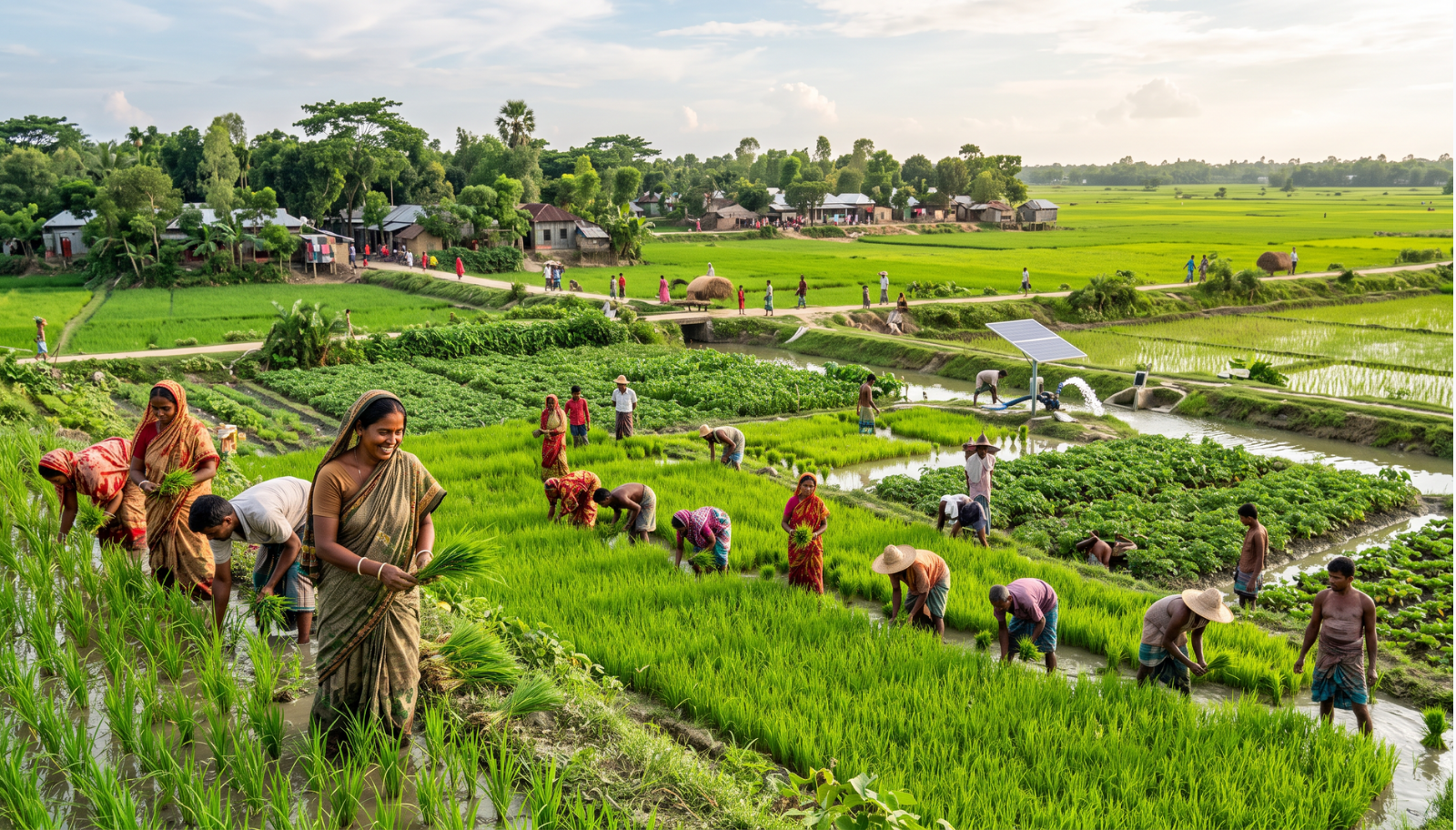
Bangladesh has long been celebrated for pulling itself from the brink of famine to near self-sufficiency in rice, but that achievement is now colliding with a harder question: can the country feed a population that keeps growing on a land base that keeps shrinking?
How this question is resolved will influence Bangladesh’s progress toward its Sustainable Development Goal commitments, especially SDG 2, which targets ending hunger, and while the country is exploring new opportunities in the Bay of Bengal through its blue economy initiatives. This article aims to spark that conversation.
The Arithmetic of Land and People
Bangladesh is currently home to about 170 million people living within an area of just under 148,000 square kilometers, which makes it among the most densely populated large nations in the world. Depending on which fertility assumptions are used, population projections for 2050 range from roughly 202 million to 215 million people, which implies the country will eventually need to feed tens of millions more residents than it does now.
Meanwhile, the amount of arable land available is shrinking rather than holding steady; studies estimate a drop of about 10 percent by 2030 and up to 20 percent by 2050, driven by expanding cities, growing industry, erosion along riverbanks, and increasing soil salinity in coastal areas.
This convergence of population growth and shrinking land underpins Bangladesh’s core food security challenge. Modeling suggests combined demand for rice, wheat, and maize could rise by roughly a quarter between 2010 and 2050, even as land, water, and soil constraints limit domestic production. Rice will likely stay in surplus, but wheat, pulses, edible oil, and other staples will remain import dependent, meaning food import bills will keep rising unless yields improve substantially.
Put differently, true food security will not be achieved by expanding cultivated land, since there is very little additional land available, but by extracting greater nutritional value and caloric output from the land already in use, alongside shifting diets away from their heavy dependence on rice.
Where SDG 2 Meets the Numbers
SDG 2 sets out a mandate to eliminate hunger, secure reliable access to food, enhance nutritional outcomes, and foster sustainable agricultural practices by the year 2030. Bangladesh has incorporated these objectives into its successive Five-Year Plans and its longer-term Vision 2041 framework, and indicators of national undernourishment have declined markedly since the 1990s, reflecting sustained gains in aggregate cereal output.
However, this headline level of rice sufficiency masks considerable disparities in access at the household level: a significant proportion of households continue to experience moderate or severe food insecurity according to standard food security scales, and child stunting, although trending downward, still affects an estimated one in three children under five, a figure that points to chronic nutritional deficits rather than simple caloric shortfalls.
Given these demographic and land trends, the gap between aggregate production and real nutritional adequacy is unlikely to close on its own. Credibly achieving SDG 2 by 2050 requires simultaneous progress on several fronts: higher per hectare yields across staple and non-staple crops, genuine diversification of crops and diets beyond rice, reduced post-harvest losses, and stronger safety nets for food insecure households. Rice self-sufficiency alone is an insufficient proxy and risks overstating actual progress.
The Blue Economy as a Second Frontier
This is where the ocean enters the picture. Bangladesh’s 2012 maritime boundary settlements opened access to a vast Exclusive Economic Zone in the Bay of Bengal, and the government has increasingly framed this space as a second frontier for food and economic security under its blue economy strategy.
Recent budget allocations have created a Blue Economy Research Fund and broader funding for marine sector growth, with fisheries export earnings targeted at about one billion dollars by 2030. Plans include deep sea fishing vessels, a modern port at Matarbari, and new marine protected areas for breeding stocks. Bangladesh already ranks among top global producers of freshwater and inland fish, and experts see billions in potential value from deep sea fishing, marine biotechnology, and seafood processing.
This connects to SDG 14, but matters equally for SDG 2. A well-managed blue economy diversifies protein sources beyond land dependent staples, creates rural livelihoods, and builds climate resilience. Poorly handled, it risks repeating existing overexploitation of marine stocks.
Government Steps That Matter Most
Given this landscape, three government actions stand out as essential. First, redirect agricultural subsidies away from rice monoculture toward yield-boosting inputs, quality seeds, and diversification into pulses, oilseeds, and vegetables, since land expansion is no longer a realistic option. Second, institutionalize science-based, quota-controlled marine fisheries management, including real-time stock assessment, so that blue economy expansion adds food and income sustainably rather than exhausting the Bay of Bengal within a generation.
Third, build the storage, cold-chain, and food safety infrastructure needed to cut post-harvest losses and connect diversified production, both from land and sea, to markets and household plates. Without these three steps, Bangladesh’s impressive production numbers risk becoming a statistic that masks, rather than solves, the food security challenge of a nation approaching a quarter of a billion people.
Reference:

