
Dr. Naima Parvin
Coventry University
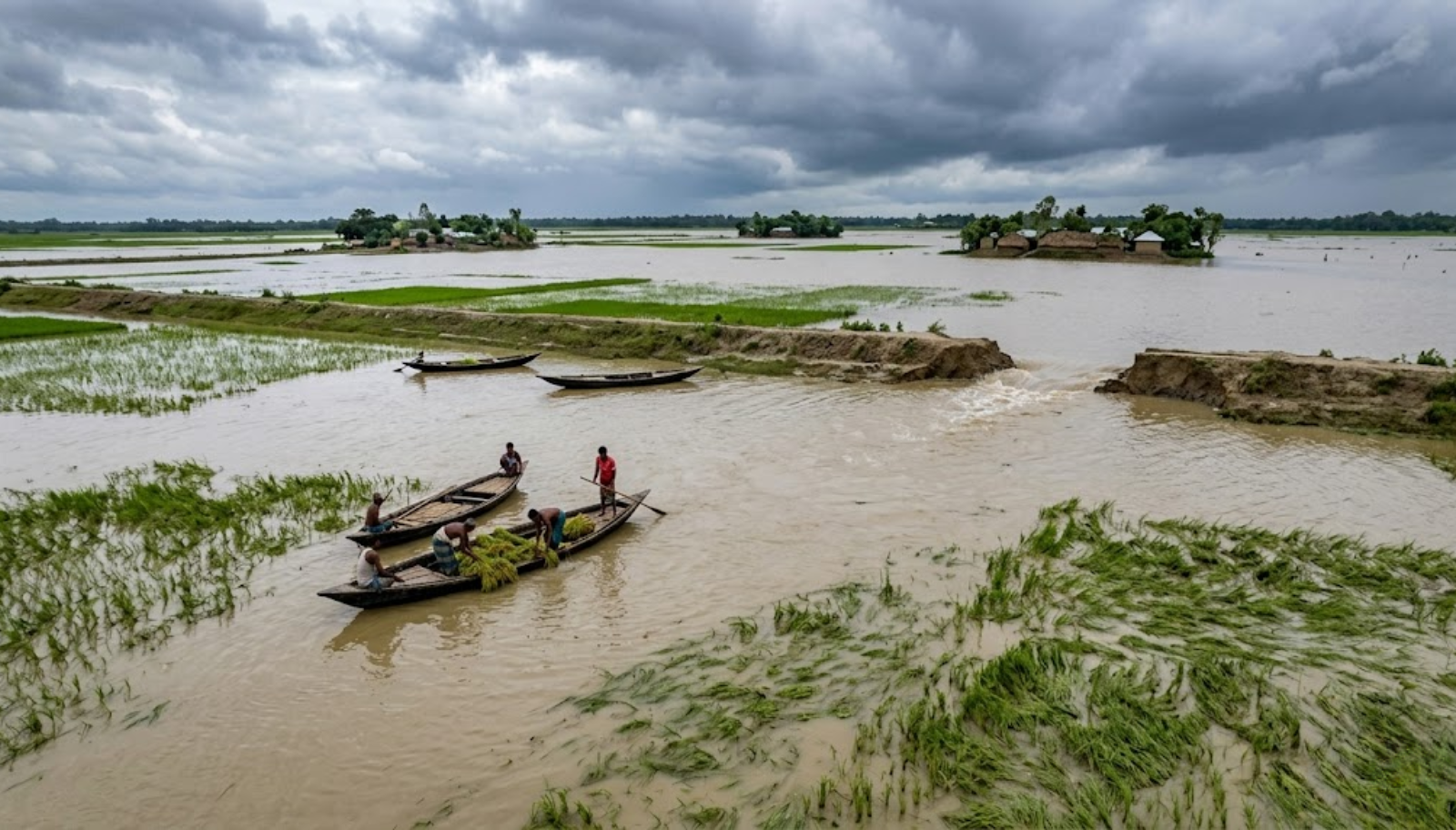
The unfolding crisis in Bangladesh’s haor region is not just another episode in the country’s long history of floods, it is a warning signal of a deeper structural failure in development strategy. What appears as a localised agricultural disaster is a systemic shock to national food security, rural livelihoods, and macroeconomic stability.
The haor basin produces roughly 18-20% of Bangladesh’s rice, making it a cornerstone of national food supply. At the same time, flash floods have destroyed up to 70% of standing crops in some areas, exposing the fragility of an ecosystem that supports nearly 20 million people across 2 million hectares. The implications, therefore, extend far beyond a seasonal agricultural loss, they strike at the heart of Bangladesh’s development model.
A Crisis of ‘Development,’ Not Just Climate
The prevailing narrative frames the haor crisis because of climate change, and rightly so, as early flash floods are becoming more frequent and intense. However, the deeper issue is policy-induced vulnerability. Unplanned embankments, roads, and silted waterways have disrupted the natural hydrology of the basin, amplifying flood risks rather than mitigating them.
This represents a classic case of maladaptation, where infrastructure investments fail to account for ecological dynamics. The haor ecosystem is inherently seasonal and flood-dependent; attempts to “control” water without understanding its flow have instead intensified disaster risks.
Moreover, climate change is compressing the agricultural calendar. The window between crop maturity and flooding is shrinking, making traditional long-duration rice varieties increasingly untenable. This interaction between climate variability and rigid agricultural practices has transformed predictable seasonal floods into systemic production shocks.
The Macro-Economics of a Local Disaster
The haor crisis reverberates through the national economy in several ways:
- Crop losses threaten food security, potentially forcing Bangladesh to increase rice imports by around 15%.
- Flood-induced production shortfalls historically push imports to surge,by over 2,000% in some years, yet fail to stabilise prices effectively.
- Previous flood events destroyed over 1.1 million tonnes of rice, triggering imports and driving food inflation up by nearly 20%.
This pattern reveals a critical insight: Bangladesh’s food system lacks resilience. Even when imports rise, supply chain inefficiencies and market distortions prevent price stabilisation, disproportionately affecting the poor.
Thus, the haor crisis should be understood not as a one-off shock, but as a recurring macroeconomic vulnerability embedded in the agricultural system.
The Political Economy of Rural Vulnerability
At the micro level, the crisis exposes a persistent agrarian trap. Farmers in the haor region operate under high debt burdens, limited access to formal credit, and exploitative market structures. Disaster shocks push them further into indebtedness, undermining future production capacity.
The problem extends beyond agriculture to common resource governance, particularly fisheries. Bangladesh’s water bodies, critical for livelihoods, are largely controlled through a revenue-oriented leasing system that favours wealthy elites and excludes local fishers. This creates perverse incentives for over-exploitation while depriving the poor of a vital safety net.
Empirical studies show that community-based fisheries management (CBFM) can improve both sustainability and equity, yet institutional inertia has slowed its adoption. This highlights a broader failure: policies remain extractive rather than inclusive.
Climate Stress Meets Institutional Rigidity
The haor crisis is best understood as the intersection of three reinforcing failures:
- Ecological mismanagement – ignoring natural water systems
- Technological lag – slow adoption of climate-resilient crop varieties
Institutional inertia – outdated governance structures
Research shows that flash floods can wipe out up to 80% of rice yields in extreme cases, making climate-resilient agriculture essential. Meanwhile, improved short-duration, flood-tolerant rice varieties developed by IRRI and national institutions can significantly reduce risk exposure and even generate hundreds of millions of dollars in annual benefits.
Yet adoption remains uneven, reflecting weak extension systems and limited farmer access to inputs.
Policy Recommendations: From Relief to Transformation
1. Adopt Ecosystem-Based Water Management
Rather than relying solely on embankments, Bangladesh must restore natural hydrology through:
- Large-scale dredging and wetland restoration
- Scientific floodplain zoning
- Independent oversight of infrastructure projects
This aligns development with ecological realities, reducing long-term risk.
2. Accelerate Climate-Smart Agriculture
Policy must prioritise:
- Short-duration, flood-tolerant rice varieties
- Mechanisation and improved planting schedules
- Community seed banks and extension services
Evidence shows such interventions can significantly boost yields and reduce climate risk.
3. Reform Agricultural Finance
Breaking the debt cycle requires:
- Multi-year loan restructuring and moratoriums
- Subsidised credit targeted at smallholders and sharecroppers
- Expanded crop insurance programmes
This would stabilise rural incomes and sustain production capacity.
4. Transition to Community-Based Resource Governance
Replacing the current leasing system with community-led fisheries management would:
- Improve equity and access
- Enhance sustainability of fish stocks
- Strengthen rural livelihoods
Global and local evidence demonstrates the effectiveness of such models.
5. Build Integrated Social Protection Systems
Seasonal vulnerability demands:
- Year-round food security programmes
- Public works schemes tied to ecosystem restoration
- Investments in health, education, and gender equity
These measures prevent long-term human capital erosion.
6. Strengthen Market and Supply Chain Efficiency
To mitigate inflationary shocks:
- Improve public grain procurement systems
- Enhance storage and distribution efficiency
- Regulate market intermediaries
Without such reforms, even high imports will fail to stabilise prices.
Conclusion: A Test of Development Strategy
The haor crisis is not an isolated tragedy, it is a test of Bangladesh’s development paradigm in the age of climate change. A system built on short-term fixes, infrastructure-heavy adaptation, and weak institutions cannot withstand the increasing volatility of climate shocks.
Yet, the crisis also presents an opportunity. By integrating ecological intelligence, technological innovation, and inclusive governance, Bangladesh can transform the haor region into a model of climate resilience.
The choice is stark: continue managing disasters or redesign the system that produces them.
Sources
- Khan, H. D. (2026). Haor crisis turning into a national crisis. The Daily Star. [thedailystar.net]
- Noor, R. & Bhandari, H. (2026). Can Bangladesh save its haor food bowl? The Daily Star. [thedailystar.net]
- Financial Express (2025). Rice prices high despite imports. [thefinanci…ess.com.bd]
- The Straits Times (2024). Floods destroy 1.1 million tonnes of rice. [straitstimes.com]
- Firstpost (2024). Flood damage and rising food prices. [firstpost.com]
- MDPI Sustainability (2023). Short-duration rice for haor food security. [mdpi.com]
- IDEAS/RePEc (2023). Economic benefits of climate-resilient rice. [ideas.repec.org]
- MDPI Ecologies (2024). Agricultural development in haor ecosystems. [mdpi.com]
- IOSR Journal of Economics (2021). Importance of haor region. [iosrjournals.org]
- WorldFish (CBFM). Community-based fisheries management in Bangladesh. [digitalarc…center.org]
DU Economics Research (2026). Fisheries leasing policy and inequality