
Abul Fazal
University of Michigan
For most of the twentieth century, jute was Bangladesh’s identity crop. The golden fibre built the foreign exchange reserves of undivided Bengal, financed the Pakistani state’s infrastructure ambitions, and gave the new nation of Bangladesh whatever economic foundation it inherited in 1971.
That era of dominance is long past. Synthetic substitutes, changing global packaging markets, and decades of underinvestment in both cultivation technology and industrial processing have eroded jute’s economic centrality. And yet the crop refuses to become irrelevant. A global reckoning with plastic waste, combined with scientific breakthroughs in jute genetics and a widening range of industrial applications, has created conditions in which jute could experience not a nostalgic revival but a genuinely transformed second chapter, only if Bangladesh’s policy environment can support it.
The Present Condition
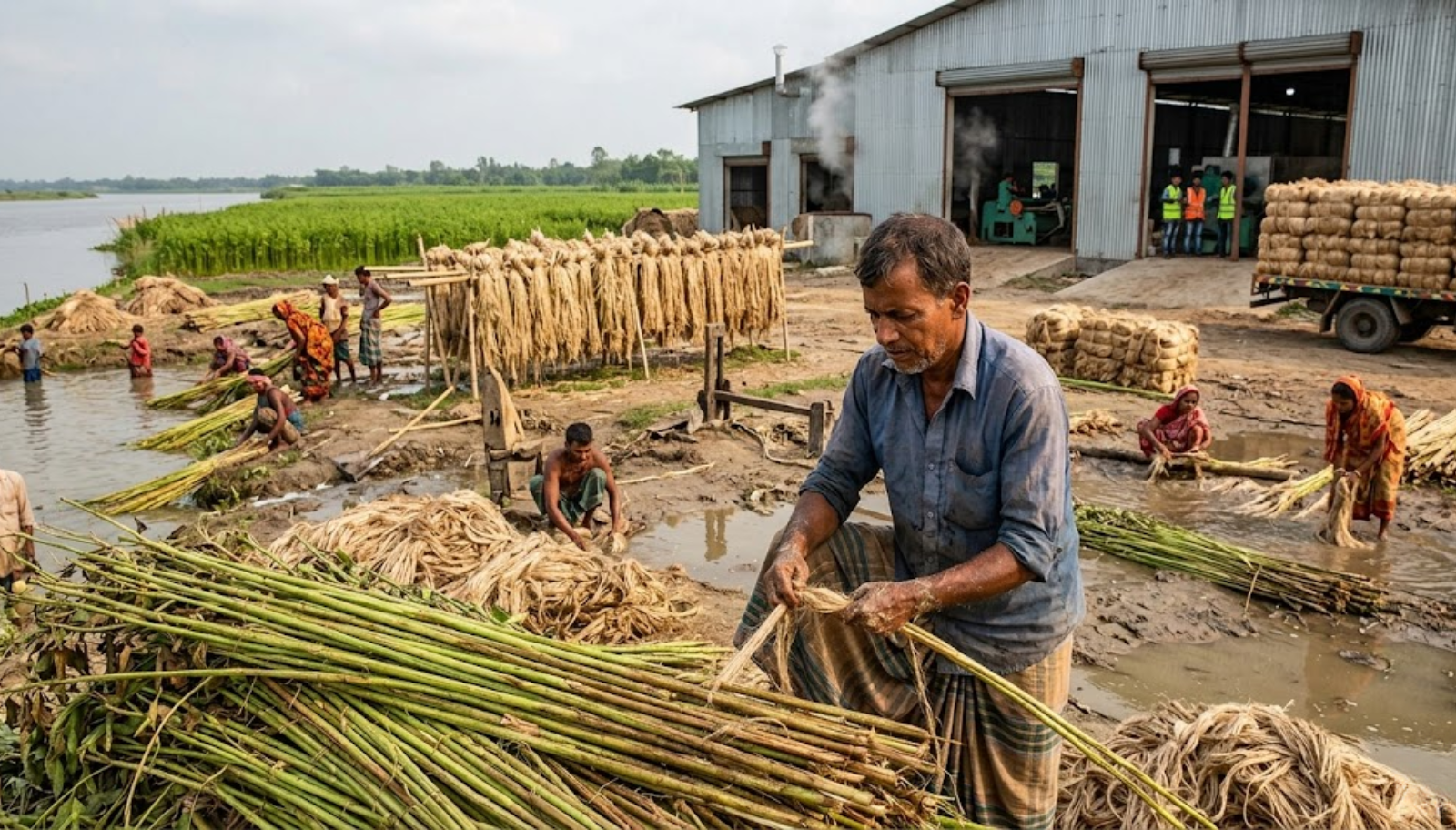
Bangladesh remains the world’s largest exporter of raw jute and jute goods, with the sector generating between eight hundred million and one billion dollars in annual export earnings. Jute cultivation is concentrated in the river-fed districts of northern and central Bangladesh, including Faridpur, Tangail, Sirajganj, Rangpur, and their neighbours where the alluvial soil and seasonal flooding create near-ideal growing conditions. Approximately four million farm families depend on jute cultivation for a significant share of their income, making it a crop of profound rural economic importance even in a period of relative decline.
The structural problems are serious and well-documented. Cultivation area has fluctuated rather than grown, constrained by competition from more immediately remunerative crops including vegetables and rice. Retting (the water-based process by which jute stalks are separated into usable fibre) remains largely manual and environmentally problematic, consuming large quantities of clean water and generating organic waste that damages local water bodies. Farm-gate prices are volatile and frequently inadequate, leaving cultivators exposed to market swings that their thin financial margins cannot absorb.
The industrial side presents an equally mixed picture. The Bangladesh Jute Mills Corporation, which operates state-owned jute mills as a legacy of nationalisation decisions made in the 1970s, has accumulated losses of thousands of crores of taka over decades of operational inefficiency, overstaffing, and inability to compete with private sector mills on quality, speed, or cost. The repeated political difficulty of reforming or rationalising BJMC has made it a persistent drain on public finances while simultaneously distorting the market environment for private sector jute processors who operate more competitively.
The Emerging Potentials
Against this difficult present, the future of jute carries genuine and growing promises across several dimensions. The global movement against single-use plastics, driven by legislative bans in the European Union, the United Kingdom, and an expanding list of developing economies, is creating structural demand for biodegradable packaging materials at scale. Jute is uniquely positioned to serve this demand. It is biodegradable, compostable, carbon-sequestering during its growing cycle, and capable of being processed into bags, wrapping, and packaging materials that directly substitute for plastic in a widening range of applications. Bangladesh, as the world’s leading jute producer, sits at the centre of this opportunity.
Geotextiles represent a second high-value application with relevance to Bangladesh’s own infrastructure needs. Jute geotextile fabric is used in road construction to stabilise embankments, prevent erosion, and extend road life in soft soil conditions … precisely the conditions that characterise most of Bangladesh’s road network outside major urban centres. India has mandated jute geotextile use in a proportion of its road construction projects. A similar policy in Bangladesh would simultaneously develop a high-value industrial application, reduce import dependence for road construction materials, and create a sustainable domestic market for higher-grade jute processing.
Jute fibre composites for the automotive and furniture industries, jute-based activated carbon for water filtration, and jute pulp as a substitute for wood pulp in paper production are additional application areas in which research and commercial development is advancing globally. The 2010 decoding of the jute genome by a team led by Maqsudul Alam created a scientific foundation for developing higher-yield, disease-resistant, and fibre-quality-optimised cultivars that could meaningfully improve both farm productivity and industrial processing efficiency- if the research investment to translate that genomic knowledge into commercially deployable seed varieties is sustained.
Essential Policy Reforms
First, BJMC must be decisively restructured. The state-owned mills model has failed by every measurable criterion over multiple decade. The politically difficult but economically necessary step is a transparent privatisation or public-private partnership process that transfers operational control to entities capable of running the mills competitively, while establishing credible labour transition and retraining programmes for displaced workers. Continuing to subsidise institutional failure at BJMC diverts resources from every more productive intervention available to the sector.
Second, a minimum support price mechanism for raw jute must be established and consistently maintained. Cultivators cannot be expected to maintain or expand jute acreage against competing crops unless the price risk of doing so is managed. A transparent, annually reviewed minimum support price, backed by government procurement capacity as a market-of-last-resort, would stabilise cultivation incentives and provide the production volume predictability that industrial processors and export traders require for long-term investment planning.
Third, investment in value-added jute product development and export market promotion must be treated as a strategic trade priority. Bangladesh currently exports predominantly raw jute and lower-grade jute goods. The value-added premium in geotextiles, composites, biodegradable packaging, and technical textiles is substantially higher. A dedicated export development programme combining R&D support, certification assistance for international markets, and coordinated trade promotion would begin shifting Bangladesh’s jute export profile toward the higher-margin products that the global market’s plastic substitution imperative is actively seeking. The golden fibre’s second chapter is available. Claiming it requires the institutional will to invest in it seriously.