
Farzana Nupur
Stamford University
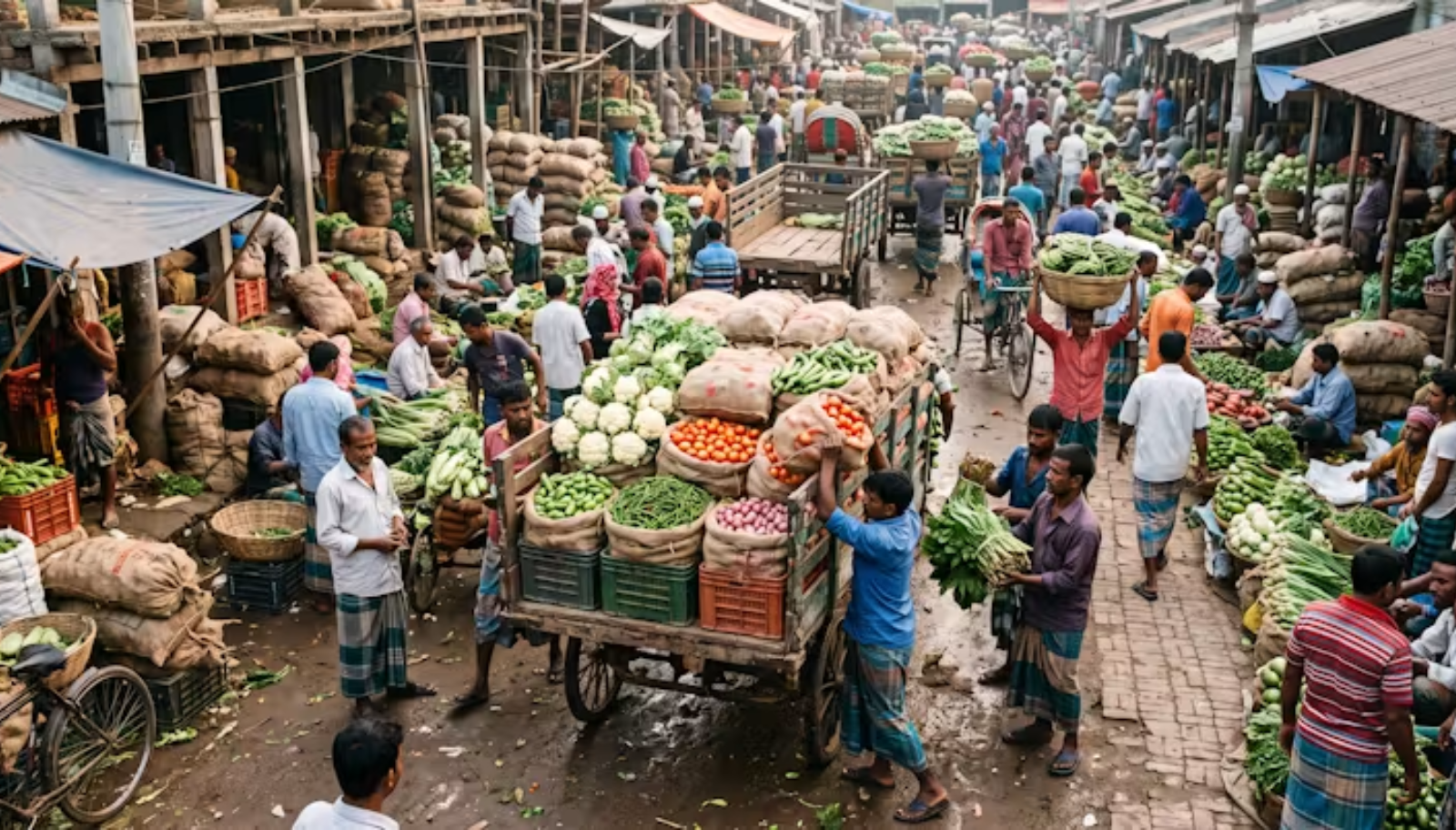
The regional vegetable supply chain in Bangladesh is broken in ways that punish both the farmer who grows the crop and the consumer who buys it. Between the field and the kitchen table, vegetables pass through layers of intermediaries, endure days of unrefrigerated transport, and fall prey to cartels that manipulate prices with impunity. The result is a system where farmers receive a fraction of what consumers pay, vast quantities of produce rot before reaching market, and syndicates extract profits from both ends of the chain.
Understanding and resolving this crisis demands attention to three interlocking failures: shelf-life deterioration, brokerage exploitation, and syndicate corruption. This article revisits these three.
The Shelf-Life Crisis
Bangladesh loses an estimated 25 to 40 percent of its fruits and vegetables to post harvest spoilage, a figure equivalent to approximately 2.4 billion dollars annually. Tomatoes alone suffer post-harvest losses of around 30 percent. Brinjal losses across the supply chain reach 23.38 percent, with 12.51 percent destroyed by the grower level alone.
The causes are rooted in the absence of cold chain infrastructure. Over 41 percent of farmers aggregate their harvested crops on bare soil under direct sunlight immediately after cutting. Only 20 percent of farmers and 24 percent of traders use plastic crates for packaging, while the majority rely on jute or nylon sacks that offer no protection against bruising or compression. Only 27 percent of farmers and traders wash produce before marketing, and of those, 32 percent use unsafe canal or ditch water that introduces microbial contamination rather than removing it.
Transportation relies overwhelmingly on open vehicles, three-wheeler vans, rickshaws, and tempo trucks with no temperature regulation. Cold storage facilities exist primarily for potatoes and are virtually absent from perishable vegetables. The Food and Agriculture Organization has noted that investments in cold storage and agro processing could reduce post-harvest losses by 45 to 55 percent, yet such facilities remain concentrated near Dhaka and a handful of divisional cities, leaving the rural producing regions entirely unserved. The consequence is predictable: vegetables that could survive five to seven days under proper refrigeration lose marketable quality within 24 to 48 hours, forcing distress sales and compounding the power of middlemen.
The Brokerage Burden
The vegetable supply chain in Bangladesh is defined by three tiers of intermediaries: the Faria, who operates as a petty trader across a few local markets; the Bepari, a professional buyer who purchases directly from farmers or Farias at the village level; and the Aratdar, a commission agent who provides warehouse space and sits between the Bepari and the urban retailer.
Research consistently shows that consumers pay two to three times the price that farmers receive. The dominant marketing chain runs from farmer to Faria to Bepari to Aratdar to retailer to consumer, with roughly 40 percent of produce flowing through this single channel. Each intermediary Adds a margin, a transportation charge, and often a commission fee that compounds through every stage. For cauliflower, the Bepari alone incurs a marketing cost of roughly 248 taka per quintal, while the urban retailer adds a margin of 130 taka per quintal. The farmer, who bears the entire risk of production, captures the smallest share of the consumer price.
Farmers lack market information, capital to store produce, and transportation to reach terminal markets directly. This structural dependency forces them to accept whatever price the visiting Bepari or Faria offers, often at harvest time when supply peaks and prices collapse. The brokerage system is not merely inefficient. It is structurally designed to extract value from the weakest participants.
Syndicate Corruption
Separate from the legitimate intermediary function is the problem of organized syndicates that manipulate vegetable markets through collusion, stockpiling, and political protection. Syndicates cartelize regional wholesale markets, agreeing among themselves to set floor prices, restrict market access for outsiders, and control the timing and volume of produce releases.
Reports confirm that certain syndicates stockpile vegetables during peak harvest seasons, buying cheaply from desperate farmers and releasing inventory gradually to maintain artificially inflated retail prices. These groups often hold political affiliations that shield them from regulatory enforcement.
Agricultural researchers have directly blamed government failure to control syndicates for recurring price spikes, noting that a lack of market oversight and the inability to obtain accurate real time market data allow these groups to operate without accountability. When a farmer attempts to bypass the syndicate and sells directly to urban buyers, they face barrier to entry in terminal markets, including informal fees, denied access to wholesale platforms, and even physical intimidation.
The syndicate system is reinforced by the patronage politics that characterize rural governance in Bangladesh. Politically connected traders use their affiliation to secure dominance over local market committees, which in turn control licensing, stall allocation, and grievance resolution. The result is a market that functions not on competition but on connections, and in which the consumer pays premium prices for vegetables while the farmer remains trapped in poverty.
The Way Forward
Reforming this system requires simultaneous action across all three failure points. Cold chain infrastructure must be expanded beyond Dhaka to every major vegetable producing district, with cold storage, refrigerated transport, and crate standardization mandated through public private investment.
The brokerage system can be made transparent through digital market platforms that provide farmers with real time price information, connect them directly to wholesale and retail buyers, and eliminate unnecessary intermediary layers. Syndicate corruption demands regulatory enforcement: market monitoring bodies with real authority, strict penalties for price manipulation and market restriction, and the political will to dismantle patronage networks that protect cartel operators.
Digital supply chain twins and internet of things monitoring systems have been proposed as frameworks to track freshness, optimize routing, and reduce waste in real time. Contract farming models, where farmers deal directly with exporters and retailers under enforceable agreements, have demonstrated viability and must be scaled nationally. The technology exists. The market demand is constant. What remains absent is the institutional commitment to build a supply chain that serves producers and consumers rather than the intermediaries and cartels that currently control it.

