
Ameera Haidar
Freelance architect
Bangladesh stands at a critical juncture in its urban governance. With over 23,688 tons of municipal solid waste generated daily across urban centers and waste volumes doubling every fifteen years over the past three decades, the country can no longer afford to treat waste management as an afterthought.
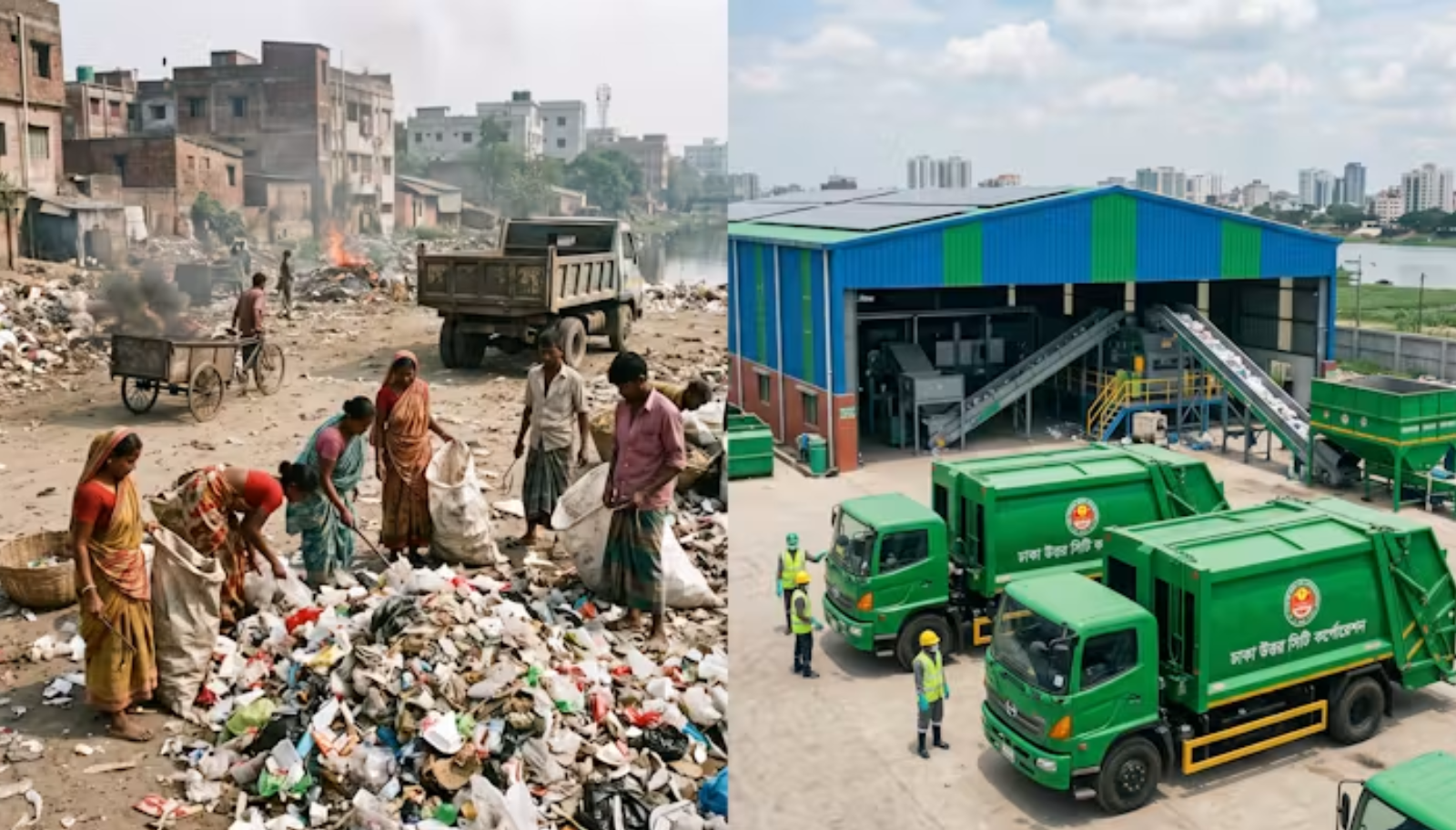
The evolution of waste management technology in Bangladesh tells a story of slow, uneven progress from crude open dumping toward nascent systems of recycling, composting, and waste to energy conversion. But the journey remains far from complete, and the urgency for reform has never been sharper. This article is intended to motivate the government and policy stakeholders to re-engage in the discussion.
From Open Dumping to Policy Ambition
Following independence in 1971, Bangladesh had virtually no structured waste management framework. Waste was collected manually and deposited in open dumps with no environmental safeguards. The Dhaka City Corporation Ordinance of 1983 marked the first legislative attempt to impose order on urban waste handling, though it functioned largely on paper. By the early 2000s, the government began developing strategies for municipal solid waste planning in Dhaka. The transformation from crude dumping to sanitary landfills was initiated in 2008, a modest but meaningful shift.
The National 3R Strategy of 2010, built around the principles of reduce, reuse, and recycle, represented the most coherent policy vision to date. More recently, the Asian Infrastructure Investment Bank approved the Bangladesh Integrated Solid Waste Management Improvement Project in 2024, which aims to construct infrastructure covering waste collection, transportation, processing, disposal facilities, and dumpsite remediation.
Digital innovation also entered the landscape in 2018, when a local startup began working to digitalize and organize solid waste management operations. Despite these milestones, the operational reality on the ground remains deeply troubled.
Why This Matters
The importance of effective waste management extends far beyond urban aesthetics. In Bangladesh, approximately 70 percent of municipal solid waste is organic, and open dumping of this material generates methane, contaminates groundwater, and degrades air quality. Over 82 percent of households dispose of mixed waste without segregation, meaning recyclable and hazardous materials are buried together in landfills or scattered across streets and drains.
The public health consequences are severe: communities near dumpsites report elevated rates of diarrhea, asthma, bronchitis, and pneumonia. The economic costs are equally striking. Informal waste pickers, working under hazardous conditions, recover only 15 to 20 percent of recyclables. Roughly half a million people depend on the recycling business for their livelihoods, yet the system operates without safety standards, formal contracts, or institutional support.
Financial allocation for waste management remains below 1 percent of municipal budgets, and over 70 percent of collection vehicles are outdated. Collection efficiency averages just 56 percent nationally, meaning nearly half of all urban waste never reaches any formal disposal point. The projected daily waste generation for Dhaka alone by 2025 is 47,665 tons, a figure that dwarfs current capacity.
Essential Reforms
The first and most fundamental reform is mandatory source segregation. Without separating organic, recyclable, and hazardous waste at the household level, every downstream process, from collection to treatment to disposal, is compromised. City corporations must enforce segregation through ordinance, backed by sustained awareness campaigns and household incentive programs. Second, financial allocation must rise dramatically from the current sub 1 percent threshold to at least 3 to 5 percent of municipal budgets. Modern collection fleets, transfer stations, and treatment plants require capital that current budgets cannot support.
Third, waste to energy technology must move from pilot stage to national scale. Studies indicate that by 2050, waste to energy projects in Dhaka and Chittagong alone could generate 751 million dollars per year in electricity sales and carbon credit revenue. Incineration, pyrolysis, and gasification technologies have demonstrated feasibility, and the high organic content of Bangladeshi waste makes it suitable for anaerobic digestion and biogas production, as proven by the successful Gaibandha pilot project in 2011.
Fourth, the informal waste sector must be formally integrated into the management chain. Waste pickers should receive protective equipment, legal recognition, fair wages, and access to healthcare, transforming a precarious occupation into a professionalized workforce. Fifth, governance reform is essential. Chronic lack of coordination among ministries, municipal bodies, and implementing agencies has fragmented accountability. A single national authority with clear jurisdiction over waste management policy, enforcement, and monitoring must be established.
Sixth, smart technologies including Internet of Things sensors for route optimization and artificial intelligence for waste sorting must be adopted to increase efficiency and reduce operational costs. Finally, public private partnerships must be structured to bring investment, innovation, and management expertise into a sector that the government alone cannot sustain at the required scale.
Bangladesh has the demographic energy and economic momentum to transform its waste crisis into a waste economy. Technology exists, the policy frameworks have been drafted, and the financial models have been projected. What remains is the political will to enforce existing laws, fund adequate infrastructure, and coordinate the institutions whose fragmented efforts have kept the country locked in a cycle of open dumping and missed opportunity.
The cost of inaction is measured in disease, pollution, and wasted economic potential. The cost of reform is measured in investment, coordination, and sustained commitment. The choice is clear, and the time for half measures has passed.