
Dr. A. Khan
Dhaka University
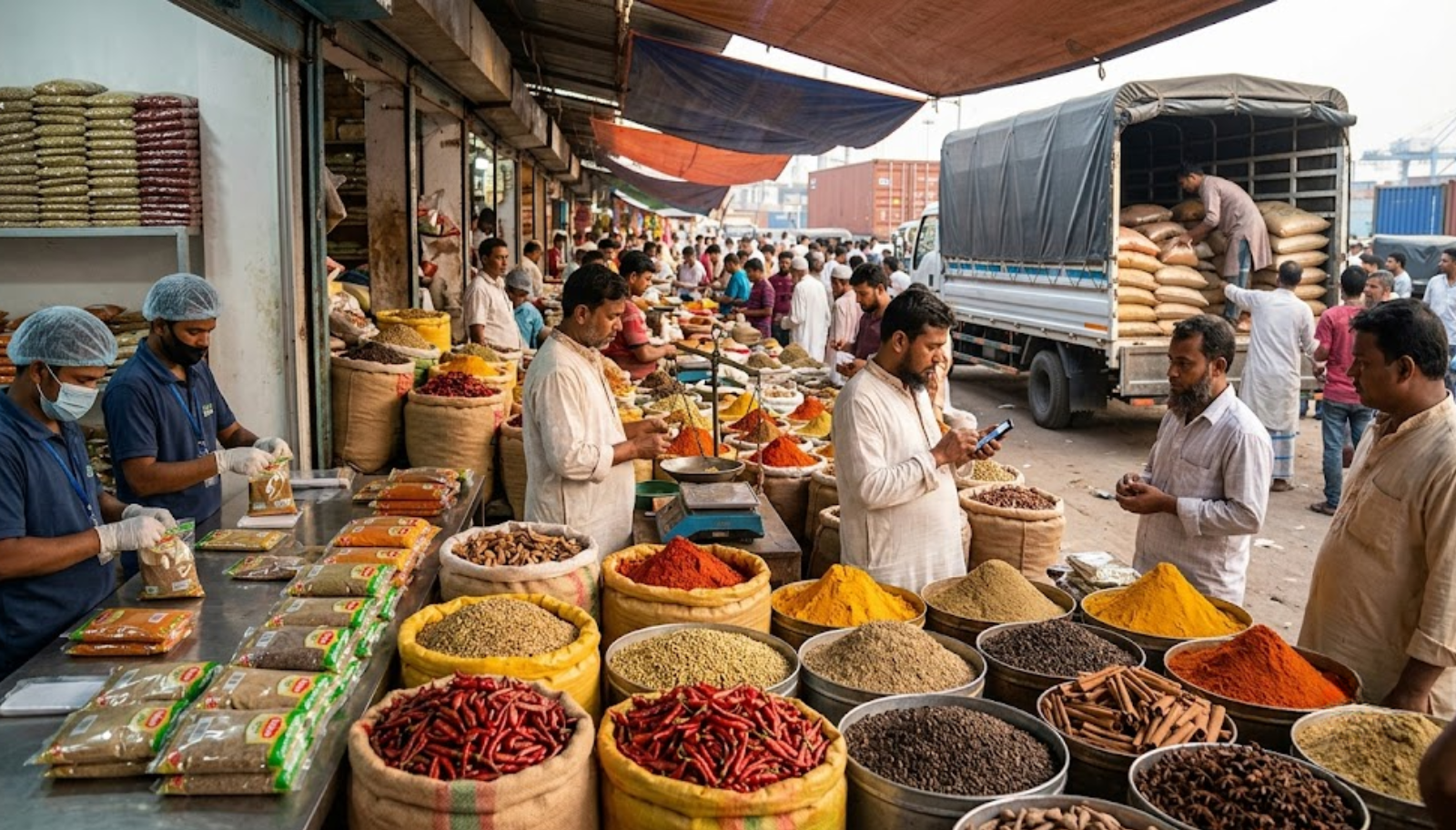
Spices- integral to the national cuisine, have evolved to become part of a dynamic and versatile market of immense scale and strategic importance in Bangladesh. Growing population, rapid urbanization, changing income margins, evolving consumer preferences, and a considerable surge in food processing industries have redefined the country’s spice demand. Hence, the spice market in Bangladesh is simultaneously shaped by multiple factors including domestic consumption, agricultural production, and global trade.
Bangladesh is the world’s second-largest consumer of spices, with an annual intake of 1.3 million tons, and its fourth-largest producer, with an output of 600,000 tons. The gap in domestic demand and production highlights the critical role of imports in ensuring year-round availability, consistent quality, and price stability. Among the multitude of spices consumed, a few clearly dominate Bangladesh’s import landscape which include chili, onion, garlic, ginger, turmeric, cumin, coriander, cinnamon, cloves, and cardamom. Some of these spices, despite being produced locally, must be imported due to inconsistent domestic production influenced by climate change and fragmented farming. Currency driven cost increases and supply chain disruptions also influence the import of these spices.
Driven by an *annual spice market deficit of 13.54 lakh tonnes* and an *import drain of BDT 8,000 to BDT 9,000 Crores*, the government and private investors are aggressively scaling local ecosystems for domestic spice cultivation. To reduce reliance on imported spices, the government has launched a multi-faceted approach. The necessary structural and fiscal reforms to curtail spice imports target three main areas: i) Agricultural Reforms, ii) Fiscal & Trade Policy, and iii) Market Monitoring and Compliance.
Agricultural Reforms
High-yield, high quality seed distribution: The state is focusing on research and development to introduce high-yield, disease-resistant seeds for vital crops like ginger, turmeric, garlic, and chilies. The Bogura Spice Research Centre (SRC) has engineered 58 specialized spice varieties to thrive in local agro-climatic zones. Onions (BARI Piaz-4 & 6) were developed as climate-adaptive winter and summer varieties to counteract extreme off-season supply crunches. Chilies (Binamorich-2 / IndoCF-25) are highly pungent, disease-resistant hybrid strains maximizing commercial output. Once considered impossible to cultivate locally, cumin is now commercially scaled across 17 districts, delivering up to 4x the profit margin of traditional rice.
Structured, non-traditional farming frameworks: Rapidly scaling in places like Kushtia’s “Village of Spices” (Baria), where ginger and turmeric are grown intensively in geo-bags to achieve zero-fallow land waste. Chittagong Hill Tracts (specifically Bandarban and Ruma) are actively transitioning from low-yield Jhum farming into lucrative, high-margin black pepper and ginger corridors. Agro-stimulus packages: Bangladesh Bank has rolled out massive agricultural stimulus packages (exceeding BDT 100 billion), providing genuine farmers and new agricultural entrepreneurs with easier access to financing, subsidies, and credit.
Commercial cultivation initiatives: Broadening commercial cultivation beyond localized farms into high-potential zones to meet the BDT 30,000 Crore annual domestic spice demand. Contract farming frameworks: Private corporations lease land or directly finance smallholders with high-quality seeds, guaranteeing a buy-back market to secure raw inputs for processing plants. The government can also take such initiatives to build a system of community level farming for small scale farmers.
Fiscal and Trade Policies
Tariff rationalization: Following the FY26-27 budget, the government has fully withdrawn the 5% regulatory duty on all types of spices, making raw materials slightly more accessible while still aiming to protect domestic growers from unfair import surges. Source tax relief: The source tax for the supply of key daily essentials, including spices, has been reduced from varying rates of 1% to 5% down to a flat 0.5% to ease supply-chain friction and reduce inflationary pressures.
Easing import: To stabilize the market during seasonal demand shocks, the central bank has instructed commercial banks to ease LC (Letters of Credit) opening restrictions for essential commodities.
Market Monitoring and Compliance
Anti-Hoarding Measures: State intelligence and consumer protection agencies (like the DNCRP) actively monitor wholesale hubs like Chattogram’s Khatunganj to combat artificial scarcity, syndicate markups, and hoarding. Curbing Illegal Trade: The Bangladesh Trade and Tariff Commission (BTTC) has previously flagged how excessively high tariffs inadvertently encourage the illegal smuggling of spices (which deprives the state of revenue). Rationalized tariffs combined with border control measures aim to bring all spice trade into legal, taxable channels.
Reforms and policy changes at both public and private levels will ensure a boost in local spice production and ultimately reduce import reliance. However, initiatives to minimize post-harvest loss through updated supply chain management and storage infrastructure is also crucial to reap the benefits of domestic spice production. A holistic framework will involve high yielding local seed production and targeted distribution, support for farmers before, during and after cultivation, post-harvest storage and processing, and final product delivery to consumer level through data driven supply chain logistics.