
Naima Onamika
Commissioning Editor, The Oniket Bulletin
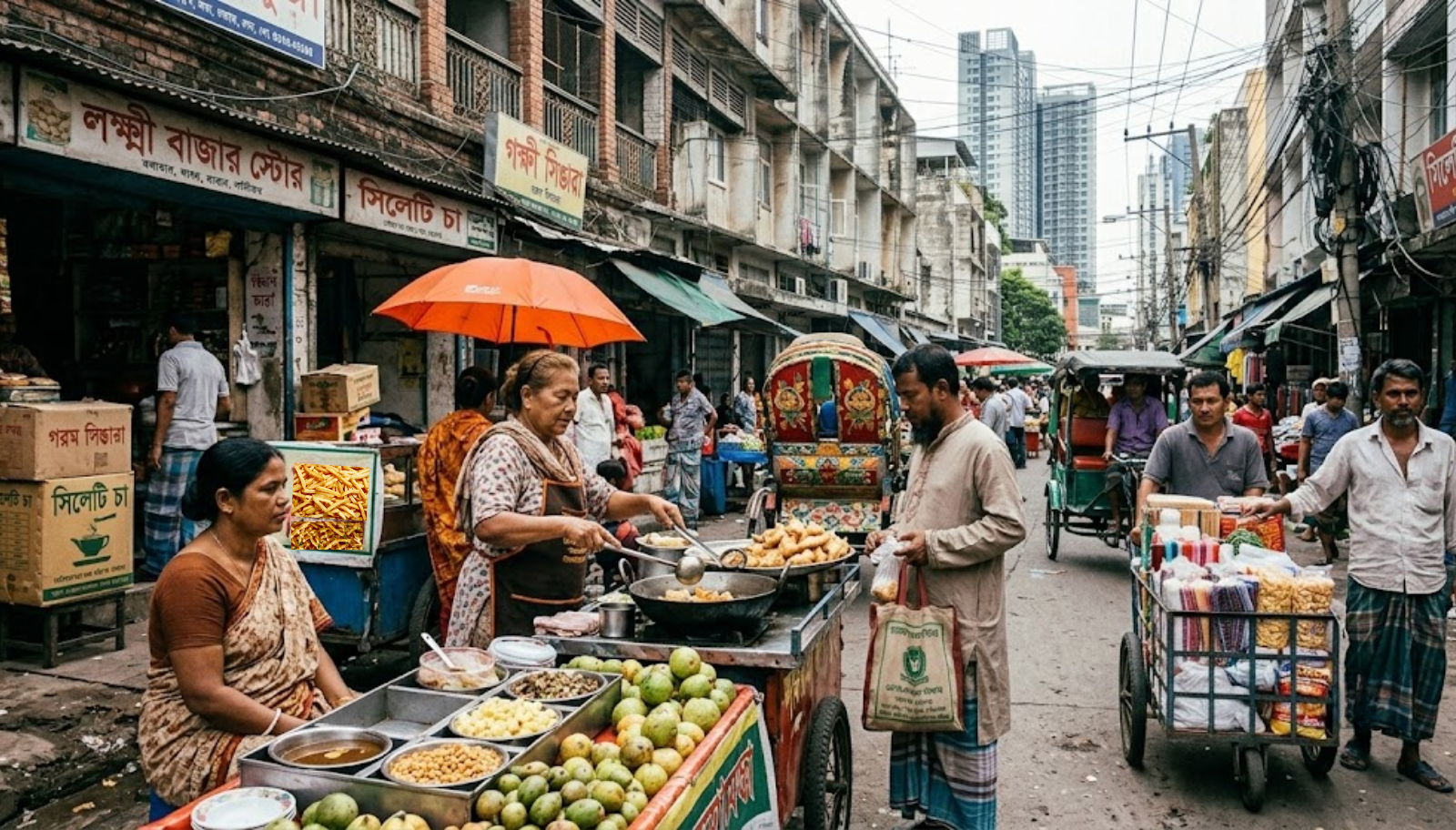
Street vendors are an unavoidable reality in the economic and social life of Bangladesh’s major cities. From Dhaka to Chattogram, Khulna, Rajshahi, and Sylhet, vendors are deeply integrated into the daily lives of urban residents. By providing affordable food, clothing, household goods, and other essential products, they have become an important part of the urban economy.
Despite their contribution, this community has long existed in an illegal, insecure, and uncertain position in the eyes of public policy and urban management. This raises an important question: Are street vendors truly a problem for city management, or does the crisis surrounding them reflect broader policy failures? A closer examination of the issue helps clarify its realities within the context of contemporary urban Bangladesh.
A Strong Pillar of the Informal Economy
The importance of the informal sector in Bangladesh’s economy has long been recognised. A significant portion of the country’s workforce depends on this sector of employment and income. Street vendors are among the key drivers of this vast informal economy. In Dhaka alone, hundreds of thousands of vendors provide affordable goods and services to millions of people every day. Many lower- and middle-income households rely on footpath markets to meet their daily needs. At the same time, street vending offers newly arrived urban migrants an opportunity to earn an income with minimal capital investment.
According to experts, climate change, uncertainty in the agricultural sector, and limited employment opportunities in rural areas have increased migration to cities. A large proportion of these migrants eventually become involved in street vending or other informal occupations. As a result, street vending is not merely a business activity; it also serves as an informal social safety net for many urban poor.
Conflict with Urban Management
Despite their economic significance, the relationship between street vendors and urban authorities has historically been marked by tension. There is no denying the importance of keeping footpaths and public spaces accessible to pedestrians. However, limitations in urban planning and growing population pressures often leave vendors with little choice but to conduct business in these spaces. Authorities frequently carry out eviction drives to clear sidewalks and public areas. In most cases, however, these operations fail to produce lasting results. After eviction, vendors are rarely provided with alternative employment opportunities or designated trading spaces. Consequently, they return to the same locations out of necessity.
This situation clearly demonstrates that eviction-based policies do not address the root causes of the problem. Instead, they often deepen the long-standing conflict between authorities and street vendors.
Political Economy and Power Structures
Another important dimension of the street vending issue lies in its political economy. Various studies and observations indicate that local political groups, influential individuals, and corrupt administrative networks often collect regular payments or unofficial fees from vendors. In exchange for these payments, vendors are allowed to continue operating their businesses. As a result, the legal uncertainty surrounding street vending creates economic benefits for certain interest groups. This is one reason why efforts to formally register or legalise street vendors often fail to progress as expected. The challenges surrounding street vending therefore extend beyond urban management. They are also part of a complex equation involving power, politics, and economic interests.
The Unique Challenges Faced by Women Vendors
Although the number of women street vendors has increased in recent years, their experiences are often more difficult than those of their male counterparts. Social attitudes, security concerns, harassment, and financial limitations create additional barriers for women working in this sector. Nevertheless, many women continue to enter the profession to support their families financially. As a result, street vending is no longer exclusively a male dominated occupation. It has become an important avenue for women’s participation in the urban economy.
Prospects for Policy Reform
In recent years, some positive initiatives have emerged in the management of street vending. Measures such as digital registration systems, vendor identification cards, and the creation of designated vending zones have the potential to make urban management more effective. International experience suggests that organised management, rather than eviction, is the most sustainable approach. Successful examples can be found in India’s Street Vendors Act and Singapore’s carefully planned hawker centres.
If Bangladesh adopts a registration-based management system, establishes designated vending zones, ensures hygienic conditions, provides social protection, and introduces transparent oversight mechanisms, it will be possible to safeguard the interests of both vendors and pedestrians.
Conclusion
Street vendors are an integral part of Bangladesh’s urban economy. Their activities provide employment for hundreds of thousands of people while ensuring that millions of consumers have access to affordable goods and services. For decades, however, the sector has remained trapped in uncertainty due to the absence of legal recognition, recurring eviction drives, political interference, and inadequate planning.
The reality is that a sustainable solution cannot be achieved through eviction. Instead, street vendors must be recognised as a legitimate and planned component of the urban economy. The need of the hour is to establish a practical, participatory, and humane policy framework that balances the rights of street vendors with the requirements of urban order. Only then can the street economy become not an obstacle to urban development, but a valuable partner in its progress.

