Farah Zahir
Editor, Oniket Research Group
A Fading Cultural Heartbeat
There was a time when the theatre hall functioned as the definitive heartbeat of Bangladeshi cultural life. From the intimate, experimental stages of Dhaka’s Nilkhet to the historic, storied boards of the Shilpakala Academy, live performance was the crucible where society examined its conscience, debated its fractures, and ultimately understood its identity.
While that defining era has not entirely vanished, its pulse is noticeably faint. Bangladesh’s theatre tradition, recognized as one of the most socially engaged and artistically ambitious movements in South Asia, currently fights for structural survival. It faces an existential convergence of algorithmic entertainment, shrinking institutional patronage, and systemic neglect.
Post-Independence Roots and Political Consciousness
Historically, the modern Bangladeshi theatre movement emerged less as a commercial enterprise and more as a sophisticated form of political consciousness. In the critical decades following independence, pioneering collectives such as Nagorik Natya Sampraday, Dhaka Theatre, and Aranyak Natyadal utilized the stage to challenge authoritarian governance, interrogate deep-seated social inequalities, and celebrate the secular Bangla identity that the Liberation War had consecrated. Playwrights of the stature of Syed Shamsul Haq and visionary directors like Ataur Rahman introduced a rigorous intellectual ambition to the stage, firmly distinguishing Bangladeshi theatre from mere popular spectacle.
The group theatre movement of the 1970s and 1980s established a robust network of dedicated practitioners across Dhaka and various divisional cities, operating on the belief that theatrical performance was a vital civic duty as much as an artistic pursuit.
The Organic Currents of Indigenous Folk Tradition
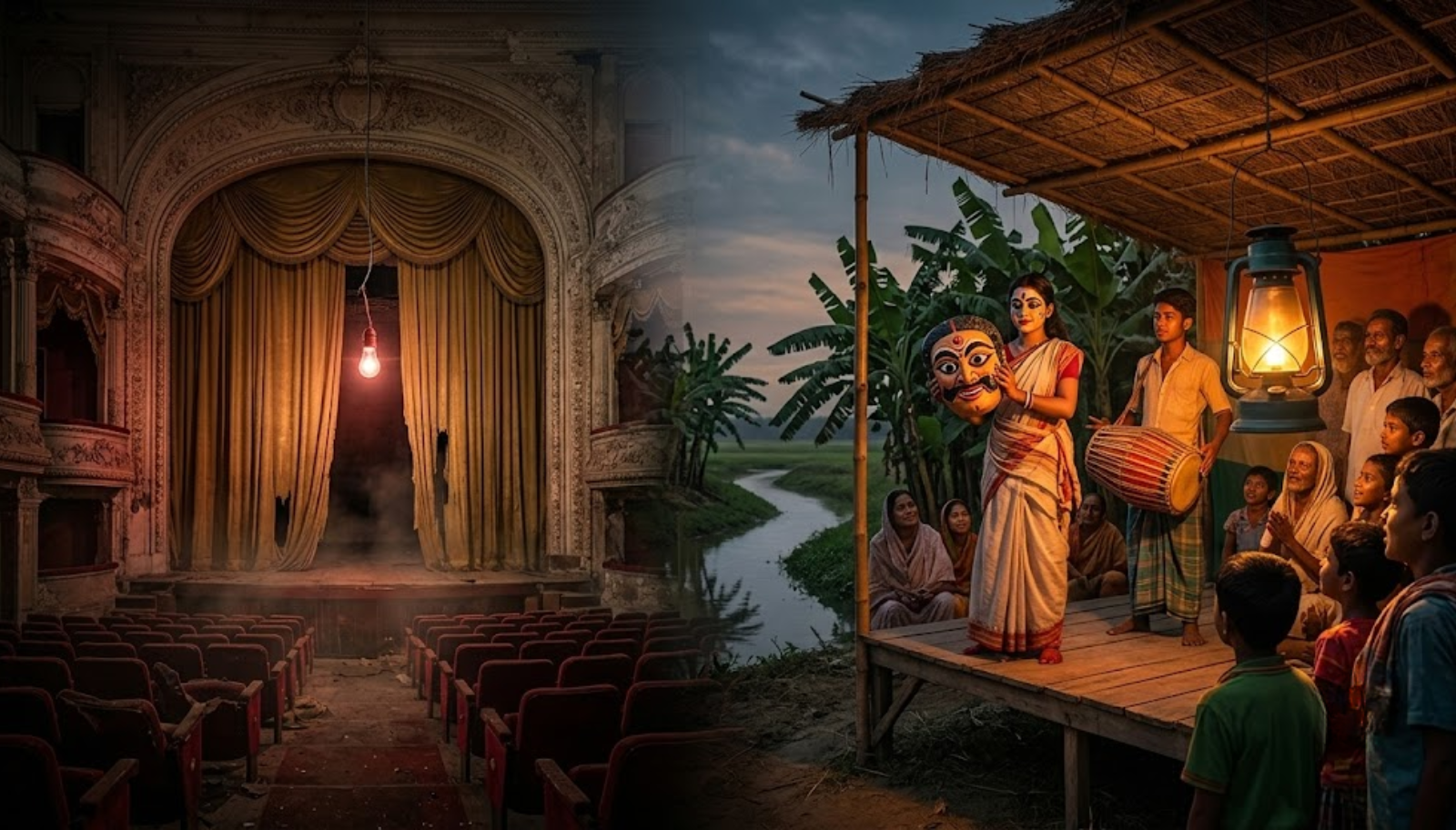
Simultaneously, this urban, politically conscious trajectory was mirrored by the deep, organic currents of indigenous folk performance. Jatra, a centuries-old theatrical medium blending song, stylized drama, and communal storytelling, routinely gathered thousands of spectators around open-air stages across rural Bangladesh. Parallel traditions like Baul performances, pala gaan, and the distinctive narrative arts of the char lands and haor regions flourished as living heritages. These expressive forms required neither formal proscenium arches nor centralized institutional funding, functioning seamlessly as the authentic theatre of the people.
The Structural Crises Paralyzing Urban Theatre
At present, both the urban and rural traditions confront severe, destabilizing pressures. The urban group theatre movement is paralyzed by a multi-faceted crisis characterized by crumbling venue infrastructure, a near-total absence of sustainable funding models, and the steady migration of young creative talent toward the immediate financial rewards of film, television, and digital content creation.
Collectives that historically mounted weekly performances now struggle to finance even one or two productions a year. Ticket revenues remain fundamentally insufficient to offset escalating operational overheads, while corporate sponsorship has withdrawn amid wider economic volatility. Furthermore, physical performance spaces are suffering from severe decay, with many of Dhaka’s dedicated venues either being converted to lucrative commercial uses or left to deteriorate entirely.
The Existential Threat to Rural Arts
The crisis facing folk theatre is arguably even more existential. The Jatra troupes that once animated the countryside have largely dissolved, primarily because satellite television and ubiquitous mobile streaming platforms have captured the rural audiences that previously sustained them. This disruption has severed the oral transmission of performance knowledge from master practitioners to successive generations. Consequently, intricate staging methodologies, specialized vocal techniques, and classic character conventions fade rapidly, surviving almost exclusively within the fragile memories of aging artists.
The Irreplaceable Value of Live Performance
The argument for saving the stage is far from a simple exercise in nostalgia. Live performance possesses an irreplaceable phenomenological value that no screen can replicate, as it places human beings within the same immediate physical space as the narrative. This proximity demands a unique quality of sustained attention and shared empathy that passive digital consumption cannot generate. In a society marked by deep political complexities and profound social stratification, the theatre’s inherent capacity to hold a mirror to power and facilitate cross-class dialogue remains entirely essential.
Institutional Reforms and Policy Solutions
Reversing this decline demands an immediate, structural commitment. A critical starting point would be the creation of a national theatre endowment, administered independently of political interference and funded through a dedicated cultural levy anchored to broadcast and streaming revenues. Such a mechanism would establish a stable financial baseline that individual theater groups cannot generate independently. Additionally, municipal governments in major hubs like Dhaka, Chattogram, Sylhet, and Rajshahi must face legal obligations to maintain at least one subsidized, high-quality performance venue within their jurisdictions.
On an educational level, theatre must be integrated into secondary and tertiary curricula to cultivate future audiences, ensuring that younger generations experience the unique vulnerability of live performance. For the rural arts, preservation architecture consisting of targeted documentation projects, master-apprentice grants, and localized community performance festivals funded at the upazila level could slow the erosion of these non-commercial art forms.
Grassroots Mobilization and Digital Adaptation
To truly ensure the stage does not dim, the responsibility must expand beyond top-down policy to include grassroots civic mobilization and collective ownership. As citizens, we can actively counter this artistic drought by establishing independent, community-driven fringe festivals that operate outside traditional institutional gatekeeping. Audiences can shift from passive consumers to active cultural stakeholders by utilizing crowdfunding models to directly finance local productions, ensuring financial autonomy for independent troupes.
Moreover, instead of viewing digital media strictly as an adversary, contemporary theater practitioners must creatively co-opt digital spaces, using short-form storytelling and behind-the-scenes content to demystify the stage and capture the imagination of younger demographics. By intentionally choosing the raw, unedited vulnerability of the auditorium over the algorithmic comfort of our personal screens, we can collectively rebuild the habit of active spectatorship.
What Is at Stake: Preserving the Moral Imagination
Ultimately, a society that allows its theatre to wither loses a vital dimension of its moral imagination, specifically the capacity to inhabit another person’s truth in real time and in a shared, unmediated environment. Bangladesh successfully forged its independence on the foundational strength of its cultural convictions. The stage that carried those very convictions forward deserves a robust renaissance rather than a slow, unexamined fade into silence.