
Barna Ahmed
Burghfield St. Mary’s School, UK
In the United Kingdom, children with disabilities and special educational needs (SEN) are granted certain advantages in the context of systematic learning. These benefits include access to educational health and care plans, support from qualified staff, inclusive learning environments, adapted teaching methods, a positive learning environment, and statistical data and trends. These measures guarantee that children with disabilities and special educational needs (SEN) have the privileges and advantages they need to thrive in systematic learning at school in the UK.
Across Bangladesh, children with learning difficulties are systematically excluded from the education to which they are legally entitled. Despite the existence of strong legislative commitments and international treaty obligations (e.g UN SDGs), a considerable gap persists between policy rhetoric and classroom reality. The data reveals a narrative that does not depict sluggish progress, but rather, it exposes a fundamental failure in the system’s design.
Scale of the Crisis
According to the 2019 Multiple Indicator Cluster Survey, 7.3 percent of Bangladeshi children aged 2 to 17 live with functional disabilities, with higher prevalence in rural areas at 7.6 percent compared to 6.1 percent in urban zones. The National Survey on Persons with Disabilities 2021 reveals that only 40.55 percent of children with disabilities are enrolled in primary education, against 98 percent for children without disabilities.
At the secondary level, this figure precipitously declines to 24.36 percent. It is estimated that more than half a million school-aged children with disabilities are not receiving any formal education. It has been demonstrated that girls with disabilities encounter heightened levels of exclusion, as evidenced by school participation rates that are 10 to 15 percentage points lower compared to those of boys with disabilities.
In districts such as Bandarban, Habiganj, and Narail, the rate of children with disabilities who remain out of school ranges from 80 to 100 percent. The prevalence of primary nonattendance among disabled children exhibits significant geographical variation, with rates ranging from 34.61% in Sylhet to 70.73% in Chattogram. Secondary exclusion levels reached a peak of 88.70 percent in Barishal.
Where Schools Fail
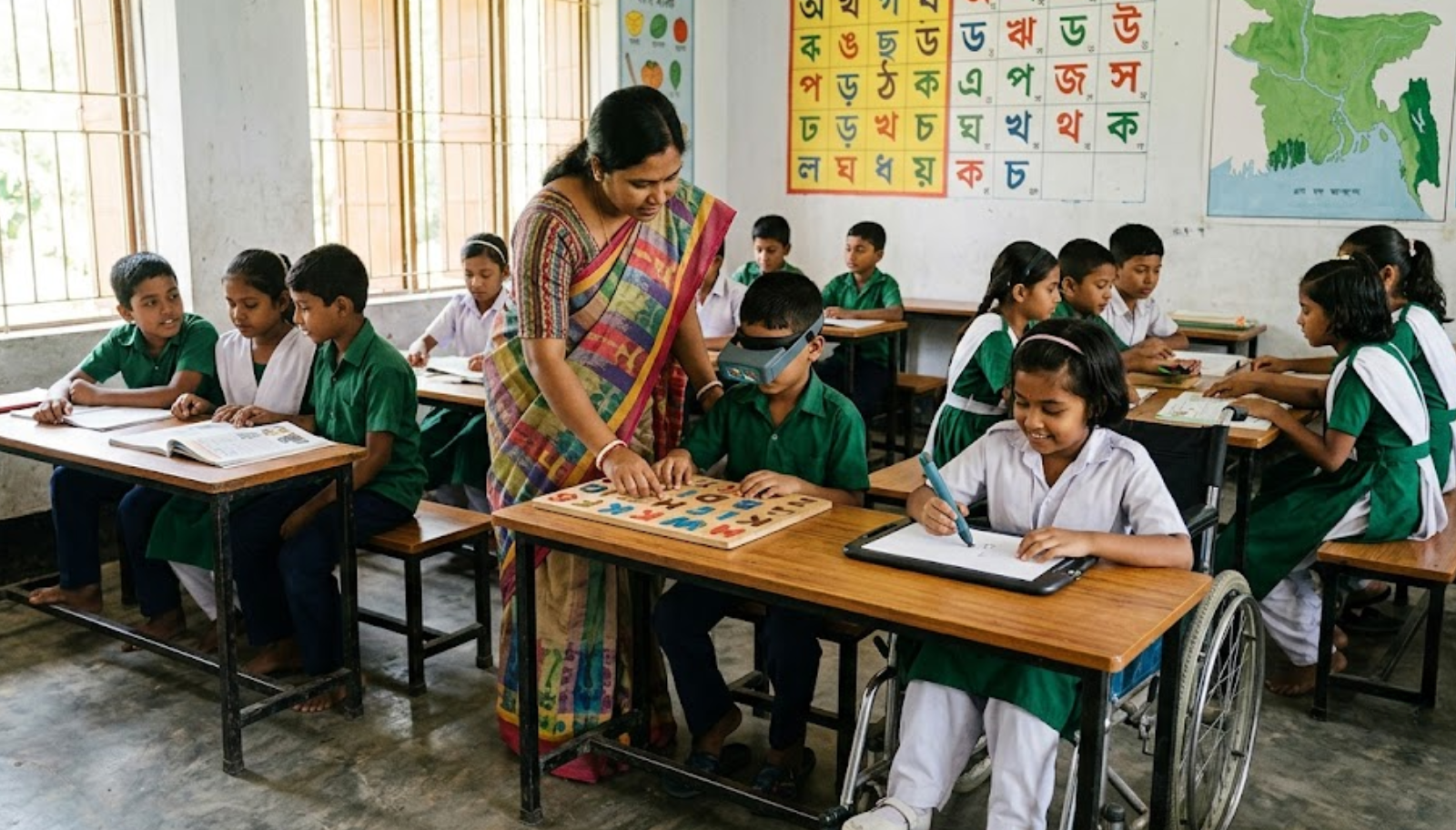
The concept of reasonable adjustment, modifying teaching methods, physical infrastructure, and assessment systems to accommodate diverse learners, exists almost nowhere in Bangladeshi schools. Fewer than 5 percent of rural schools comply with basic accessibility norms. Most lack ramps, accessible toilets, widened doors, tactile signage, and Braille materials.
Consequently, overcrowded classrooms, which typically consist of 50 or more students, impede teachers’ ability to provide individualized instruction and differentiate their teaching methods. The impact of overcrowded classrooms on learning and student engagement is well-documented. The substantial increase in the student population has resulted in a situation in which educators are unable to allocate personal attention to each student and effectively supervise the class. A survey of educators in Bangladesh reveals that less than 20 percent of teachers have received training in disability-inclusive pedagogy. It is noteworthy that inclusive modules have not yet been incorporated into the national teacher licensing curriculum.
Insufficient training in disabilities outcomes can lead to significant barriers and negative impacts on individuals with disabilities. The result is predictable: teachers view disability as a personal deficit rather than a prompt for pedagogical adaptation. Students with learning difficulties, whether autism, ADHD, intellectual disability, or dyslexia, are either refused admission or pushed to the margins of classroom activity until they drop out. A 2024 study estimated that approximately 1.7 percent of Bangladeshi children may have autism, yet official records capture fewer than 80,000 cases nationwide, less than a third of the estimated figure, reflecting chronic underdetection.
Unfortunately, the government operates only 11 autism schools, 7 hearing impaired schools, 5 blind schools, and 1 centre for intellectual disabilities. Twenty-four districts have no special school at all. Even these figures overstate provision, because special schools are concentrated in urban hubs and serve a fraction of those in need.
There are approximately 1050 special schools in England which include both state- funded and non-state-funded institutions working alongside. Evidence on disabled people lived experience of education from the systematic review conducted by the Centre of Disability Studies at the University of Leeds and Disability Rights UK;
The evidence reviewed describes the barriers disabled people face in education. It also looks at examples of reasonable adjustments and inclusive schemes designed to improve educational experiences.
Stigma and Economic Barriers
Cultural attitudes remain a formidable wall. In many communities, disability is attributed to divine punishment or karmic retribution, leading families to conceal affected children out of shame. Nearly 73 percent of parents do not permit their children with disabilities to travel to school unaccompanied. Poverty compounds the exclusion. Disability stipends, typically under Tk 1,200 per month, rarely cover the additional costs of transport, assistive devices, or private tutoring.
A recent study has revealed that among eligible families, only 20 percent are aware of the available entitlements. Furthermore, less than 15 percent have successfully accessed disability-specific stipends. Concurrently, a disability top-up of 20 percent, which is intended to supplement primary stipends allocated to families in the poorest quintile, is received by only approximately 10 percent of eligible disabled girls. In circumstances where resources are limited, families tend to prioritize the education of non-disabled children, perceiving it as a financially prudent investment.
Policy Reforms Required
Bangladesh must urgently adopt a five-pillar reform strategy. First, inclusive pedagogy must be institutionalised in all teacher training. A mandatory three-month module on differentiated instruction, universal design for learning, and classroom accommodation should be integrated into every Bachelor of Education programme and linked to national teacher accreditation. Second, infrastructure accessibility must be enforced through mandatory audits. No new or renovated school should receive government funding unless it meets universal design standards including ramps, accessible toilets, and assistive technology. Fewer than 5 percent of rural schools currently comply this must transition to 100 percent compliance for new construction within two years.
Third, a disability-inclusive conditional cash transfer programme should replace the current failing stipend system. Inspired by successful models in Brazil and Mexico, financial incentives must be digitised, tied to biometric attendance tracking, and include a 20 percent disability top up for primary stipends, prioritising rural and female students. Fourth, the Education Management Information System must be upgraded to disaggregate data by disability type, gender, and location. Without reliable data, planning remains blind. The current system operates in silos, disconnected from health and social welfare databases.
Fifth, a national awareness campaign must dismantle stigma through mass media, school-based inclusion clubs, and engagement with religious and community leaders. Kenya has demonstrated that peer mentorship programmes and child to child inclusion clubs significantly reduce discrimination. Bangladesh, with its rich network of community organisations and madrasas, is well positioned to scale this model across all 64 districts.
The policy reforms for SEN students in UK schools are outlined in the 2026 Schools White Paper, which includes significant changes such as Statuary individual support plans, Three-tier support model, Legislative changes and Tighter use of EHCPs. Relative to the scenario in Bangladesh, this may look like a distant possibility to replicate the similar. However, the fundamental principles of the UK reforms can be a strong foundation and philosophy for reforms in Bangladesh.
From Exclusion to Belonging
Private educational institutions, which are serving an increasing number of Bangladeshi students, must also be brought under compliance. The Rights and Protection of Persons with Disabilities Act (RPDA) of 2013 stipulates the requirement for reasonable accommodation. However, the efficacy of this mandate is negligible in private institutions. The government should mandate that all registered private schools submit annual inclusion plans as a condition of license renewal. These plans should include specific targets for enrolling students with learning difficulties and evidence of adjusted teaching practices.
Additionally, the lack of a designated budget line for inclusive education within the Ministry of Primary and Mass Education indicates that inclusion is regarded as an additional component rather than a fundamental responsibility. This approach must be addressed. The establishment of an exclusive inclusion budget is the most quantifiable evidence of a nation’s commitment to implementing its legal and treaty obligations.
The true measure of Bangladesh’s commitment to children facing learning challenges cannot be found in the enactment of policies or the ratification of treaties. It is important to note that 60% of disabled children never enter a classroom. Each year of inaction contributes to this increase. Reform is not solely a matter of allocating resources. The crux of the issue is whether the state acknowledges these children as citizens with the right to equal access to education.
The Equality Act 2010 of the UK ensures that schools must not discriminate against disabled pupils and must make reasonable adjustments to ensure they can access and participate in education. This includes providing additional support, adapting learning materials, trained support staff and ensuring the school environment is accessible. The Bangladesh government must therefore focus on developing a strong and updated equality act before embarking on this journey of reforms.
The concept of inclusivity does not stem from a political agenda. This phenomenon can be considered a social transformation. In instances where social transformation is not autonomous or where aligning with conflicting opinions (or the lack of clarity in opinions and stereotypes) presents significant challenges, legislative reforms become imperative.




Comment on “Reasonable Adjustment in Bangladeshi Schools”