
Desk Report
The announcement by the state minister for Fisheries and Livestock that a modern meat processing center will be established in Rajshahi follows a depressingly familiar script in Bangladeshi policymaking: grand in ambition, evasive on detail, and conspicuously silent on precisely the questions that separate genuine reform from press-release theatre.
The proposed center checks every box imaginable, such as pre-slaughter veterinary checks, halal-compliant slaughter, laboratory-verified meat quality, environmentally friendly waste management, by-product exports, biogas production, organic fertilizer manufacture. This is a catalogue so exhaustive it appears almost designed to preempt criticism rather than to guide implementation. When a single announcement claims to solve every deficiency in the meat supply chain at once, the sheer comprehensiveness should invite suspicion, not confidence.
Comprehensive promises, however, are different from credible plans, and the gap between the two deserves scrutiny. This desk report attempts to initiate and motivate the discussion.
Impact on Competition
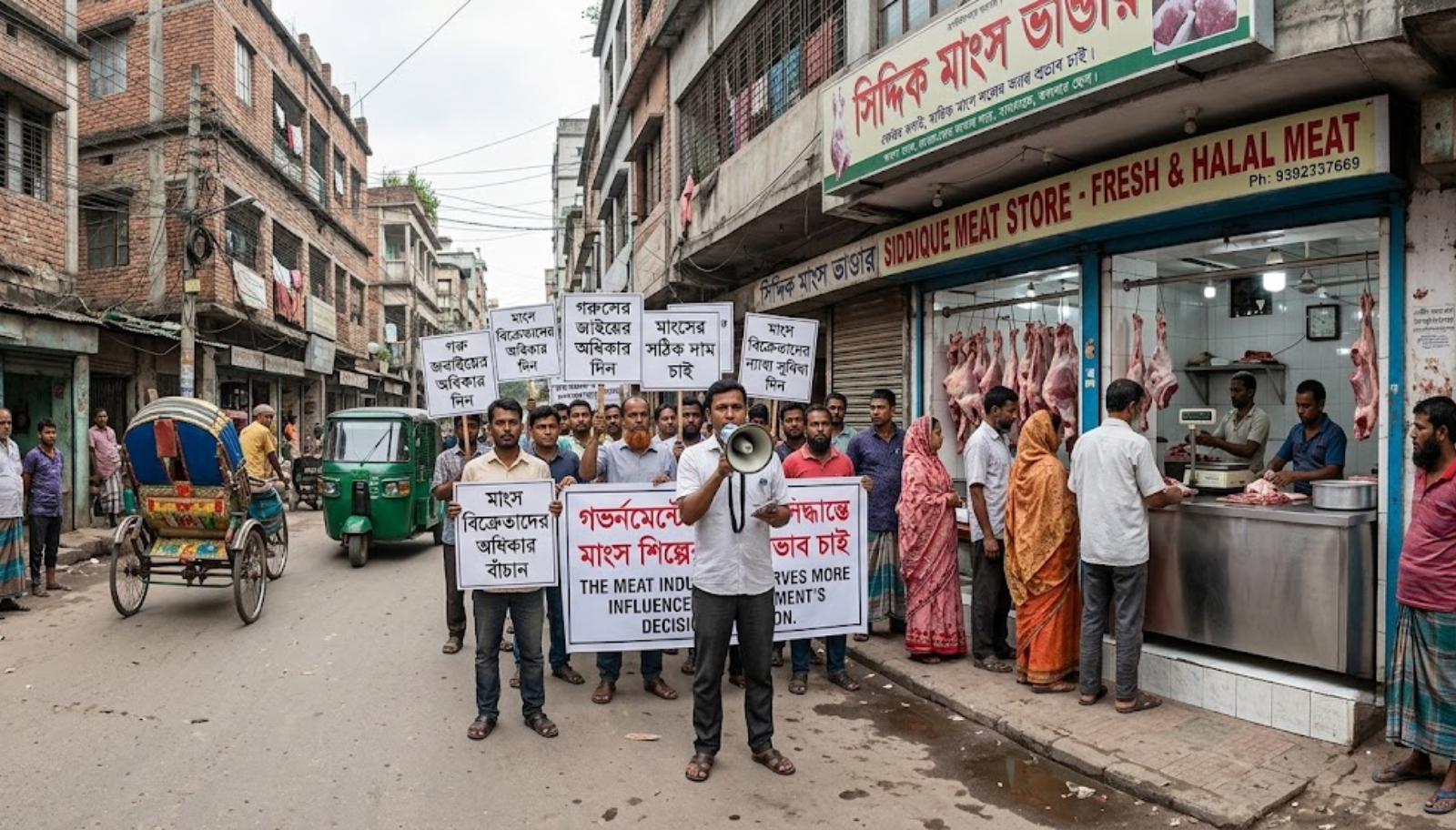
The most glaring danger here is market distortion, and it’s hard to believe this was not anticipated. Bangladesh’s meat supply chain runs on thousands of small butchers, informal slaughterhouses, and private processors, all scraping by on thin margins with barely any infrastructure to speak of. Into this fragile ecosystem strides a government-backed processing center … flush with subsidized land, concessional financing, and public infrastructure, armed with structural advantages that no private operator could ever hope to match.
Should this center price its processed meat according to its artificially subsidized cost base rather than genuine market rates, the effect will not be complementary; it will be predatory. This is not competition; it’s cannibalization dressed up as development. Small butchers in Rajshahi, many already buckling under rising input costs, may soon discover they’ve been priced out of their own market entirely, undone by an entity that occupies an absurd triple role: their regulator, their competitor, and their landlord all at once. The conflict of interest is not incidental … it is structural.
The competitive question is not whether modern processing infrastructure is needed. It plainly is whether the government should own and operate it. A more competition-neutral approach would establish the center as a publicly regulated but privately operated facility, with the government setting standards, enforcing compliance, and ensuring access on non-discriminatory terms. This model would raise industry standards without displacing the very enterprises that constitute the industry’s backbone. The current announcement provides no indication of the operating model, which is a significant omission.
Sustainability Claims and Realities
The sustainability dimensions, e.g., biogas production, organic fertilizer from waste, and zero-waste processing, are laudable in principle. Yet the practical track record of government-operated waste management infrastructure in Bangladesh offers limited cause for optimism. City corporation waste systems across the country routinely suffer from capacity underutilization, maintenance neglect, and institutional fragmentation between agencies responsible for collection, processing, and disposal. A meat processing center’s waste management system will face the same governance constraints unless it is ring-fenced with dedicated operational budgets, professional management, and accountability mechanisms that are notably absent from the announcement.
The by-product export aspiration similarly warrants caution. International markets for animal by-products (hides, offal, bone meal) require phytosanitary certification, traceability systems, and consistent quality standards that Bangladesh’s livestock sector currently struggles to provide at scale. The center can produce export-grade by-products only if the animals entering it meet import-grade health standards from the point of origin … a condition that depends on veterinary infrastructure well upstream of Rajshahi.
The Future of the Industry
A single processing center in Rajshahi, whatever its quality, cannot modernize a national industry. Bangladesh’s meat sector is characterized by fragmented supply chains, absence of cold-chain infrastructure, unregulated slaughter practices, and negligible export presence. These are systemic problems that require systemic interventions: national slaughterhouse standards enforced uniformly, cold-chain investment incentivized through tax policy, livestock health certification systems built from the district level upward, and private-sector participation designed into the architecture rather than added as an afterthought.
The Rajshahi center, if conceived as a pilot that generates replicable institutional and operational templates, could serve as a catalyst. If it is conceived as a standalone project … one modern facility in one city … it will function as an isolated improvement that leaves the broader industry unchanged.
The announcement also leaves unanswered the most fundamental operational questions: the capital budget, the operating entity, the revenue model, the timeline, and the performance benchmarks against which the center’s success or failure will be measured. A modern meat processing center that is not held to defined standards of throughput, cost recovery, and quality output risks becoming the kind of underperforming public asset that Bangladesh has accumulated before … inaugurated with promise, sustained with subsidies, and eventually forgotten. The industry deserves better than a press release. It deserves more meat, such as a more detailed plan.