
Barrister Nasir Uddin Mahmud
Freelance Legal Expert
Bangladesh, home to the world’s fourth-largest Muslim population, enforces some of the strictest alcohol controls in Asia. Its legal framework governing alcohol sale and consumption reflects a delicate balance between Islamic religious values, indigenous cultural traditions, and the practical demands of a modernising economy. Understanding how this framework operates and where it falls short is essential to any informed discussion of reform. This article aims to accomplish the first step towards that.
The Current Legal Framework
The primary legislation is the Narcotics Control Act 2018, which replaced the earlier 1990 version. Under this Act, alcohol is defined as any spirit, wine, beer, or liquid containing more than half a percent alcohol by volume. Section 10 establishes an unequivocal principle: no person may produce, distribute, sell, consume, import, export, or store alcohol without a government license or permit. Violations carry severe penalties, ranging from six months to ten years of imprisonment depending on the quantity involved, with unlicensed distillery operations punishable by up to ten years.
In 2022, the Ministry of Home Affairs introduced the Alcohol Control Rules to implement the 2018 Act more effectively. These rules filled several glaring gaps. They established for the first time a minimum legal age of twenty-one years for alcohol purchases; prior to this, Bangladesh had no defined age threshold at all.
They mandated health warning labels on all alcoholic beverages. They limit the quantity a permit holder may purchase to three units at one time and seven units per month, with limited exceptions. They specified that bars and liquor shops must close on Fridays, the Islamic day of congregational prayer, as well as on major religious observances including Muharram, Shab-e-Baraat, Eid-e-Miladunnabi, Shab-e-Kadar, Eid-ul-Fitr, and Eid-ul-Adha. They also set conditions for establishing bars in hotels, restaurants, and clubs, requiring at least two hundred permit holding members.
The Religious Architecture of Restriction
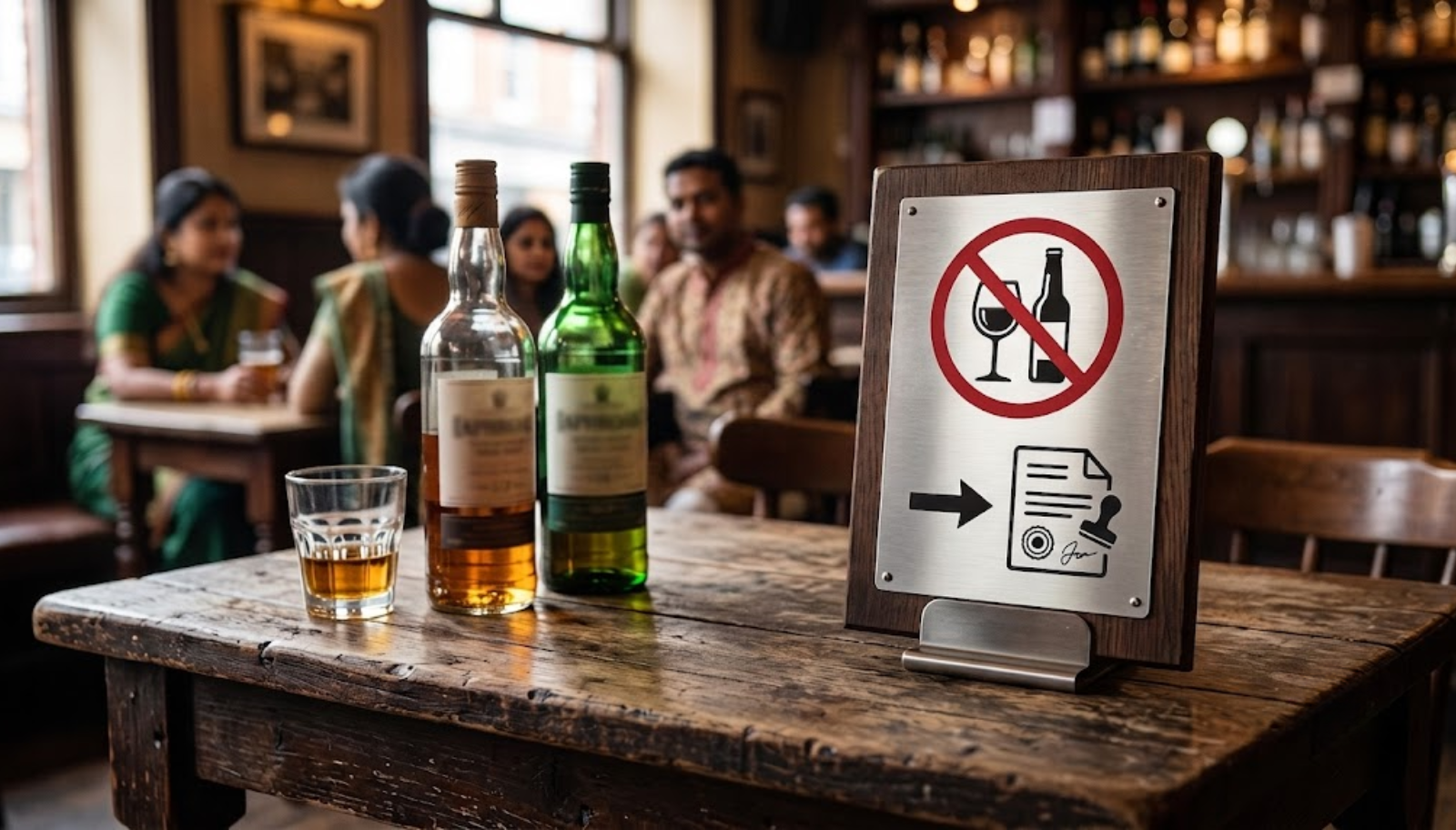
The most distinctive feature of Bangladeshi alcohol law is its differentiation by religious identity. Any Bangladeshi citizen who wishes to drink must hold a government permit. However, for Muslims, who constitute roughly ninety percent of the population, a permit may be issued only on medical grounds. The applicant must present a prescription from a civil surgeon or an associate professor at a medical college, detailing the disease and explaining why alcohol is therapeutic necessary.
Non-Muslim citizens, e.g. Hindus, Christians, and Buddhists, face no medical requirement and may obtain permits on broader grounds. Foreign nationals can drink inside licensed bars and hold separate privileges through diplomatic channels. Indigenous communities in the Chattogram Hill Tracts (Rangamati, Bandarban, and Khagrachari) may consume traditionally produced alcohol as part of their cultural heritage, while groups like tea garden labourers are permitted traditional fermented liquors such as Taree and Pochui.
This tiered system reflects Islam’s constitutional and social supremacy in Bangladesh while accommodating religious minorities and indigenous traditions. But it also creates striking inconsistencies: a Muslim citizen drinking without a medical permit commits a criminal offence, while a non-Muslim neighbour drinking the same beverage commits none. That medical permit, moreover, is widely seen as a formality. It is obtainable through channels of varying rigour that raises real questions about the restriction’s sincerity and enforceability.
Public Health Realities
The World Health Organization reports that Bangladesh has among the lowest per capita alcohol consumption rates globally, with over ninety percent of the population living alcohol free. Yet among those who do consume, patterns are concerning.
Over forty one percent of youth aged fifteen to nineteen who drink engage in binge consumption. The country recorded over three thousand deaths attributable to alcohol in a single year. The absence of a coherent public health approach to alcohol, beyond prohibition for the majority community, means that dependency, abuse, and treatment gaps go largely unaddressed.
Policy Imperatives
The medical permit requirement for Muslims should be replaced with a uniform, secular permit system based on age verification rather than religious identity, eliminating the de facto discrimination embedded in current law while maintaining strict access controls consistent with social values; a religion-based legal distinction is, after all, both constitutionally fragile and practically unenforceable.
Alongside this, public health investment in treatment and counselling for alcohol dependency must replace the current reliance on criminalisation alone; no national rehabilitation programme currently exists, leaving dependent individuals without support and pushing consumption further underground.
Enforcement also needs strengthening. The quantity restrictions under the 2022 Rules should be paired with robust monitoring, particularly around licensed establishments, to prevent bulk diversion into unregulated markets, while zoning regulations should keep alcohol outlets at defined distances from schools, mosques, and residential areas, reinforcing the existing social consensus around restricted access. Public awareness campaigns, in turn, should frame the health risks of alcohol consumption within Islamic teachings on the preservation of life and bodily integrity, making the public health case culturally resonant rather than culturally antagonistic.
Finally, the indigenous and traditional exemptions in the Hill Tracts must be preserved but supported with health education and community engagement to prevent cultural permissions from being exploited for commercial trafficking.
Bangladesh does not need to choose between its religious identity and a rational alcohol policy. It needs a framework that respects both, while protecting public health and upholding equal treatment before the law.