
Desk Report
Oniket Desk
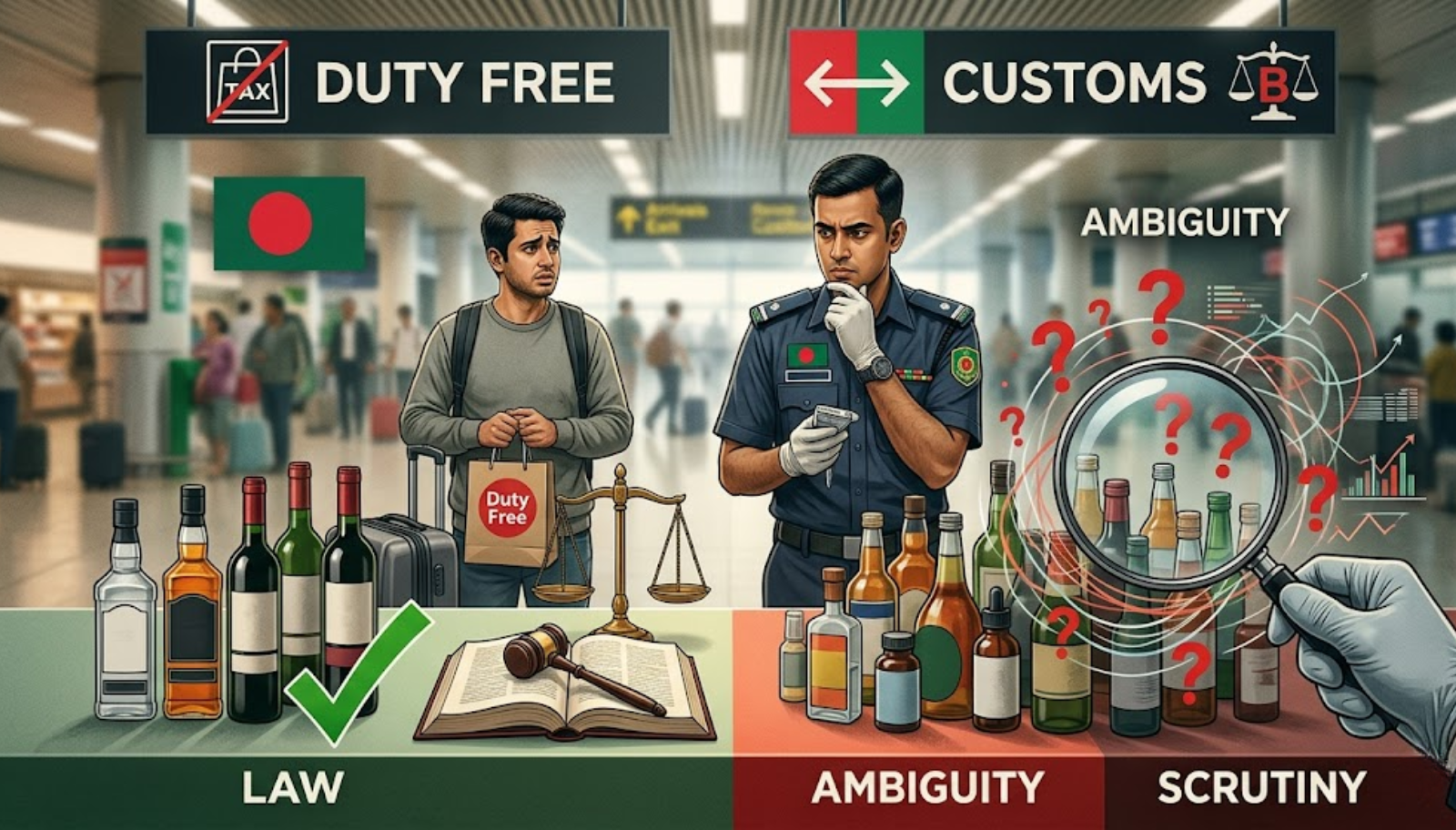
Bangladesh occupies a distinctive position on the global map of alcohol regulation. The state in question cannot be characterized as either a fully prohibitionist state or an open market. Instead, it employs a layered framework of permissions and restrictions that is, in practice, riddled with inconsistency, ambiguity, and social tension.
This phenomenon is particularly evident in the regulations that govern the duty-free import allowance for alcohol, a specific provision that gives rise to broader questions concerning legal clarity, religious sensitivity, and the rights of non-Muslim citizens.
The Rules as They Stand
According to Bangladesh Customs regulations and the officially published guidelines of Hazrat Shahjalal International Airport, a foreign passport holder may bring up to one litre of alcoholic beverages into Bangladesh duty free as part of their accompanied baggage. In many international airports (e.g Dubai, London), the additional information is that the foreign passport holder travelling to Bangladesh must be non-Muslim to use their duty-free alcohol quota, where passports do not actually register a religion as part of an individual identity in a travel document. In addition, no Bangladeshi passport holder, regardless of their religion, ethnicity, or personal beliefs, is permitted to bring any quantity of alcohol into the country. Any such imported liquor is subject to seizure and detention by customs authorities.
A further layer of complexity emerges in the distinction between tourist and non-tourist passengers. Regulatory sources diverge in their stipulations, with some allowing two bottles for tourists and one bottle for non-tourists, while others cite the one-liter figure. The Bangladesh Customs Act, the Passenger Baggage Import Rules of 2011, and the Alcohol Control Rules of 2022 do not employ fully harmonized terminology, creating a regulatory landscape that is challenging to navigate, even for trained customs officials, let alone arriving passengers.
Social and Religious Barriers
Bangladesh is a Muslim-majority nation, with Islam deeply embedded in its cultural, legal, and social fabric. The country’s approach to alcohol is shaped not only by statutory law but by prevailing religious sentiment and community expectation. Alcohol consumption is considered sinful by the majority population, and this moral weight extends into the enforcement culture surrounding import regulations.
Muslim Bangladeshis who wish to consume alcohol legally must, in principle, obtain a permit, and the Alcohol Control Rules of 2022 require that a Muslim produce a doctor’s prescription even to access alcohol on medical grounds (and in licensed bars in the country). Legislation governing the sale of alcohol imposes restrictions on sellers. Specifically, the number of units of alcohol that can be dispensed during a single transaction is limited to three, and the total number of units dispensed per month is limited to seven. These restrictions are in place to mitigate the social implications of alcohol consumption within a Muslim-majority society.
The Grey Areas
The most troubling dimension of the current framework is what it leaves undefined or contradictory. Bangladeshi citizens who are non-Muslim, including Hindus, Christians, and Buddhists, are subject to the same blanket prohibition on bringing alcohol into the country as their Muslim counterparts. The rule distinguishes by passport nationality rather than religion, meaning that a Bangladeshi Hindu returning from abroad has fewer rights than a foreign visitor of any faith (other than Muslim, as per duty free outlets in foreign airports from where the tourist is travelling). This creates a legal anomaly that sits uncomfortably with constitutional guarantees of equal treatment.
Duty-free shops operating within Dhaka airport legally sell alcohol to arriving passengers; however, the distinction between whom may purchase and who may carry remains poorly communicated. The practices of informal enforcement vary significantly between officers and shifts, thereby encouraging selective application and undermining both trust and legal consistency.
Essential Revisions
A genuinely functional regulatory framework for duty-free alcohol allowance in Bangladesh requires urgent clarification and reform across several dimensions.
The government should first consolidate the existing patchwork of rules into a single, publicly accessible document that precisely defines allowances for all categories of passengers. This document should distinguish clearly between foreign nationals, foreign Muslim nationals, non-Muslim Bangladeshi citizens, and Muslim Bangladeshi citizens. It should also contain consistent figures for quantities rather than conflicting references across different instruments.
The blanket prohibition on Bangladeshi non-Muslim citizens importing alcohol should be reviewed. A faith-neutral, legally grounded personal import allowance for non-Muslim citizens, equivalent in principle to that extended to foreign non-Muslim visitors, would bring Bangladesh closer to its constitutional commitments on religious equality and personal freedom.
Customs officials at ports of entry should receive standardised training on current alcohol import rules to reduce the informal discretion that currently governs enforcement. Clarity at the institutional level must precede consistency at the operational level.
The broader Alcohol Control Rules should be reviewed with input from religious communities, civil society, legal experts, and public health professionals to produce a framework that is honest about what it permits, transparent about what it prohibits, and coherent in the values it reflects. Bangladesh need not abandon its cultural and religious identity to produce regulations that are clear, fair, and consistently applied.


Comment on “Between Law and Ambiguity: Bangladesh’s Duty-Free Alcohol Allowance Under Scrutiny”