
Ruksana Akhter
Freelance Architect
Bangladesh’s urban centers are expanding at a rate that has proven to be challenging for its governance institutions to effectively address. Dhaka, which is among the most densely populated cities on Earth, along with Chattogram, Sylhet, Khulna, and Rajshahi, is undergoing rapid and largely unregulated physical expansion.
The ramifications of this development, characterized by the deterioration of infrastructure, the encroachment of water bodies, the inundation of residential areas, and the displacement of local populations, underscore a systemic failure in the enforcement of building codes and the governance of land rights. This phenomenon poses a direct and escalating threat to the sustainability of urban life.
The State Building Codes
Bangladesh does possess a legal framework for safe construction. The Bangladesh National Building Code, first introduced in 1993 and substantially revised as the BNBC 2020, sets detailed minimum standards for structural design, fire safety, earthquake resistance, setback requirements, and permissible floor area ratios. The Capital Development Authority, RAJUK, holds primary regulatory jurisdiction over Dhaka, while Chattogram Development Authority and equivalent bodies govern other major urban centres.
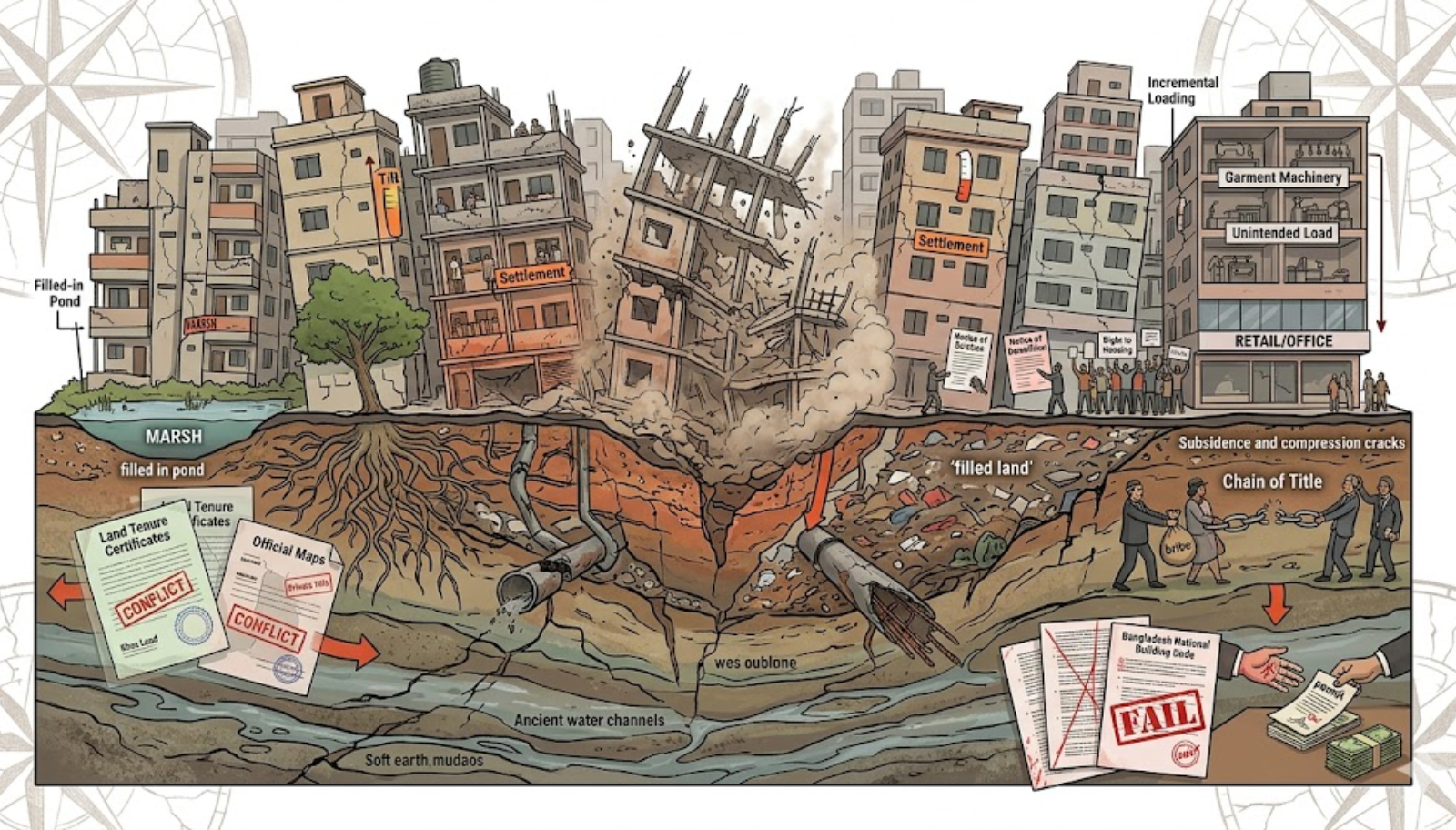
Five years after the BNBC 2020 was gazetted, its implementation remains deeply inadequate. A substantial number of existing buildings across Dhaka and other cities have been constructed in violation of floor area ratios, setback regulations, and structural requirements. Many of these buildings were constructed with permits obtained through a system riddled with corruption.
Empirical studies of RAJUK’s plan approval process have documented systematic irregularities in the issuance of land use clearance and building permissions (some have been revised and updated and simplified very recently). In these cases, approvals are negotiated rather than earned on technical merit. The result is a built environment that routinely exceeds permissible densities, neglects fire egress requirements, and is situated on land that was never legally cleared for the purpose for which it is used.
The Rana Plaza collapse of 2013, which resulted in over a thousand fatalities, stands as the most salient illustration of the profound human consequences of building code failure (the building was under Savar Municipality code, and not RAJUK). However, the structural conditions that led to this disaster persist in thousands of commercial and residential buildings across all major Bangladeshi cities including the capital Dhaka. Despite the heightened international scrutiny that followed the Rana Plaza disaster, the broader culture of noncompliance in the urban built environment has remained largely unaltered.
Land Rights and the Governance of Urban Property
In Bangladesh’s urban areas, land rights are marked by contentious titles, fraudulent registrations, and the audacious occupation of both private and public land. Article 42 of the Constitution stipulates the right to property ownership; however, this right is frequently superseded by the actions of politically (and commercially) influential actors. These individuals employ coercive tactics, including bribery of land officials, manipulation of legal processes, and physical intimidation, to effectuate forcible transfers of property. The phenomenon of land grabbing in urban Bangladesh cannot be considered an informal one operating on the margins of governance. This phenomenon is facilitated by privileged access to state institutions, thereby embedding it structurally and making it difficult to dislodge.
Government khas land, wetlands, and flood retention zones on the periphery of Dhaka and other cities have been systematically encroached upon by developers and politically influential individuals, converting ecological buffers into built developments that intensify flooding for surrounding communities. Slum settlements on waterbodies, railway land, and embankment zones house millions of urban poor whose tenure is legally hazardous, leaving them vulnerable to sudden eviction without compensation or resettlement. Meanwhile, the land record system, still heavily paper-based in many areas despite ongoing digitization efforts, enables duplicate registrations, forged documents, and multiple competing claims on the same parcel to persist for years through a backlogged and corruption-prone judicial process.
Policy Reforms for Sustainable Urban Living
Addressing this compound crisis requires reforms that are simultaneous, interlocking, and insulated from political interference. The comprehensive digitization of land records, encompassing survey maps, mutation records, and registration documents, must be expedited and made publicly accessible. The establishment of a transparent, centrally administered digital land registry has the potential to mitigate the prevalence of fraudulent duplication, thereby empowering citizens to verify ownership without the need for intermediaries. This process must be accompanied by a systematic review and correction of existing fraudulent titles, supported by dedicated land tribunals with fixed timelines for resolution.
Building permit and inspection processes must be removed from the sole authority of RAJUK and equivalent bodies and placed under an independent inspection regime with professional engineers certified by a statutory body, subject to random audits and criminal liability for false certification. Despite the recent reforms, the current system, in which both approval and inspection (in most areas) are still handled by the same institution with well-documented corruption problems, creates an incentive structure that is the opposite of safety.
To address this issue, it is imperative that strict and publicly transparent zoning enforcement be implemented in all major urban areas. The use of satellite and drone-based monitoring of construction activity is crucial for the identification of unauthorized development before its completion, rather than after. The demolition of structures that do not comply with building codes must be carried out in a consistent manner, without exception due to political considerations. This process should be accompanied by the implementation of compensation and resettlement programs for displaced individuals with low incomes, when applicable.
Finally, security of tenure for urban slum residents must be recognised through incremental titling programmes that provide legal acknowledgement of long-term occupation without requiring immediate formalisation, removing the insecurity that prevents residents from investing in their own shelter and that makes them perpetually vulnerable to displacement by wealthier interests. Sustainable urban living in Bangladesh begins with the certainty that the ground beneath a citizen’s home is theirs to stand on.