
Sumaiya Hasi
Oniket Research Group
On the twenty ninth of August this year, Bangladesh marks fifty years since the death of Kazi Nazrul Islam, the man the nation calls its national poet. Half a century is long enough to judge whether reverence has been matched by responsibility. A recent article in The Oniket Bulletin, written by Tanzina Fardoush, reminded readers why Nazrul still matters. It traced how his most famous poem, Bidrohi, refused to bow before any throne or any god of oppression, and how poems such as Samyabadi and Manush attacked caste and class hierarchies with a force few Bengali writers ever matched.
The article recalled his insistence, in Manush, that the truest pilgrimage is toward the human being rather than toward temple or mosque, and his declaration in Naree that no great achievement in history was ever accomplished without woman as an equal partner. That essay is a fitting reminder of who Nazrul was. It is worth asking, on this anniversary, whether the state that claims him has lived up to the equity he preached.
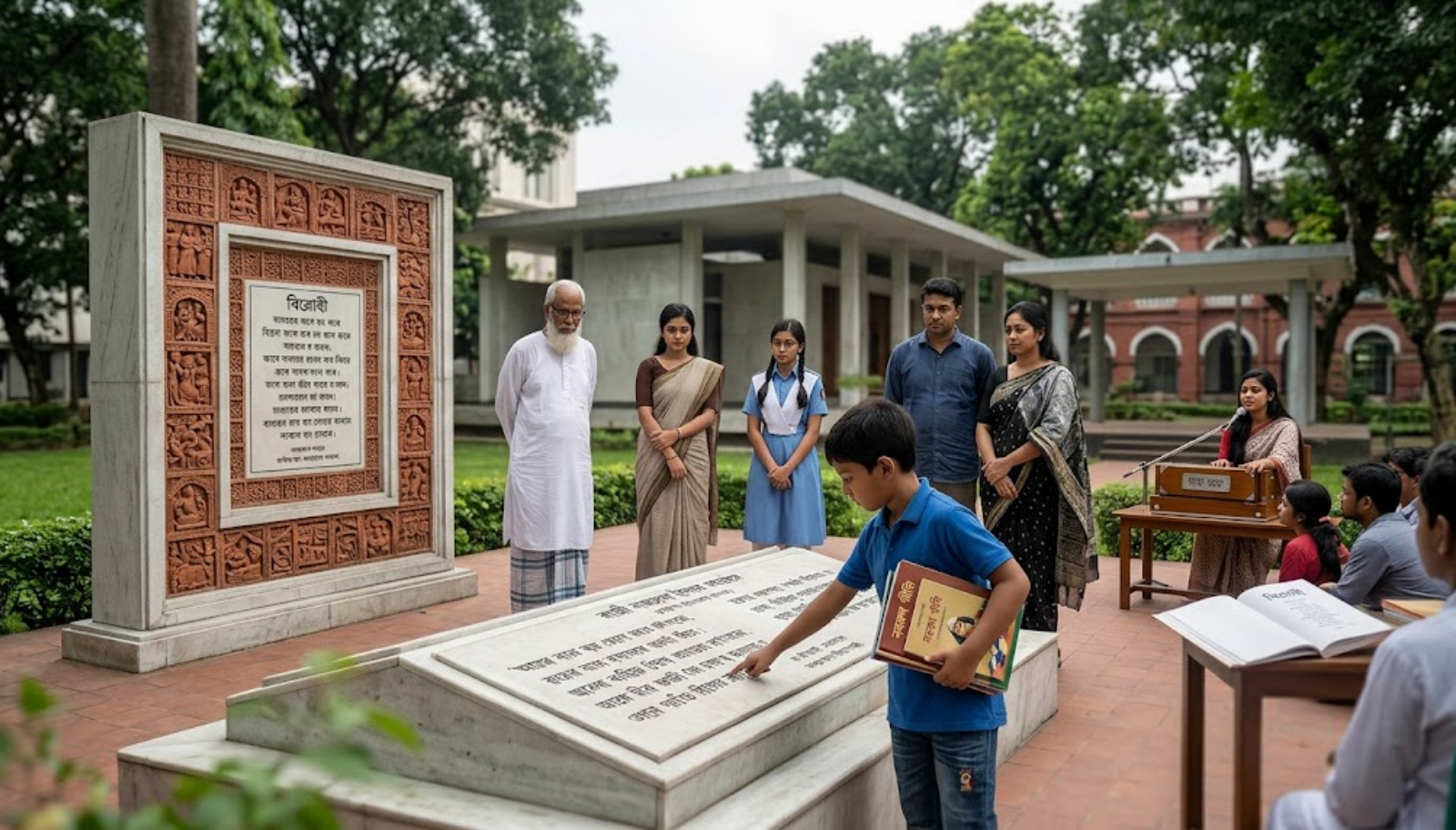
The formal answer looks respectable. Nazrul was brought from Kolkata to Dhaka in 1972 by Sheikh Mujibur Rahman, granted citizenship in 1976, and buried beside the central mosque of Dhaka University as his own verse had requested. A mausoleum was eventually built there. A national institute bearing his name was established in 1985 under a government ordinance, tasked with researching his writings, publishing his complete works, training singers in Nazrul Geeti, and preserving his legacy for future generations. On paper, the machinery of remembrance exists.
Look closer and the picture grows uneven. The institute itself, now renamed the Jatiya Kabi Nazrul Institute, operates out of a modest six storey building in Dhanmondi that former staff and researchers have described as too small for its own mandate, tucked away from the main road in a quiet residential pocket that visitors struggle even to locate. Auditoriums for major events routinely have to be hired elsewhere because the institute cannot host its own programmes.
A parallel effort at Dhaka University, the Nazrul Gobeshona Kendra, has by its own director’s admission produced negligible research since it was founded in 1989, its office so obscure inside the Arts Building that finding it takes real effort. Multiple biographers who set out to write the definitive life of Nazrul, including Ataur Rahman and Abdul Mannan Syed, died before completing the task, leaving what the current director general of Shilpakala Academy recently called a fragmented and incomplete record of the poet’s life, philosophy and complete body of work.
Perhaps the most telling detail is this: although Nazrul had been called the national poet in popular usage for decades, that status was only formally recognized through an official government gazette in 2024, nearly half a century after his death. An English translation of his selected writings, meant to carry his voice beyond Bengal, only appeared this year, the first such attempt in forty five years. These are not the marks of a country that treated its national poet as urgent business. They are the marks of a legacy kept alive more by devoted individuals, family members, and cultural societies such as the older Nazrul Academy than by sustained state investment.
There are signs of correction. The current executive director of the institute has spoken openly about Nazrul having been neglected for too long, and this year’s government sponsored Nazrul Barsho, along with new publications and a proposed diploma course on his journalism, suggest a belated seriousness. But officials themselves warn that a single commemorative year cannot substitute for permanent institutional commitment: proper funding, adequate premises, a completed critical biography, and research that reaches beyond seminars held once around his birth and death anniversaries.
Nazrul foresaw this exact pattern. In his final public speech in Kolkata in 1942, he predicted that once he was gone, grand seminars would be organized in his name and poems would be written praising him as patriot, martyr, and rebel, even as the harder work of understanding and living by his ideals went undone. Fifty years after his death, that prophecy still stings with accuracy.
To truly honor Kazi Nazrul Islam is not to unveil another plaque or hold another ceremonial evening of his songs. It is to fund the institute meant to carry his work forward, finish the biography that has defeated three generations of scholars, give his research centers the space and staff they need, and let his uncompromising demand for equity shape policy rather than decorate speeches. Bangladesh owes him more than affection. It owes him the institutional seriousness it has, for fifty years, too often withheld.
Reference: