
Farah Zahir
Editor, Oniket Research Group
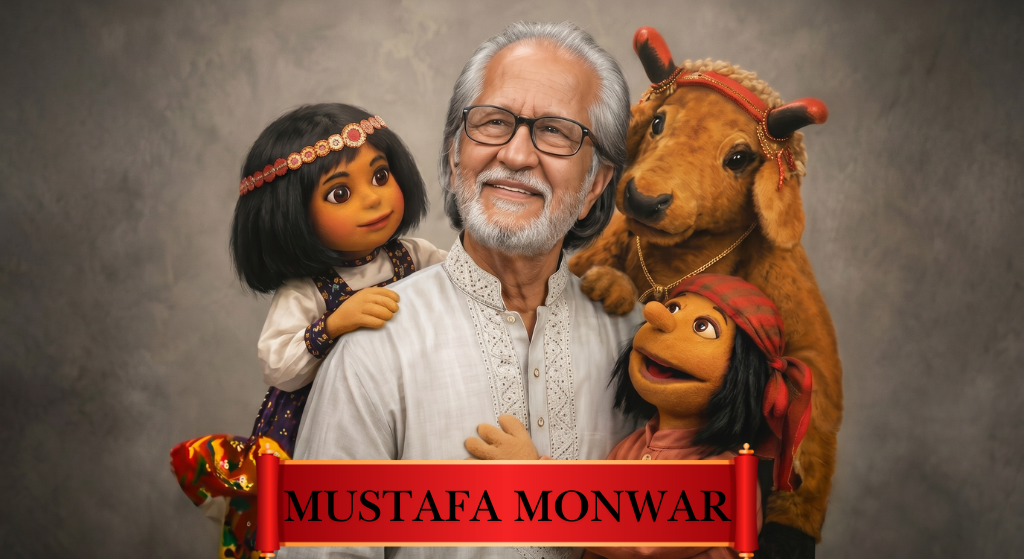
Mustafa Monwar, who passed away on 29 June 2026 at the age of 91, was one of the most versatile and beloved cultural figures in the history of Bangladesh. A painter, sculptor, puppeteer, television director, art educator and radio performer, his creative life spanned nine decades and left an enduring imprint on the nation’s artistic and cultural identity. Revered as Bangladesh’s “Puppet Man”, he transformed puppetry into a respected artistic medium and inspired generations of children through television, visual arts and cultural education.
Early Life and Education
Born on 1 September 1935 in Matulalay, Jessore, with ancestral roots in Manoharpur village of Shailkupa upazila in Jhenaidah, Mustafa Monwar grew up in a family steeped in literature and the arts. His father was the renowned poet Golam Mustafa, while his mother, Jamila Khatun, encouraged his creative pursuits from an early age. His schooling began at Shishu Vidyapith in Kolkata, where he studied music under the guidance of his father and elder brother. He later enrolled at the Government Art College in Kolkata, receiving vocal training from Ustad Santosh Roy, a disciple of the legendary Ustad Fayyaz Khan, and learning alongside the celebrated musician Nirmalendu Chowdhury.
Although music revealed his artistic potential, painting soon became his greatest passion. He briefly enrolled as a science student at Scottish Church College before leaving that path to pursue fine arts. In 1959, he graduated with First Class First honours from the Government College of Art & Craft, Kolkata, establishing himself as one of the most promising young artists of his generation.
Political Awakening and the Liberation War
Mustafa Monwar’s commitment to social justice emerged at an early age. During the Language Movement of 1952, while studying in the ninth grade at Narayanganj Government School, he responded to the killing of students in Dhaka by creating protest posters with friends and displaying them across the city. The act led to his arrest and a month-long imprisonment.
His patriotism found its strongest expression during the Liberation War of 1971. As leader of the cultural team of the Bangladesh Government in Exile, he travelled to different parts of India, using art and culture to strengthen international support for Bangladesh’s independence.
The war also gave birth to what would become his most enduring artistic legacy. Witnessing the trauma endured by children in refugee camps, he organised his first puppet show to bring moments of joy amid fear and uncertainty. After independence, he continued to devote himself to the emotional and creative development of children through puppetry, earning the title that would define his career: Bangladesh’s “Puppet Man”.
A Distinguished Professional Career
Mustafa Monwar began his professional life as a lecturer at the East Pakistan Arts and Crafts College before joining Bangladesh Television in 1964 as a programme producer. Over the following decades, he served in several of the country’s most important cultural institutions, including as Deputy Director General and General Manager of Bangladesh Television, Director General of Bangladesh Shilpakala Academy, Director General of the National Institute of Mass Communication, Managing Director of the Film Development Corporation, Chairman of Janabibhag Unnayan Kendra, Project Director of the Educational Puppet Development Centre and Chairman of Bangladesh Shishu Academy.
His influence on Bangladeshi television was profound. In 1966, he launched Notun Kuri, a children’s talent programme that later became a nationwide platform for discovering young artists after regular broadcasts began in 1976. Earlier, between 1967 and 1968, he created and presented the innovative television programme Ajob Deshe, where puppet characters Bagha and Meni cleverly used satire to reflect the political realities of the time.
His celebrated children’s programme Moner Kotha introduced unforgettable puppet characters, including Parul, Rakhal and Sharh, who became familiar companions in countless Bangladeshi households. Beyond television, he also contributed to the development of the South Asian animated series Meena and played an important role in designing the iconic red sun backdrop behind the Central Shaheed Minar, a powerful national symbol that continues to represent the spirit of the Language Movement.
Recognition and Awards
Mustafa Monwar’s artistic excellence was recognised early in his career. He won a gold medal in graphics at the All-India Arts and Crafts Exhibition in Calcutta in 1957, followed by two more gold medals for oil painting and watercolour at the Calcutta University Students’ Fine Arts Exhibition in 1958.
Throughout his career, he received numerous honours, including the Tenashas Padak (1990), Bangladesh Charushilpi Sangsad Award (1992), Kids Honorary Padak (1999), Shishu Kendra Special Award and Rishi Padak (both 2002), Sultan Padak and, most notably, the Ekushey Padak in 2004, Bangladesh’s second-highest civilian honour, in recognition of his outstanding contribution to fine arts and culture.
Legacy Beyond Measure
The Bangladesh Shilpakala Academy later documented his remarkable journey in the film Shilpo Sarothi, highlighting his pioneering role in establishing puppetry as a respected art form in Bangladesh.
Mustafa Monwar’s legacy extends far beyond his paintings, sculptures and puppet characters. Through his lifelong dedication to children’s creativity, cultural education and artistic excellence, he helped shape Bangladesh’s modern cultural landscape. His work nurtured generations of artists and performers while proving that art could educate, heal and unite. His contributions to the nation’s cultural heritage will continue to inspire future generations and be remembered with profound respect and gratitude.