
Iftekhar Rahman
Verdant Global
Bangladesh’s new Chinese loan for Mongla Port should not be reduced to a convenient political label. The serious question is whether the $335.78 million concessional facility from China’s Export-Import Bank represents strategic infrastructure finance, disguised support for Chinese contractors, or a future pressure point for Bangladesh’s debt management. ¹
The answer is not binary. This is not “dumping” in the strict trade-law sense. It is a strategic borrowing decision whose value will depend on execution and transparency.
Summary of findings
The Mongla project has a credible economic rationale. Bangladesh needs a stronger second seaport to reduce excessive dependence on Chattogram, support the southwest economy and improve trade resilience. However, concessional finance is not automatically good finance. A port creates value only when it improves logistics performance, attracts cargo, lowers costs and strengthens private-sector competitiveness. The test is not the headline interest rate, but whether borrowed money becomes a productive national asset.
Why Mongla matters
Bangladesh’s external trade remains highly concentrated around Chattogram Port. For an economy dependent on imported raw materials, fuel, machinery and food commodities, and on garment exports, this is a structural vulnerability. Any serious disruption at Chattogram can quickly move from a port problem to a national competitiveness problem.
Mongla offers an alternative. Its location gives it relevance for the southwest corridor, including Khulna and Jessore. The Padma Bridge has changed movement between Dhaka and the southwest, making Mongla more commercially plausible. If properly developed, the port can reduce pressure on Chattogram, shorten selected inland routes and support a more balanced trade infrastructure network.
There is also a regional argument. Mongla could support cargo connected to India, Nepal and Bhutan, subject to transit arrangements and border efficiency. But aspiration is not demand. Shipping lines choose ports that are reliable, cost-effective and predictable.
Not dumping but tied-finance risk
Calling the loan “dumping” is technically weak. Dumping usually refers to selling exported goods below cost or below domestic prices to capture market share. A sovereign infrastructure loan does not fit that definition.
The more relevant risk is tied finance. Chinese concessional lending often comes with Chinese contractors, equipment, engineering standards and implementation structures. Part of the loan may return to China through procurement, while Bangladesh retains the repayment obligation. This does not automatically make the project harmful, but it raises questions about competitive bidding, local value addition, technology transfer and operating control.
Bangladesh should avoid both complacency and paranoia. The project should not be accepted as strategic merely because the terms are cheap. Nor should it be rejected merely because the lender is Chinese. The correct test is economic return, governance quality and national benefit.
The finance looks attractive but incomplete
The reported terms are favourable: 2% interest, repayment over 20 years and a five-year grace period. ¹ In the current global financing environment, that is meaningful. Bangladesh is also moving towards a post-LDC reality, where concessional windows will narrow and borrowing choices will require greater discipline. This also sits within a wider relationship in which Bangladesh has asked China to accelerate infrastructure delivery while narrowing the bilateral trade gap.3
Yet cheap debt remains debt. Earlier reporting indicated that the broader Mongla modernisation project was approved at Tk 4,068.23 crore, with Tk 3,592.90 crore financed by the Chinese loan and the remainder funded domestically.² This creates repayment exposure and fiscal accountability.
The loan is reportedly denominated in renminbi. If the taka weakens against the yuan, the local-currency cost of repayment will rise. Bangladesh has already faced pressure on reserves, import financing and exchange-rate management. A low interest rate reduces the burden, but it does not remove currency vulnerability.
Execution is the real economics
A port is not simply a construction project. It is a logistics system. Terminals, cranes and yards matter, but only if vessels arrive reliably, cargo moves inland efficiently and customs processes do not trap goods in delays.
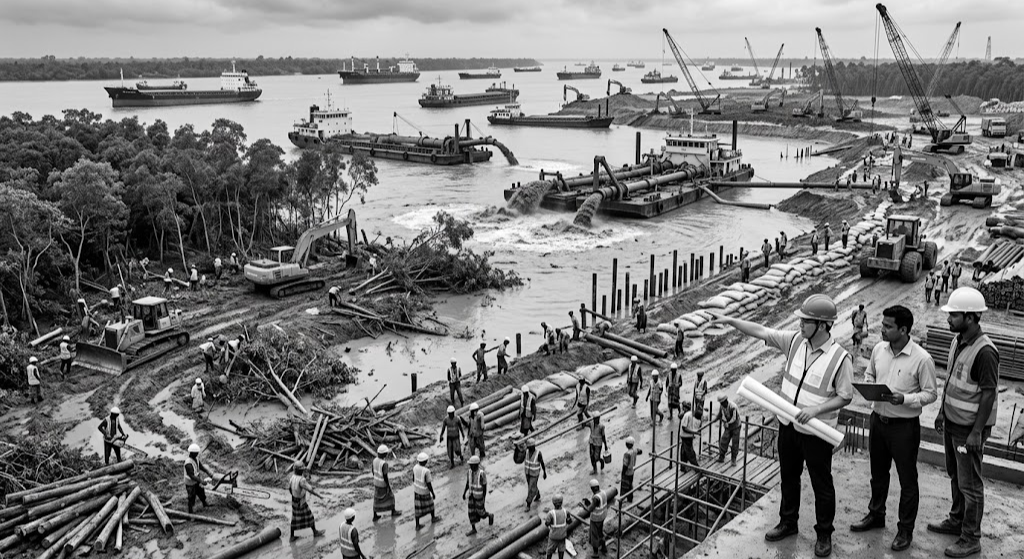
This is where Mongla faces its main test. The port operates in a riverine and siltation-prone environment. Without reliable dredging and channel maintenance, new terminal capacity will not automatically attract commercial shipping. Without strong road and rail links, cargo movement will remain constrained. Without efficient customs and professional port management, users will continue to prefer established routes.
Bangladesh should measure the project not by physical completion alone, but by vessel turnaround time, container dwell time, channel depth, annual throughput, customs clearance time, operating cost per container, private-sector usage and port revenue. Ceremonial completion is not economic success.
Governance will decide the outcome
The strongest response to the “debt trap” narrative is transparency. Bangladesh should disclose the procurement framework, contractor obligations, feasibility assumptions, implementation timetable, operating model and revenue projections. The public should know who builds the terminals, who supplies the machinery, who operates the facility and what guarantees apply.
Independent monitoring is equally important. The Economic Relations Division, Ministry of Finance, Ministry of Shipping and Mongla Port Authority should track cost escalation, timeline slippage, procurement variations and operational performance. If assumptions are weak, transparency will expose problems early.
Strategic value with conditions
The Mongla loan can be defended as a strategic decision, but only conditionally. It can diversify Bangladesh’s maritime access, reduce concentration risk, support the southwest economy and improve the country’s bargaining position among external partners. But strategy is not proved by signing a loan. It is proved by implementation.
Bangladesh should treat Mongla as a performance contract with its own future. If dredging, connectivity, procurement, customs reform and port management are delivered with discipline, this loan may look like prudent statecraft. If those conditions are missed, the project will not fail because China offered finance. It will fail because Bangladesh borrowed for strategy but executed like a routine public works project.
References
- Star Business Report, ‘Bangladesh signs $335.78m Chinese loan for Mongla port modernisation’, The Daily Star, 12 October 2026. https://www.thedailystar.net/business/news/bangladesh-signs-33578m-chinese-loan-mongla-port-modernisation-4297216.
- The Financial Express, ‘Govt plans big to modernise Mongla Port for making it regional hub’, 2 February 2025. https://thefinancialexpress.com.bd/trade/govt-plans-big-to-modernise-mongla-port-for-making-it-regional-hub.
- Reuters, ‘Bangladesh urges China to reduce trade gap, speed infrastructure delivery’, 26 June 2026. https://www.reuters.com/world/china/bangladesh-urges-china-reduce-trade-gap-2026-06-26/ .