
Professor Dr. Tanvir Fittin Abir
Daffodil University
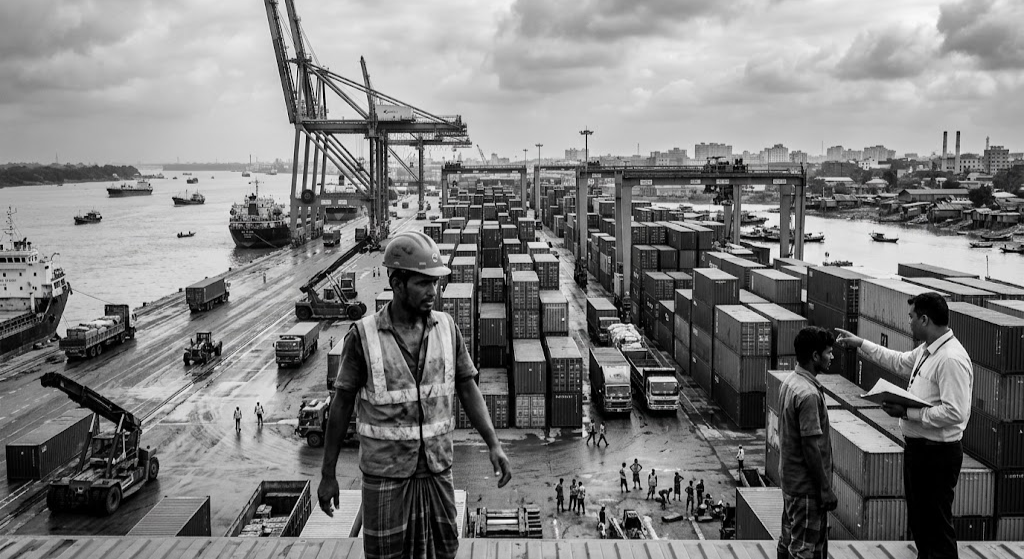
The signing of an agreement between Bangladesh and DP World to run the New Mooring Container Terminal in Chattogram may further enhance the trade competitiveness in the port. But foreign management cannot assure low logistics costs or boost local businesses. The economic issue is whether operational improvements trickle down to the exporters, importers, workers and consumers, instead of just sitting on terminal revenues.
The contract provides operating rights for 15 years under the agreement while it is owned by Chattogram Port Authority, according to Prothom Alo (2026). It is reported that about Tk600 crore investment has been made so far and over the next 10 years, over Tk1,000 crore will be invested in modernisation. Chattogram’s container volume is approx 44% through the New Mooring Container Terminal (NCT). These numbers clearly represent the importance of the agreement, but announced investment is not complete investment and benefits must be shown.
Logistics plays a vital role in Bangladesh due to its export-oriented structure. The Bangladesh Garment Manufacturers and Exporters Association (BGMEA) has compiled the figures of merchandise exports of the country for FY2025–26 in the amount of US$48.00 billion of which US$38.70 billion has been contributed by garments. Thus, the apparel sector generated 80.62% of the earnings on merchandise exports (BGMEA, n.d.). Economy is subject to disruptions of the imported production factors and shipped products. Repeatable delivery is as important as price, quality, and compliance to being competitive.
The greatest potential upside is a lower level of uncertainty. Smaller precautionary stocks would be achieved if factories could unload faster and achieve better scheduling and cargo tracking. Earlier delivery may help to speed up the payment process, free up working capital and cut down on emergency transport costs. These enhancements may be more significant to smaller companies that borrow less. These are potential economic outcomes of the accord, however, and not metrics.
What is the problem, as demonstrated by history? For leather footwear, the study by The World Bank estimated the domestic logistics cost at 4.5% of sale, while for horticulture it was estimated at 47.9% of sale. It also estimated the average container dwell times of four days for exports and eleven days for imports at Chattogram (Herrera Dappe et al., 2020). These older estimates cannot be given as up-to-date values. They show why logistics reform is important and the need for refreshed baseline data.
However, terminal efficiency only deals with part of the supply chain. After unloading, the cargo may be subject to further delays due to customs procedures, inspections, road congestion, transportation to and from ports and documentation. Slow clearance and unreliable truck access is no match for the modern crane. In this context, coordinated reform needs to be implemented throughout the trading process in Bangladesh. Otherwise, a great enhancement within NCT will yield minimal savings for business beyond its walls.
This is reflected in global evidence. According to the Maritime transport review 2024 by the United Nations Conference on Trade and Development (UNCTAD), over 80% of the volume of international trade in merchandise is carried by sea. It captures disruptions in the region of the Red Sea, Suez Canal and Panama Canal, leading to longer journey times and higher costs (UNCTAD, 2024). A better terminal can make Bangladesh more resilient against disruption but cannot reduce the volatility of shipping companies’ commercial decisions, geopolitical risk or international freight rate.
The monetary aspects of the agreement should be reviewed as well. According to a report in the business daily, Prothom Alo (2026), the port authority will be able to retain 67% of the specific container handling revenues. But it’s not a revenue share and it’s not a profit share; it’s not evidence of public value. Evaluation demands clarity on charges that are applicable and operating obligations, investment schedules, retained risks. Up-front payment is the instant income; affordable and reliable services must be useful during the concession.
There may be uneven impacts on local businesses. Boosted throughput and improved time predictability would be advantageous to exporters, importers, transport operators and warehouse operators. Subcontractors, however, may have to adhere to stricter procurement requirements and smaller traders may not be familiar with the digital systems. Authorities need to ensure that there are systems in place to ensure rapid onboarding, transparent procurement and equitable requirements for services. There needs to be a realistic chance of competition from domestic suppliers, but at the same time not to the detriment of the customer.
There is also an economic evaluation of the interests of the workers. Changes in operating practices and automation may impact on employment and skills and bargaining. A good response should be a realistic transition plan which will include training, workplace safety, consultation and grievance procedures. If not taken care of, these can cause disruptions and mistrust. The same is true with public ownership – monitoring of operational decisions, commercial information, continuity plans should be effective.
An evaluation should start before making operational changes, and that should be statistical in nature. Report on initial and quarterly vessel waiting times, container dwell times, truck turnaround, equipment availability, charges and complaints. Report medians and exceptionally long delays; averages can conceal serious delays. When assessing performance, volume and the type of cargo as well as customs changes should be taken into consideration. Improvements following takeover do not necessarily demonstrate that the operator brought about all improvements observed.
This relationship should be evaluated based on the tangible benefits and accountability measures that can be put in place in Bangladesh. While it is good to invest, it’s more important to be optimistic than to have an opinion, but it’s better to have proof. The critical question is whether the overall costs are reduced for business, delivery is more reliable and access is equitable, but workers and the public still have effective protection. A concession ought not to be a mere change of management of one of these important terminals, but it should bring about improvements in the trading system.
References
Bangladesh Garment Manufacturers and Exporters Association. (n.d.). Export performance. Retrieved October 12, 2026, from https://www.bgmea.com.bd/page/Export_Performance
Herrera Dappe, M., Kunaka, C., Lebrand, M., & Weisskopf, N. (2020). Moving forward: Connectivity and logistics to sustain Bangladesh’s success. World Bank. https://doi.org/10.1596/978-1-4648-1507-2
Prothom Alo. (2026, October 8). 15 bochhor New Mooring Terminal porichalona korbe Dubaiyer DP World, chukti soi [Dubai’s DP World to operate New Mooring Terminal for 15 years; agreement signed]. https://www.prothomalo.com/business/xkter5hxpt
United Nations Conference on Trade and Development. (2024). Review of maritime transport 2024: Navigating maritime chokepoints. United Nations. https://unctad.org/publication/review-maritime-transport-2024