
Vivek Chauhan
Columbia University, USA
At the UN General Assembly’s 81st session this month, Bangladesh’s Prime Minister delivered his first address as head of government, a milestone overshadowed by an absence rather than a presence. A planned visit to India, long expected after his party’s landslide return to power, never materialised throughout the year. Talks have reportedly resumed for November, though no date is confirmed. Behind the delay lies a single unresolved question: the fate of exiled former Prime Minister Sheikh Hasina, whose extradition to Dhaka has quietly made a precondition for warmer ties. This article examines India’s perspective on that standoff, and the economic costs both nations bear the longer it persists. [1]
Delhi’s Dilemma
India’s position, however, is not without logic, even if its conclusion remains difficult to defend. Delhi’s reluctance traces first to loyalty: the Awami League, under Hasina, maintained a long and cooperative alignment with New Delhi, one reinforced by personal history, Hasina found refuge in India after her family’s 1975 assassination, a debt of sorts that has shaped her relationship with Delhi since [2]. That loyalty was not sentimental alone. India benefited strategically from Hasina’s rule, smoother border security, counter-terrorism cooperation in the northeast, and a reliably aligned neighbour at a time of rising anti-India sentiment elsewhere in the region [3]. These two pressures, personal and strategic, converge in India’s legal posture: officials frame Hasina’s charges as politically motivated, invoking Articles 6 and 7 of the India-Bangladesh Extradition Treaty, covering political vindictiveness and the interests of justice, as grounds for refusal [4].
The Cost of Waiting – Dhaka
Let us look at Bangladesh’s economics for a bit. The numbers make the Prime Minister’s target harder to believe. Bangladesh’s economy, worth roughly $451 billion, has seen its growth slow down. The IMF now expects just 3.5 percent growth for FY2026-27, and says growth could stay under 3 percent for the next few years because of fiscal strain and problems in the banking sector. To reach the Prime Minister’s trillion-dollar target by 2034, the economy needs close to 10 percent growth every year in dollar terms. That is a big ask, especially when the country hasn’t managed anything close to that pace in years. Making things harder, Bangladesh is set to graduate from Least Developed Country status this November, which means losing preferential trade access right when growth is slowing and investors are already cautious. [5, 1]
None of this makes the target impossible, but it does make it unrealistic given the current situation. What could actually help is not just domestic reform, it is fixing the relationship with India. Investors see regional tension as a risk, and the unresolved extradition issue with Bangladesh’s biggest neighbour adds to that risk, making it more expensive for Bangladesh to borrow and attract investment at the exact time it can least afford that. Resolving ties with Delhi would not get Bangladesh to a trillion dollars by 2034 on its own. But it would close part of the gap between the government’s ambition and where the economy is actually headed, a gap that only grows the longer the two countries stay apart.
The Cost of Comfort – Delhi
Now let us turn to the economics of India. In pure numbers, the standoff barely registers for India. Bangladesh’s entire trade with India, somewhere between $10-13 billion depending on the year, is less than one percent of India’s total trade, which crossed $1.74 trillion in FY2024-25 [6]. India’s foreign direct investment in Bangladesh, at roughly $87-105 million, is similarly tiny next to India’s overall economy. In that narrow sense, India can afford to wait. The court belongs to India economically, and Delhi knows it.
But the numbers hide something important: Bangladesh’s trade with India hasn’t collapsed, it has just stopped growing while everything else around it grew. In fact, India slipped to third place among Bangladesh’s trading partners in 2026, the first time this has happened in sixteen years, overtaken by both China and now the United States. This is not because India’s trade disappeared, it is because Bangladesh found it could survive, and even benefit, by leaning elsewhere, consumer boycotts of Indian goods, China’s aggressive pricing, India withdrawing transshipment access through Kolkata after Bangladesh restricted Indian yarn imports. This shift is effective for Bangladesh in the short run, but I don’t think it is efficient in the long run, depending more heavily on China while a reliable, geographically close partner like India sits unused is not a sound long-term strategy for either side. [5]
My own view is that India is losing something the trade numbers cannot capture, trust, and standing with a neighbour that matters far more strategically than it does economically. Bangladesh is not just another trading partner, it is a country that shares a border, a river system, and decades of security cooperation with India, evidence forged particularly under Sheikh Hasina’s government. If India continues to shield her at the cost of that relationship, it risks pushing Bangladesh further into China’s orbit, exactly the outcome India has spent decades trying to avoid in the region. I believe the relationship with Bangladesh is worth more than the political cost of letting Hasina face trial. Protecting one ally today may come at the price of losing a far more important one tomorrow.
The Uncanny Uncertainty
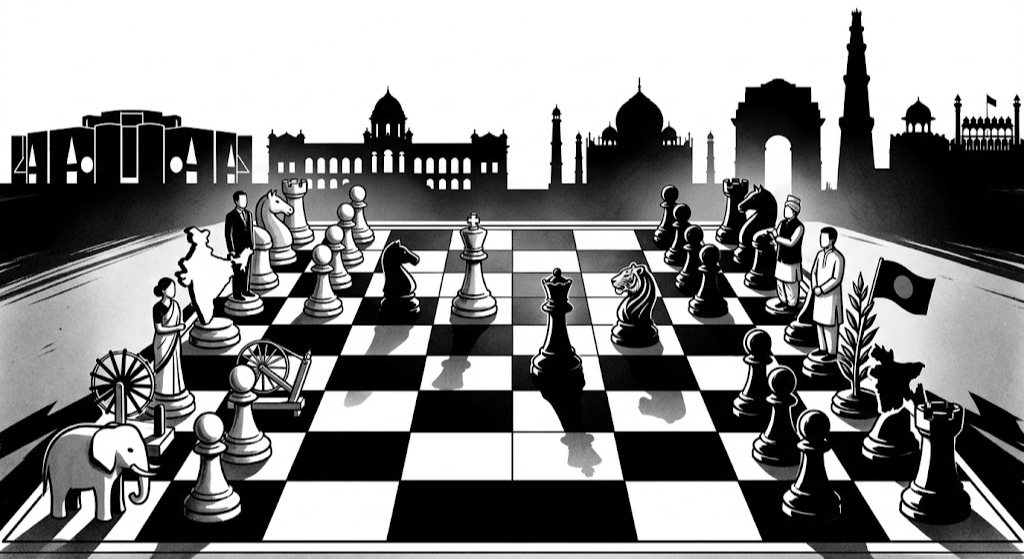
Put together, the picture is uneven but not frozen. In my opinion, India’s caution here is shortsighted, the relationship with Bangladesh is worth more than protecting one person. Right now, India is in a comfortable spot, it has the trade numbers on its side, so there’s no real urgency for it to move first. But this comfort will not last forever. Every month this drags on pushes Bangladesh closer to China and quietly wears down years of goodwill between the two countries. Both sides are bleeding because of this, but Bangladeshi much more so, its growth is slowing, investors are cautious, and the trillion-dollar goal keeps slipping further away. India’s losses are smaller, but they are still there, less trade, less influence in its own neighbourhood. At some point, someone has to move first on this chessboard. For now, neither side wants to show its hand first, and the region is once again left waiting for an answer that keeps almost arriving.
References
1. Between New York and New Delhi, Bangladesh Waits for Its Own Answers. Selim, . s.l. : The Oniket Bulletin, 2026. https://bulletin.oniket.org/chief_editor/between-new-york-and-new-delhi-bangladesh-waits-for-its-own-answers/.
2. Why India likely won’t return Hasina to face Bangladesh death penalty. Sharma, . s.l. : Al Jazeera, 2025. https://www.aljazeera.com/features/2025/11/18/why-india-likely-wont-return-hasina-to-face-bangladesh-death-penalty.
3. Why India Welcomes Sheikh Hasina’s Return to Power in Bangladesh. Pasricha, . s.l. : VOANews, 2024. https://www.voanews.com/a/why-india-welcomes-sheikh-hasina-s-return-to-power-in-bangladesh/7434039.html.
4. Treaty Between The Republic of India & People’s Republic of Bangladesh Relating to Extradition. Dhaka : s.n., 2013. https://www.mea.gov.in/Portal/LegalTreatiesDoc/BG13B1143.pdf.
5. US Becomes Bangladesh’s Second-Biggest Trading Partner, Pushing India To Third. Brij,. s.l. : Swarajyamag, 2026. https://swarajyamag.com/news-brief/us-becomes-bangladeshs-second-biggest-trading-partner-pushing-india-to-third.
6. The World Bank Group. World Bank Open Data. [Online] https://data.worldbank.org.



