
Asad Shafik
DTech Bangladesh
This article assesses the current state of telecommunication infrastructure in Bangladesh, identifies the main gaps in its physical and technological foundations, and recommends the essential steps the telecommunications ministry should take to close them.
Bangladesh has one of South Asia’s largest mobile markets. At the end of June 2026 it had about 189.8 million active mobile subscriptions, exceeding its population of roughly 170 million because many people hold multiple SIMs. Mobile networks carry about 120.8 million of the 135.9 million internet subscriptions. Grameenphone, Robi Axiata, Banglalink and state owned Teletalk share the market, with Grameenphone leading at about 86.6 million subscribers (Financial Express, 2026). Services such as bKash and Nagad give millions of unbanked people access to financial services, showing how connectivity drives economic participation.
Coverage looks strong, but quality lags. Broadband speeds trail regional peers, and users report drop calls, urban congestion and weak indoor signals. Bridging subscriber numbers and service quality is the sector’s central challenge.
Gaps in Physical Infrastructure
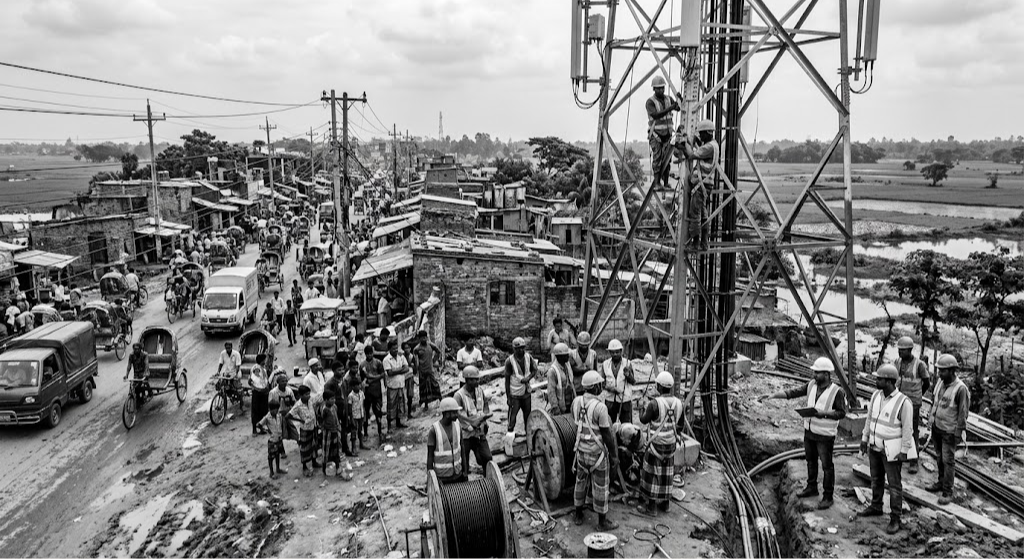
Fiber is the backbone of any network, and Bangladesh falls well short here. Cables reach district headquarters and many upazilas, but connections to unions, villages and individual buildings remain sparse. Outside major cities, many mobile towers still depend on microwave links or outdated backhaul, which restricts capacity and makes 4G performance inconsistent.
Power supply is another weakness. Frequent load shedding and an unstable grid push towers onto batteries and diesel generators, which raises costs and triggers outages. In Dhaka and Chattogram, overhead cables hang in dense, tangled bundles, and theft, accidental cuts and road works regularly interrupt service. Underground ducts exist along only a few corridors.
International connectivity lacks diversity too. The country depends on a handful of submarine cable systems landing at Cox’s Bazar, along with terrestrial links through neighboring countries. One cable fault or political disruption can slow the whole national network. Redundancy has improved, but not enough to support a digital economy aiming to host data centers and export digital services.
Gaps in Technology
Bangladesh trails in the transition to next generation networks. 5G has been trialed, but commercial deployment remains limited, while the 4G layer that most users rely on is operating near capacity. Spectrum allocation is thin relative to the subscriber base, so operators cannot sustain consistent throughput during peak load.
Fixed broadband suffers from fragmentation. Thousands of small ISPs deliver uneven quality, and fiber to the home (FTTH) is far from ubiquitous. IPv6 adoption, local content hosting and internet exchange point (IXP) capacity remain modest, so much traffic is still routed abroad and back, adding latency and transit costs.
Network security and resilience are also gaps. The 2024 internet shutdowns showed how dependent the economy is on uninterrupted connectivity, from freelancers to small businesses, and how little protection users have when access is cut. Network monitoring, complaint handling and quality benchmarking remain underdeveloped.
Policy also shapes infrastructure investment. Operators carry a heavy combined burden of license fees, revenue sharing, spectrum charges, supplementary duties and import taxes on equipment, which squeezes capital available for towers and fiber. The licensing structure, which separates nationwide transmission providers from operators, creates overlapping responsibilities and slows deployment. Unresolved disputes between operators and the regulator delay investment decisions further.
Essential Steps for the Ministry
The ministry’s first task is to publish a national broadband and spectrum roadmap with fixed timelines, giving operators predictable access to mid band frequencies so they can expand 4G capacity and launch 5G responsibly. That certainty will only translate into investment if the financial burden eases, so rationalizing taxes and fees matters just as much. Lower import duties on network equipment and a lighter combined revenue and spectrum charge would free capital for rural coverage, while a modest universal service contribution could target unserved areas.
Capital then needs somewhere to go, and that means pushing fiber deeper. By coordinating with local government, road agencies and power utilities, the ministry can build shared underground ducts, mandate infrastructure sharing and enforce one dig policies, cutting costs and untangling city cables. Resilience follows naturally: new submarine cable capacity, additional terrestrial routes, data centers, local internet exchanges and priority power for towers would protect the network from single points of failure.
Stronger infrastructure also needs cleaner rules. Consolidating overlapping licenses, enforcing public quality of service standards and limiting shutdowns to narrow legal circumstances would build trust. Finally, targeted programs and skills training can close the gender and rural gaps, turning connectivity into real economic benefit.
Conclusion
Bangladesh has achieved scale, but scale is different from quality. Closing the gaps in fiber, power, spectrum and regulation will decide whether the country’s connectivity can support its ambitions in digital finance, services and manufacturing. With coherent policy and sustained investment, the telecommunications ministry can move the sector from broad coverage to dependable, high-quality service for every citizen.
Reference
Bangladesh Telecommunication Regulatory Commission (BTRC) subscriber data for June 2026, as reported in “Internet subscriber growth outpaces mobile connections in H1,” The Financial Express (Bangladesh), 2026. https://thefinancialexpress.com.bd/trade/internet-subscriber-growth-outpaces-mobile-connections-in-h1



