
Dipti Rani Saha
Jagannath University
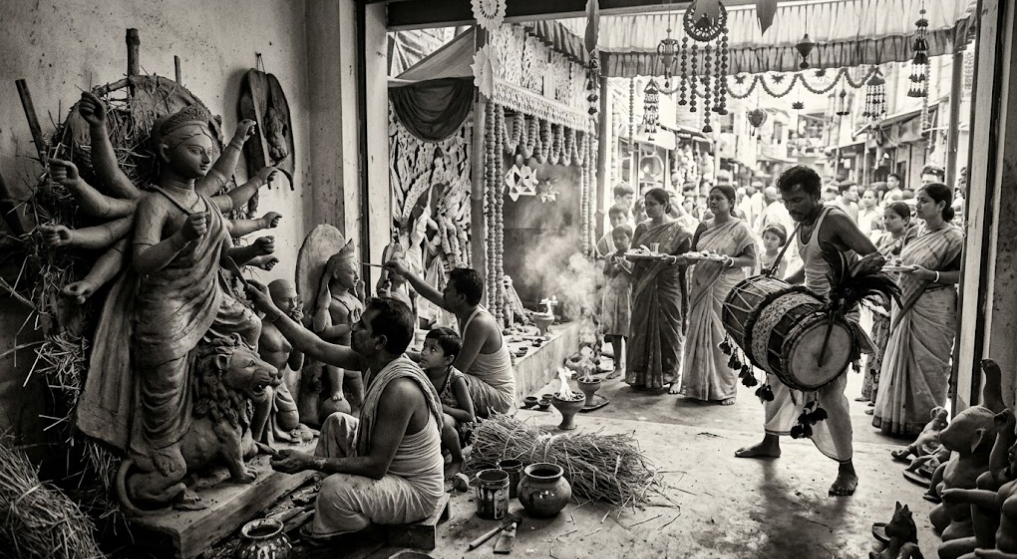
Each autumn, well before the first drum sounds, the celebration quietly begins in the dusty lanes of the potters. In Shankhari Bazar, in old Dhaka, I have watched artisans spread river clay across frames of bamboo and straw, running the flat of a thumb along a cheek until the face seems to draw breath.
The ten arms are formed one at a time, each poised to carry its weapon, and in the damp light of the workshop she is neither goddess nor statue, only a promise of what she will become. Bangladesh’s festival truly starts here, in craft rather than ritual, and it is this beginning that moves an artist most.
The Palette of the Delta
Bangladesh’s pandals are built from the materials of the land itself. Walls and canopies are made of jute, bamboo, terracotta, and handwoven cloth, stitched with the looping patterns of nakshi kantha. Courtyard floors are painted with white rice-paste alpona, and shola pith ornaments gleam like frozen blossoms. Marigold orange, vermilion, and banana-leaf green stand out against the grey monsoon sky that lingers into October. The idols have the soft, rounded features of Bengal’s folk tradition, not the polished look of stage production.
At Dhakeshwari Temple, the evening aarti becomes a living painting. Dhak drums build to a roar, conch shells call across the courtyard, and dhunuchi smoke curls upward through the lamplight like slow calligraphy. I have sketched this scene many times without ever capturing it, because what it is really about is hundreds of strangers breathing in rhythm.
Harmony in Shared Space
What I treasure most is who stands inside the frame. A canvas is only as rich as the hands that fill it, and in neighborhood after neighborhood, those hands belong to many faiths. Muslim friends and neighbors string the lights, carry the bamboo, and keep watch over the pandal through the night, so the structure rising in the lane is built by the whole community. Once the idols are in place, children of every faith run between the stalls in new clothes, and visitors of all backgrounds are handed a plate of bhog khichuri, the offering that turns a stranger into a guest. The public holiday on Dashami gives the festival a place in the national calendar, making it part of the country’s shared life.
An honest artist cannot paint only bright colors. Shadows give a picture its depth, and in past years pandals were damaged and families attacked. No gallery of beautiful images can hide that. Yet those shadows are what make the harmony of the puja so precious. It is not inherited like a landscape. It is renewed each year by ordinary people who choose to stand watch together. The neighbor guarding the pandal at midnight is as much an artist as the sculptor. Peace, like clay, must be shaped by many hands, and it holds only as long as they keep working.
Beside Our Neighbors
Across the border in Kolkata, Durga Puja has grown into a monumental spectacle. Theme pandals rise like stage sets, designers compete to astonish, and lit avenues draw millions through the night. Its recognition by UNESCO as intangible cultural heritage acknowledged a genuine artistic tradition. Yet that grandeur can tilt toward competition and sponsorship, with the crowd becoming audience rather than participant.
Bangladesh offers a quieter counterpoint. Its celebration is smaller in scale, closer to the hearth than the stage, and often owned by the neighborhood rather than a corporate patron. What it lacks in towering architecture it gains in intimacy, since a visitor can stand a few paces from the artisan, the priest, and the drummer.
In Nepal, the same goddess is honored through Dashain, a fortnight woven into family life. Elders place tika of rice, curd, and vermilion on the foreheads of the young, barley shoots sprout in household shrines, and kites and bamboo swings fill the sky and the village green. There the festival is the majority’s national rhythm. In Bangladesh, a minority’s festival is embraced by a majority that did not inherit it, and that generosity gives the celebration a distinct moral color.
The River Takes Her Back
On the final day, the idols are carried to the water. At dusk on the Buriganga, drums grow frantic, vermilion is smeared on faces in the sindur khela, and the goddess is lowered into the current. The clay that took weeks to shape dissolves into the river that gave it. As an artist, I find this the most profound act of all, because it teaches that beauty need not be kept being real.
Then come the embraces of Bijoya, the sweets pressed into hands, and the lanes slowly emptying. What remains is the memory of color and the hope that next year the lamps will burn without fear. In that hope, Bangladesh’s Durga Puja shows that a great canvas needs many hands, many faiths, and one shared sky.