
Sheikh Selim
Oniket Research Group
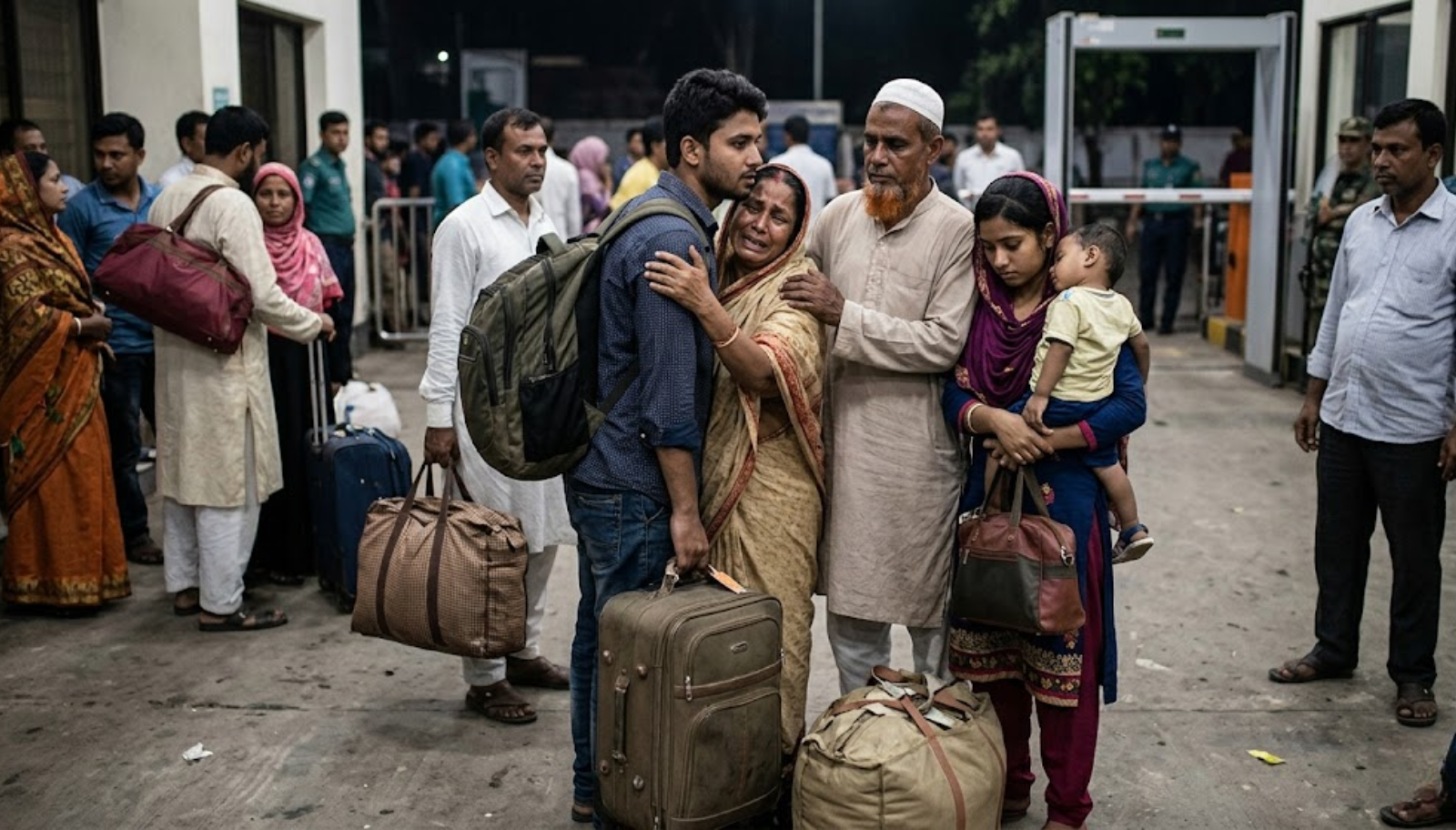
Annually, a significant number of Bangladeshis, numbering in hundreds of thousands, depart from their country to engage in labor abroad. The aggregate remittance figure, which exceeded thirty billion US dollars in the 2025 financial year, is frequently presented as evidence of migration’s economic success.
Politicians celebrate it. Economists frequently cite it in their research. The development reports have been favorable in their appraisal of the project. The significance of this headline figure lies in its systematic concealment of the profound and often irreversible costs that migration exacts from individuals, families, communities, and national economies prior to the repatriation of initial remittances.
Any practitioner who works closely with migration policy and labour economics will find the narrative not merely incomplete but, in certain respects, dangerously misleading.
The Debt Economy of Departure
For many Bangladeshi migrant workers, the journey abroad is not initiated solely by hope. The phenomenon under scrutiny commences with the accumulation of debt. Research by OKUP, corroborated by multiple field studies, has confirmed that approximately 76 percent of Bangladeshi migrant workers take out loans to finance their migration. In Bangladesh, recruitment fees are among the highest in South Asia. This phenomenon is driven by a chain of intermediaries, dalals, sub-agents, and licensed recruiting agencies. Each of these entities extract margins at every stage of the process.
A worker travelling to a Gulf destination may pay anywhere between three and six times the legal fee ceiling, borrowing from money lenders at punishing interest rates, mortgaging land, or pledging family assets. This debt structure means that a significant portion of the first year, sometimes the first two years, of a migrant worker’s earnings abroad is consumed entirely by debt repayment.
The net household gain during that period is negligible or negative. The worker has borne the full personal cost of migration, including physical separation, psychological toll, and occupational hazards. Concurrently, the financial return remains deferred and diminished by the compound interest that has accumulated in the home country.
The Remittance Transfer Trap
When workers begin to remit funds to their countries of origin, a secondary phase of cost extraction emerges. In 2024, Bangladesh’s remittance transfer costs reached 9.4 percent, which is notably higher than the global average of 6.5 percent and the South Asian regional range of 2.8 percent to 5.1 percent. This phenomenon cannot be considered a marginal inefficiency. In 2024 alone, Bangladeshi migrants overpaid an estimated 1.3 billion US dollars in excess remittance fees compared to regional benchmarks.
Over the three-year period from 2022 to 2024, the accumulated excess cost totalled approximately 2.3 billion dollars. These are not abstract numbers. These funds represent unpaid school fees, deferred medical treatments, and capital that was never invested, all of which are extracted from the earnings of workers who already bear the greatest personal costs of the migration system.
The Investment Illusion in Residency and Citizenship Purchases
At the upper end of the migration economy is a category of departure that is described, almost universally, with the language of investment. Affluent Bangladeshis who purchase residency or citizenship in countries through so-called golden visa programs, whether in the UAE, Portugal, Canada, the United Kingdom, or elsewhere, are characterized in domestic discourse as investors, as globally mobile citizens making strategic financial decisions. The minimum thresholds for such programs are typically in the range of several hundred thousand to over one million US dollars.
This framing requires direct challenge. Buying residency abroad is not an investment in any economically meaningful sense. The acquisition of legal status is a pivotal factor that enables the permanent or semi-permanent relocation of capital and human talent out of Bangladesh. The capital allocated to the golden visa program does not result in an augmentation of the Bangladeshi economy’s productive capacity. The project has not resulted in the creation of employment opportunities in Dhaka or Chattogram. The fund does not provide financial support for research, manufacturing, or agricultural development initiatives. It represents a simultaneous loss of capital and skilled human resources, the precise combination that a developing economy can least afford to export.
What compounds the misinterpretation is that the same policy framework that restricts ordinary workers from moving freely treats wealthy capital outflows under the guise of investment with regulatory deference. Bangladesh’s national economic interest is not served by a migration regime that extracts the maximum from its poorest workers while providing exit ladders to its wealthiest households under a terminology that obscures what is occurring.
An Honest Accounting
A comprehensive and sincere examination of the financial implications of migration necessitates a fundamental shift in the discourse within Bangladesh. The practice of remittances, however, does not constitute a viable development strategy in and of itself. These measures, taken collectively, are indicative of the extent of domestic economic underperformance rather than the success of a deliberate policy.
The billions of dollars in capital inflows that are received mask the billions of dollars in capital outflows that are lost due to various financial activities, including but not limited to recruitment fraud, debt servicing, exploitative transfer fees, and the permanent departure of skilled and capital-endowed citizens through residency purchase programs.
The true cost of migration from Bangladesh is not solely quantifiable in financial terms. It is also evident in the loss of the productive years of a generation of workers, whose potential was leased to foreign economies at below-market rates. This phenomenon is characterized by debt, separation, and the pervasive yet subtle notion that departure is synonymous with opportunity.
These elements are frequently concealed or overlooked. The cost of migration is the degradation of ethics and principles of the family of the migrant. Many such families exploit and enjoy the hard-earned remittance of the isolated family member. These families are seldom incentivized to cover the actual cost or to contribute to the Bangladesh economy. For many younger members of such families, the readily available remittance functions as a significant disincentive to engage in the process of contributing to the remitting member.
The social cost of this exploitation is often underestimated or understated by the remitting member. Bangladesh must cease to tolerate such overwhelming levels of ethical degradation. Furthermore, it is a matter of time when Bangladesh will realize that grasses are no longer green on the other side. They are turning grey as Bangladesh is moving up the ladder of local income.




Comments on “The Price of Leaving: Counting the True Cost of Migration from Bangladesh”