
Naima Onamika
Oniket Research Group
On 22 May 2026, Prothom Alo published a report titled “Digital Accessibility in Bangladesh: An Essential Condition for an Inclusive Future.”
The report emphasizes that all people in the country, including people with disabilities, should be included in digital accessibility initiatives, enjoy equal access to digital services in every sphere of life, and have this access recognized as a fundamental right. At the same time, it discusses the various complexities, shortcomings, and challenges that hinder the implementation of such policies.
The report is highly significant and informative, presenting a clear picture of the realities, limitations, and challenges of digital accessibility in Bangladesh. While reading it, I developed several observations and perspectives that I would like to discuss in greater detail.
To begin with, I would like to review the report’s central themes. It highlights the rapid expansion of digital services in Bangladesh as a major development achievement. However, despite this progress, the usability of digital services for people with disabilities, senior citizens, and people facing technological limitations remains questionable. Bhaskar Bhattacharya’s article brings this reality to the forefront and calls for digital accessibility to be recognized as a fundamental component of citizens’ rights. At the same time, he analyzes the issue from multiple angles and identifies several important limitations and practical challenges.
Based on my own observations, I would first like to explain the current situation and the challenges associated with implementation.
First: The Contradiction Between Digital Development Narratives and Reality
Although the promotion of “Smart Bangladesh” and digital transformation is widespread, the reality is that most digital services are still not inclusive. Many government websites and applications have not been developed in accordance with international accessibility standards. As a result, despite technological advancements, a significant portion of the population remains effectively excluded from digital services.
Second: Persistent Digital Inequality for Persons with Disabilities
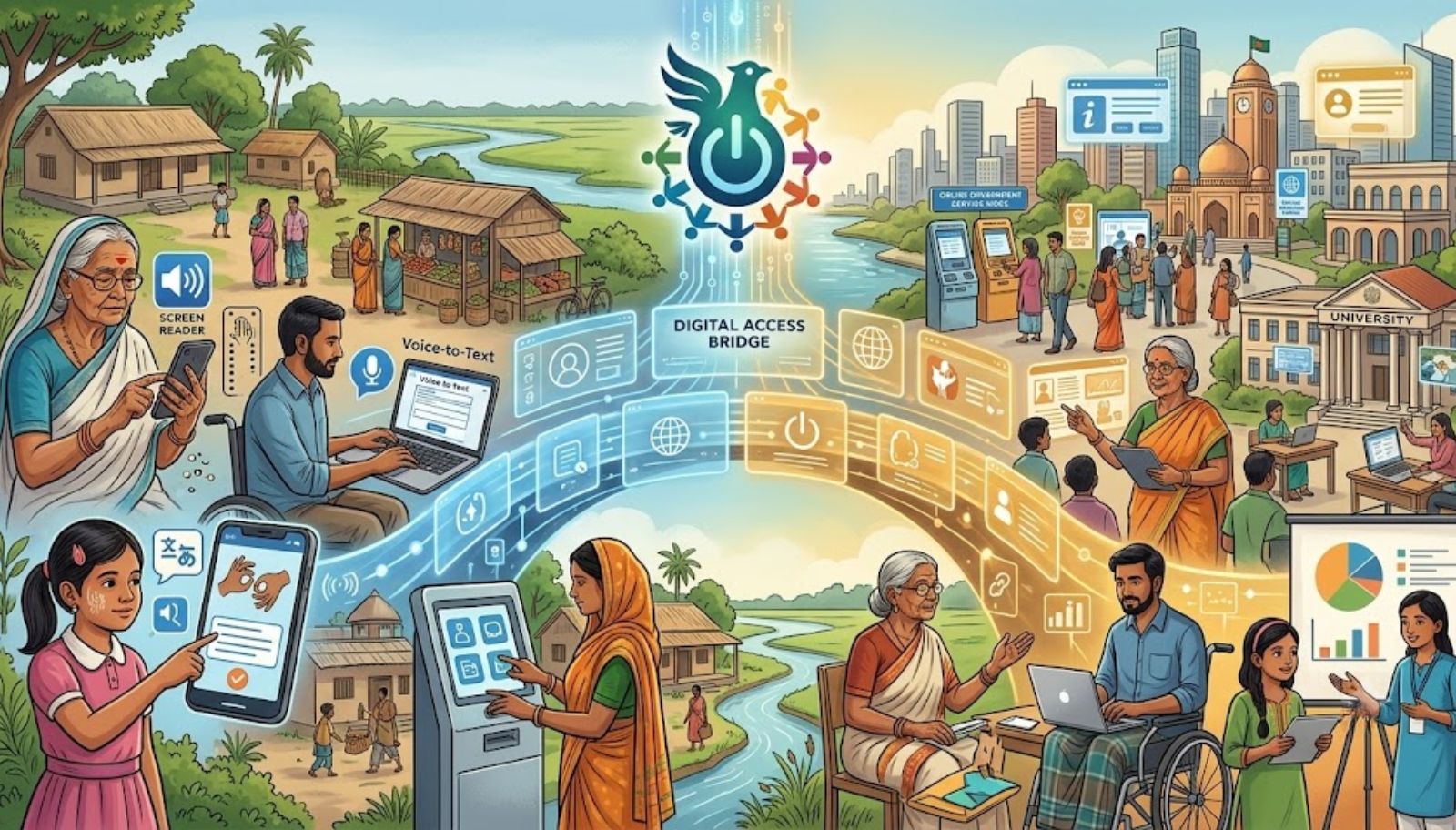
In many cases, people with disabilities continue to face digital discrimination. People with visual impairments often cannot effectively navigate websites using screen readers. Online forms, buttons, and navigation systems frequently fail to function properly, limiting their ability to access services independently. Likewise, individuals with hearing impairments often encounter unequal access to information because videos lack captions or sign language interpretation. Consequently, digital platforms are, in many instances, creating new forms of social barriers for people with disabilities.
Third: Weaknesses in Bengali Language-Based Technology
Inconsistencies in the use of Bengali Unicode and fonts reduce the effectiveness of screen readers. As a result, Bengali-language content on many websites does not meet acceptable technical standards. This highlights a significant gap in the development of inclusive technologies based on the Bengali language.
Fourth: Policies Exist, but Implementation Remains Weak
Although Bangladesh has laws protecting the rights of persons with disabilities, their effective implementation remains limited. Furthermore, the mandatory monitoring and evaluation mechanisms necessary for digital accessibility are still weak at the institutional level. A lack of awareness within government institutions also remains a major challenge.
Fifth: “Accessibility by Design” Is Still Largely Absent
Most institutions do not consider digital accessibility as an integral part of the design process. Instead, they attempt to introduce limited modifications after services have already been launched. Such measures are often neither comprehensive nor sustainable. As a result, many digital platforms are built upon inherently exclusionary structures from the outset.
Sixth: Limited Participation of Persons with Disabilities
Although the principle of “Nothing About Us Without Us” is frequently discussed, persons with disabilities remain minimally involved in technology development processes. Their experiences and opinions are not given sufficient importance in policy-making and technological innovation. Consequently, the actual needs of users are often overlooked.
Seventh: Bangladesh Lags Behind International Progress
In Europe and the United States, digital accessibility is a legal obligation. In Bangladesh, however, the issue largely remains at the policy discussion stage. Although international development partners emphasize inclusive technology, local implementation continues to progress slowly.
Despite these challenges and complexities, I remain highly optimistic about the future of digital accessibility in Bangladesh. There are several encouraging developments:
Initiatives such as a2i are helping to raise awareness about digital inclusion.
Discussions on accessibility are increasing at the government level.
Observances such as Global Accessibility Awareness Day (GAAD) are bringing greater public attention to the issue.
Naturally, the question arises: what steps can the government take to address the current situation?
Mandatory accessibility policies should be introduced for all government websites and applications.
Compliance with the WCAG (Web Content Accessibility Guidelines) should be ensured.
Bengali screen readers and Unicode-based technologies should be further developed and improved.
Training for government officials and software developers should be made mandatory and expanded.
People with disabilities should be directly involved in policy-making processes and technology testing.
Regular monitoring, evaluation, and accountability mechanisms should be established.
Conclusion
Bangladesh’s digital transformation will only be truly meaningful when technology is equally accessible and usable for every member of society. Although digital services continue to expand, significant shortcomings remain in creating an inclusive digital environment. Therefore, digital accessibility should not be viewed as an additional benefit or optional feature, but rather as a fundamental civic right. Otherwise, technological advancement will continue to create new forms of inequality, and the vision of a ‘Smart Bangladesh’ will remain limited to only a portion of the population.

