
Ali Asad Sabir
The World Bank
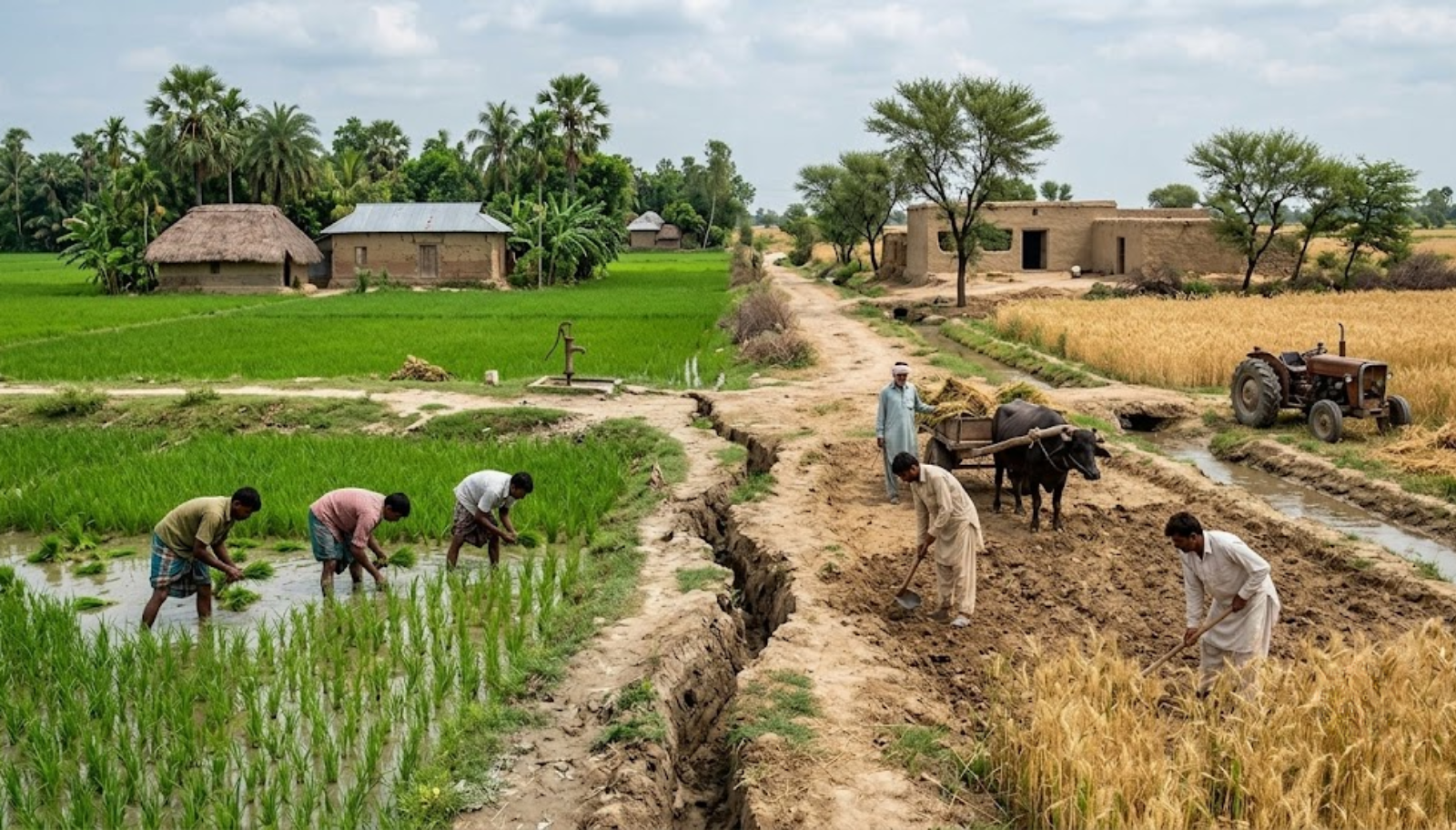
Bangladesh cut its rural poverty rate faster than almost any country in the region. Pakistan cut its poverty rate too, then watched much of that progress unwind. The two stories look opposite but they are not. This article argues that both countries grew rural incomes the same way: by pulling more people into work, not by making that work more productive. That is why Bangladesh’s gains are now stalling, and this is why Pakistan’s rural economy has stayed poor for so much longer. The lesson for both is the same, and it starts with land.
Bangladesh: Real Gains, Now Slipping
According to the World Bank’s Bangladesh Poverty and Equity Assessment report published in 2025, Bangladesh lifted 34 million people out of poverty between 2010 and 2022. Extreme poverty fell from 12.2 percent to 5.6 percent over the same period. Much of this came from rural areas, where non-farm work grew from 30 percent of rural employment in 1991 to 62 percent by 2019, the same report finds. Farmers left the field for shops, transport, and small trade.
That progress has since slowed. The same assessment notes that after 2016, growth became less inclusive, and around 62 million people, about one-third of the population, remain vulnerable to falling back into poverty from a single shock. Bangladesh grew jobs. It has not grown productivity fast enough to keep the gains secure.
Pakistan: A Longer, Harder Road
According to the World Bank’s Reclaiming Momentum Towards Prosperity: Pakistan’s Poverty, Equity and Resilience Assessment published in 2025, Pakistan’s poverty rate fell from 64.3 percent in 2001–02 to 21.9 percent in 2018–19, mostly by moving rural workers into informal urban jobs in transport and construction. But this progress ran on a narrower base than Bangladesh’s, and it came apart faster.
The same report finds poverty climbed back to 25.3 percent by 2023–24, driven by COVID-19, the 2022 floods, and high inflation, and states plainly that the consumption-driven growth model behind the earlier gains has reached its limits. Rural poverty now stands at roughly 36 percent, more than double the urban rate, and over 85 percent of jobs remain informal.
The Shared Fault Line
Strip away the different histories, and the mechanism is the same. Bangladesh diversified rural work while Pakistan urbanized it. Neither of the countries shifted labour into higher-productivity work fast enough to make the gains stick. And it results in inequality is rising in both. The Bangladesh assessment cited above finds income growth since 2016 has favoured wealthier households. The Pakistan assessment finds the Gini coefficient rose from 28.4 to 32.7 in recent years. Two different roads are leading to the same place: a rural economy that absorbs people without paying them much more for their labour.
What Productivity-Led Growth Looks Like
Vietnam offers a useful contrast. In the late 1980s, the government ended collective farming and returned land-use rights to individual households, a reform economists Prabhu Pingali and Vo-Tong Xuan credit with driving Vietnam’s subsequent rice productivity growth. Farmers then diversified into coffee, cashews, and other export crops, and Agro-processing grew alongside them. According to a World Bank agricultural transformation report published in 2022, this shift helped bring rural poverty down to under 6 percent. Vietnam did not just create rural jobs. It made rural work worth more.
The Policy Ask: Productivity, and the Land Records Under It
Bangladesh and Pakistan both need a rural strategy built around productivity, not just employment: agro-processing, value chains, and formal non-farm work that pays more than subsistence farming ever could.
But productivity-led investment needs one thing underneath it: clear, transparent land records. A farmer cannot easily borrow against land a bank cannot verify he owns. Rwanda’s national land titling program shows both the promise and the limit here. A World Bank study by Ali, Deininger, and Goldstein (2011) found the program drove a significant rise in land-related investment, especially among women and previously insecure landholders.
But a later review of the evidence across Rwanda and Ethiopia found the link to credit access much weaker: titling alone did not reliably unlock lending, and gains depended on complementary financial-sector reforms and functioning registries. The lesson is not that land records solve everything. It is that without them, nothing else has a foundation to stand on.
For Pakistan, this is not a hypothetical. In the mid-2010s, the Punjab province rolled out its Land Records Management and Information System (LRMIS), a World Bank-financed project that digitized rural land records across all 36 districts and cut the time to complete a land transaction from roughly two months to under an hour. Punjab is now building on that base through the Punjab Urban Land Systems Enhancement Project (PULSE), which extends digital records and cadastral mapping into urban and peri-urban areas and builds an integrated land and geospatial information system for the province.
Punjab moved first and fastest, but other provinces are following the same path at their own pace. That order is not a coincidence. Land records came first because everything else, credit, processing, value chains, needs them to stand on.
Bangladesh has tried the same fix but on a rockier path. A government land-digitization project launched in 2018 had, by 2022, spent less than 1 percent of its allocated budget and missed its original deadline, according to Bangladeshi reporting on the project. A newer, more targeted effort, the Land Data Digitalization for Inclusive Growth initiative, backed by the UNDP, only reached its first large-scale pilot district in August 2025.
Despite outpacing Pakistan on rural diversification and poverty reduction, Bangladesh has lagged behind on this specific, unglamorous piece of institutional plumbing. Productivity-enabling reform does not automatically follow from a stronger growth story. It has to be built on its own.
Bangladesh and Pakistan are not opposite stories. They are the same story, told at different speeds. Both grew rural employment but neither grew rural productivity enough to make that growth last. Fixing that starts with something unglamorous which is making sure that the landowner can prove ownership of the land.