
Saraswathi Srinivasan
University of Birmingham, Dubai
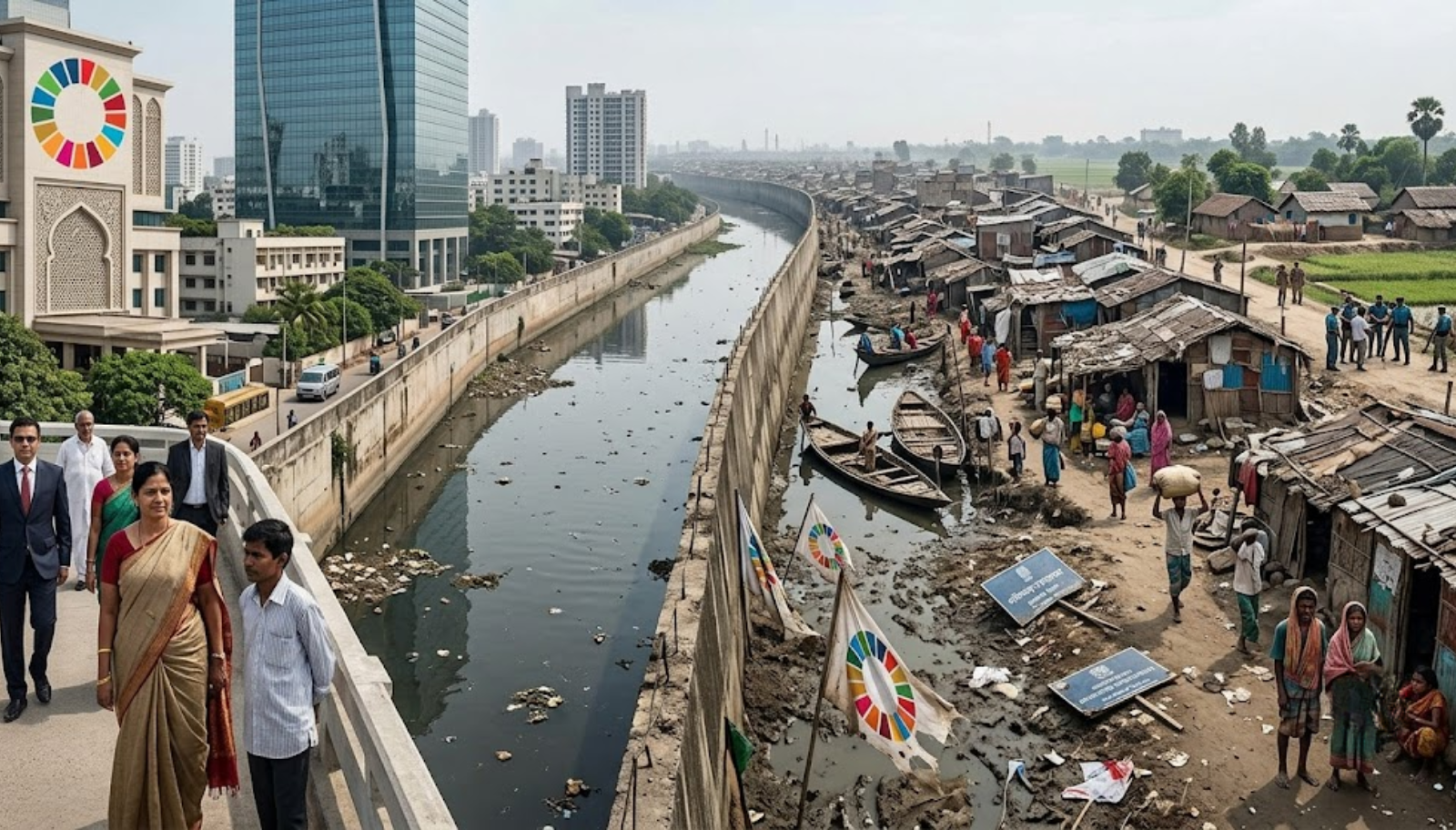
Income inequality is rarely a simple economic metric. When wealth concentrates heavily among elites, it shapes who can exercise basic rights. India and Bangladesh are often mentioned as South Asia’s growth success stories; yet both show a familiar paradox: rapid expansion of national income has not translated into a proportionate improvement in how that income is shared.
This article compares the two economies against the UN Sustainable Development Goals (SDG) as a benchmark for shared growth: SDG 10 calls for the bottom 40%’s income to grow faster than the national average, while SDG 1 (poverty), SDG 3 (health), SDG 4 (education), and SDG 16 (justice and institutions) capture how unequal income becomes unequal access to basic rights. Measured against this framework, both countries fall short and closing the gap requires policy reform as much as continued growth.
India: Structural Hierarchies and Economic Concentration
India remains the world’s fastest-growing economy, with GDP growth of 7.6%; yet the World Inequality Report 2026 found its top 10% capture about 58% of national income while the bottom half receives only 15%, directly countering SDG 10’s inclusive-growth objective. Wealth concentration runs sharper: the richest 10% hold roughly 65% of national wealth, and the top 1% control about 40%, a gap that has remained broadly stable since 2014 despite the strong growth. Apart from this, the percentage of women working has stayed the same over the same period, at 15.7%.
This inequality is made worse by differences in caste, religion, and region, so SDG 3 and SDG 4 outcomes are very different for people who can pay for private care and schooling and the marginalised communities who often depend on underfunded public services. This shows up in the labour market too: the India Employment Report 2024 found 82% of India’s workforce in the informal sector, and nearly 90% informally employed, largely excluded from minimum wages and social security. Persistent farmer distress and protests likewise demonstrate how income insecurity directly fuels public struggles over socio-economic rights and policy accountability.
Bangladesh: Economic Growth and Industrial Vulnerabilities
Bangladesh presents a different trajectory. Its economy grew a modest 3.9% in FY2025 amid political transition and elevated inflation. Bangladesh’s country sheet in the World Inequality Report 2026 shows less high concentration than India’s: the top 10% earn about 41% of the country’s income, while the bottom half earn only 19%. The top 10% also have about 58% of the wealth, and the top 1% have almost a quarter of it.
Bangladesh’s equivalent income gap narrowed slightly, from a ratio of 22.3 in 2014 to 21.6 in 2024, while female labour force participation held flat at 22.3%, low but well above India’s. Yet against the SDG 1 benchmark, nearly twenty lakh additional people fell into poverty in 2025, driven in part by how RMG sector wealth is distributed, largely accumulated among factory owners and urban elites, while frontline workers face real-wage erosion from inflation and limited freedom of association.
These gaps extend into institutional access under SDG 16: wealthier households navigate regulatory frameworks and legal systems more effectively than low-income citizens facing weak enforcement of labour standards and property rights, and the same underfunding of public services means quality healthcare and private English-medium education remain accessible primarily to upper deciles.
Comparative Structural Drivers
Bangladesh’s inequality concentrates around a handful of export industries and urban centres, so targeted labour-market reforms could narrow gaps quickly. India’s inequality is built on caste, religion, and region, and most of the workforce works in the informal sector without minimum-wage and social-security protections, making it structurally entrenched and harder to eliminate through economic policy.
SDG-Aligned Policy Reforms
To align growth models with UNSDG commitments, both countries require intuitional reforms:
First, formalising labour markets. Both countries need independent, well-resourced labour inspectorates enforcing minimum wages, safety standards, and freedom of association.
Second, progressive fiscal reform. Broadening direct tax bases, closing loopholes favouring capital income over labour income, and funding public health and education from the proceeds would help redistribute growth’s gains. India’s excessive reliance on indirect taxation, particularly the GST, burdens lower-income people; shifting toward progressive direct and wealth taxation on the rich would help offset this.
Third, targeted social protection and institutional reform. Expanding cash transfers, public healthcare, and quality education in underserved areas would narrow the divergence in access to services. In India, this could include extending social security and minimum-wage coverage to the informal workforce, the 82% of workers currently outside these protections. In Bangladesh, it could include expanding cash-transfer coverage to shield the newly poor.
Conclusion
Both nations show that macroeconomic growth alone is an insufficient measure of development against the UNSDG benchmark. Without labour rights enforcement, progressive taxation that funds public services, and social protection reaching informal and rural workers, continued GDP growth risks reinforcing rather than resolving the link between income inequality and the practical denial of SDG-aligned rights.
References
Chancel, L., Pikely, T., Moshrif, R., Ghosh, J., & Stiglitz, J. (2026). Ricardo Gómez-Carrera (Lead Author) World Inequality Report. World Inequality LAB. https://wir2026.wid.world/www-site/uploads/2026/04/World_Inequality_Report_2026.pdf
ILO. (2024). Youth employment, education and skills. https://www.ilo.org/sites/default/files/2024-08/India%20Employment%20%20web_8%20April.pdf
The Daily Star. (2025). Economic inequality set to widen in Bangladesh in the short-term: World Bank. In The Daily Star. https://www.thedailystar.net/business/news/economicinequality-set-widen-bangladesh-short-term-world-bank-4044286
World Bank Group. (n.d.). world bank open data. In World Bank Open Data. Retrieved August 2, 2026, from https://data.worldbank.org/?locations=IN-BD
Read also –