
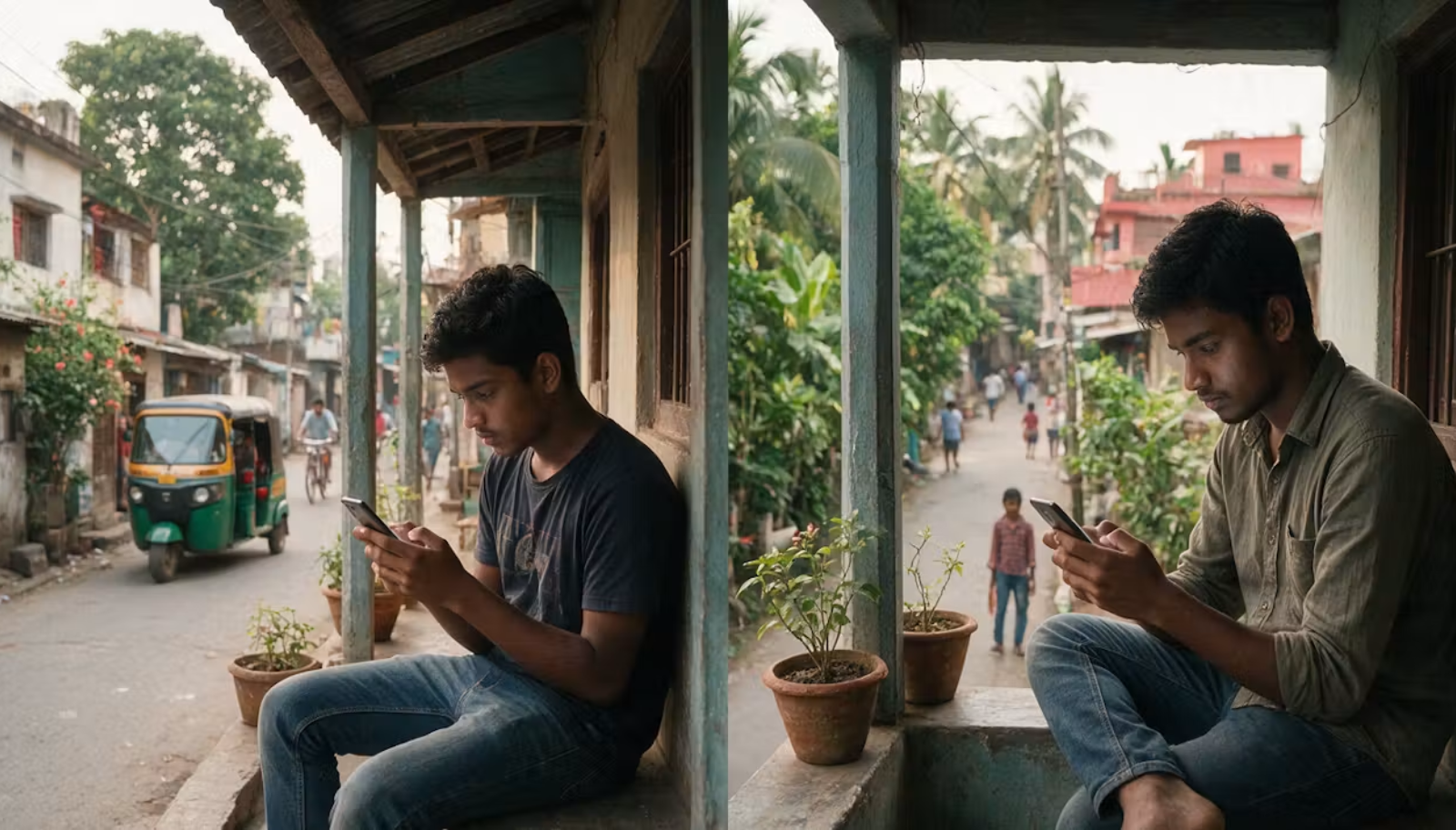
Fardeen Kabir
Jawaharlal Nehru University, India
As digital connectivity deepens across South Asia, a troubling pattern is emerging in parallel across two of the region’s most populous nations. A recent investigation in The Oniket Bulletin, “Drug Problem Among Youth and Women in Bangladesh,” serves as the main reference for this analysis, documenting how substance abuse in Bangladesh has evolved from a peripheral concern into what it calls a full blown public health and national security crisis, driven substantially by peer pressure, domestic dysfunction, academic failure, and unemployment, and amplified by unregulated OTT content that glamorizes criminal lifestyles.
A comparative look at India’s northern belt, particularly Punjab, Haryana, and Uttar Pradesh, alongside Bangladesh’s urban centers of Dhaka and Chattogram, reveals that the underlying machinery of youth distress, internet exposure, social media influence, joblessness, and family isolation, operates with striking similarity across the border.
Internet Access and Social Media as Accelerants
The Oniket Bulletin article identifies a governance gap around OTT platforms in Bangladesh, noting that crime serials and thrillers accessible through domestic and international streaming services expose impressionable young viewers to narratives that often glamorize drug use and criminal power, an exposure that operates largely unchecked given nascent media literacy education and minimal parental digital supervision.
This dynamic finds a close parallel in Punjab, where widespread smartphone penetration and social media use among rural and semi urban youth have been repeatedly linked by public health researchers to exposure to drug culture content, including music and short form video that normalizes substance use. Haryana and Uttar Pradesh show a related pattern, where rising internet access has outpaced digital literacy and parental oversight, creating fertile ground for algorithmically amplified content that mirrors the glamorized criminal narratives Bangladesh’s own researchers flag as a governance gap.
Unemployment as a Shared Root Cause
Both regions point to joblessness as a central catalyst. The Bangladesh article names unemployment directly as one of the primary drivers pulling adolescents and youth into substance use, alongside academic failure and domestic dysfunction. Punjab’s youth unemployment has long been cited by state health authorities as a structural contributor to its widely reported synthetic drug and opioid crisis, particularly among young men who, absent stable work, drift toward informal networks where substances circulate freely.
Haryana faces a comparable pattern, where a growing educated but underemployed youth population, especially in districts surrounding Delhi, has seen rising reports of substance dependency tied to idle time and diminished social standing. Uttar Pradesh, India’s most populous state, combines the largest raw pool of unemployed youth with limited access to counseling or vocational rehabilitation infrastructure, echoing the treatment access gap the Bangladesh article identifies, where facilities remain chronically underfunded and geographically concentrated in urban centers.
Family Isolation and the Erosion of Social Support
The Bangladesh analysis describes addiction as something that corrodes the foundational structures of social life, noting that families experience financial ruin and intergenerational trauma, and that children raised in households with addicted parents are statistically more likely to replicate patterns of substance abuse. A similar cycle of family isolation is documented across Punjab and Haryana, where out migration of working age adults for employment abroad or in other states has left many households, particularly those headed by women or elderly grandparents, with reduced supervisory capacity over adolescents.
Dhaka and Chattogram exhibit their own version of this fragmentation, as rapid urban migration pulls young people away from extended family networks into dense, anonymous city environments where informal peer groups increasingly substitute for family oversight.
What the Human Development Index Reveals
Development statistics help contextualize why these pressures converge so closely across the border. According to the UNDP’s 2025 Human Development Report, India’s HDI value rose to 0.685 in 2023, moving the country to rank 130 out of 193 countries, placing it essentially on par with Bangladesh, which also recorded an HDI value of 0.685 as the two countries’ 2021 HDI ranking gap has closed, with both nations now sharing an HDI ranking of 130. Notably, India and Bangladesh share almost identical HDI scores despite India having a significantly higher GDP per capita, a striking indicator of how income alone does not determine human development outcomes. This convergence in overall development, despite very different economic profiles, helps explain why youth vulnerability to internet driven social distortion, unemployment stress, and family isolation looks so similar across the border.
Neither country’s income growth has yet translated into the mental health, education quality, or family support infrastructure needed to shield young people from these compounding pressures. Bangladesh’s inequality adjusted HDI gap has also widened from 23 percent below the standard HDI in 2021 to 30 percent two years later, indicating that inequalities in human development outcomes are eating into national gains, a pattern that mirrors uneven district level development within Punjab, Haryana, and Uttar Pradesh.
A Shared Regional Challenge
Ultimately, the crisis described in the Oniket Bulletin’s Bangladesh reporting is not a nationally isolated phenomenon but a regional signature of how rapid digital connectivity, weak employment absorption, and thinning family structures interact under conditions of medium human development. Policy responses in both countries, gender sensitive rehabilitation, community based early intervention, and coordinated media content standards, will require cross border learning if either nation hopes to protect the coming generation from a crisis rooted in shared structural vulnerability rather than isolated national failure.
Reference: