
Farah Zahir
Managing Editor, Oniket Bulletin
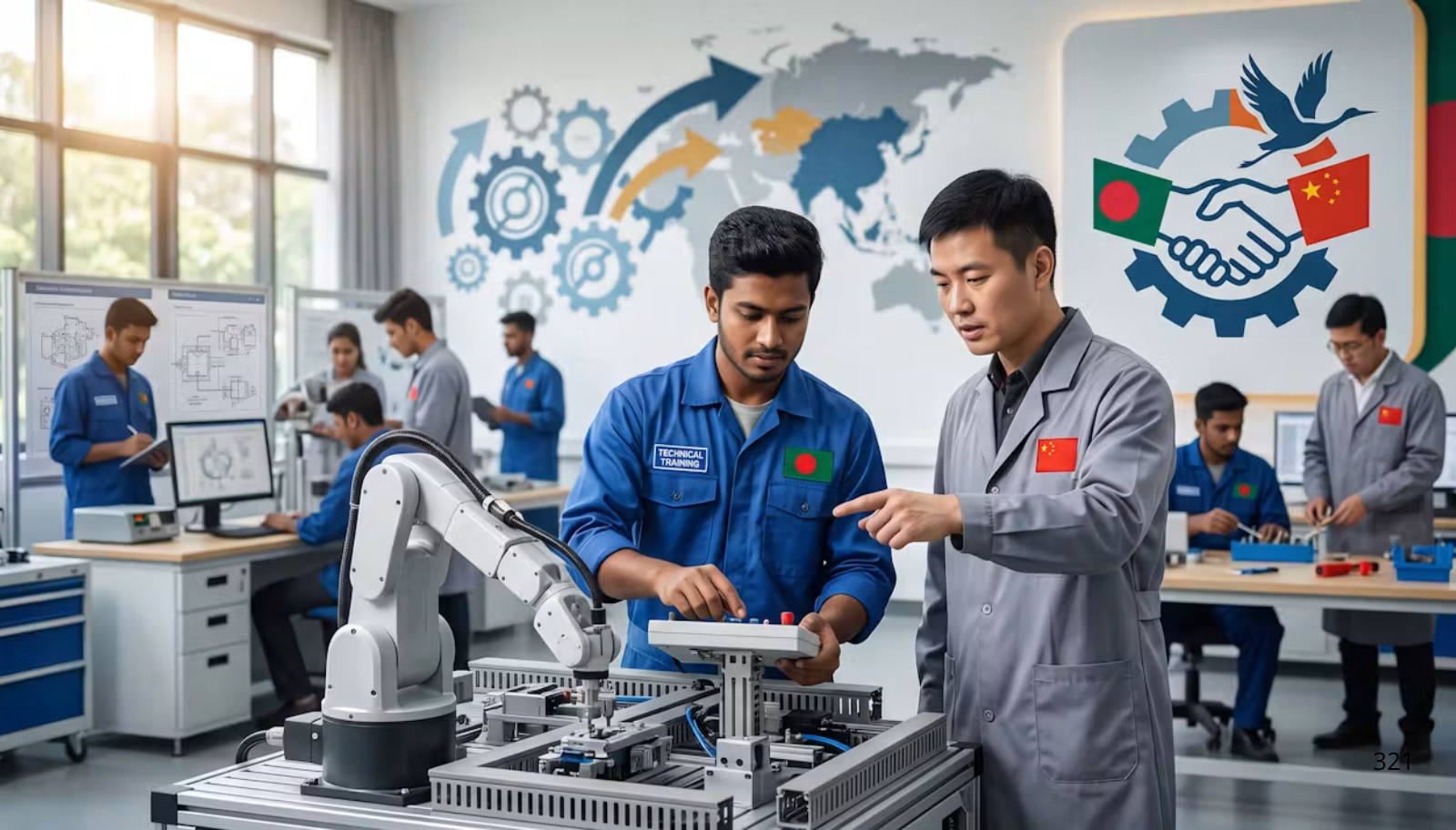
The memorandum of understanding signed between Bangladesh and China on August 27 to establish a joint vocational education, training, and research centre carries both promise and peril in equal measure. The agreement, formalised at the China Bangladesh Education Exchange Conference in Jiangxi province, envisages cooperation across vocational training programmes, bilingual teaching materials, industry education integration, industrial training in Bangladesh, study visits to China, and specialised programmes for vocational administrators.
On the surface, this is a pragmatic move. Bangladesh’s technical and vocational education and training sector needs urgent reform, and China has demonstrable expertise in building industry connected vocational systems at scale. Yet the terms and architecture of this partnership demand far greater scrutiny than they have so far received.
The State of Vocational Education in Bangladesh
Bangladesh’s vocational education sector remains in a state of chronic underperformance. The number of technical and vocational institutions has expanded rapidly, from roughly 1,600 in 2002 to over 3,300 by the early 2020s, but this quantitative growth has not been matched by qualitative improvement. Enrollment rates remain disproportionately low compared to general education. A persistent social stigma treats vocational streams as a destination for academic failures rather than a credible pathway to skilled employment.
Teachers in the TVET system are frequently underqualified for industry standard instruction, curricula lag behind the actual demands of the labour market, and the linkage between training institutions and employing industries is weak at best. The result is a paradoxical situation where employers report acute skill shortages while vocational graduates struggle to find work. The system produces certificated individuals, not competent workers. Against this backdrop, any external partnership that promises to modernise curricula, train teachers, and bridge the industry gap appears not just attractive but necessary.
The Caveats of Chinese Cooperation
The danger lies not in the offer of cooperation but in its architecture. China’s vocational education exports are not acts of educational philanthropy; they are instruments of industrial strategy. The Luban Workshops, China’s signature overseas vocational training model now present in dozens of countries, train local workforces in the operation and maintenance of Chinese manufactured equipment, from railway signalling systems to telecommunications infrastructure.
The logic is elegant and self-serving: a workforce trained only on Chinese equipment and Chinese standards becomes a captive market for Chinese goods and services. Bangladesh must ask whether the proposed joint centre will train workers in transferable, internationally recognised competencies or simply produce technicians locked into operating Chinese machinery and Chinese software ecosystems.
The inclusion of bilingual teaching materials in the MOU further raises the question of whether Mandarin language capability is being positioned as a prerequisite for technical proficiency, a subtle form of ecosystem capture that channels Bangladeshi workers into China facing roles rather than globally mobile careers. There is also the question of curriculum sovereignty.
If Chinese institutions design the training programmes, select the equipment, and set the assessment standards, Bangladeshi vocational education will gradually align itself with Chinese industrial needs rather than Bangladeshi development priorities. The garments sector, agro processing, shipbuilding, renewable energy, and IT services, which form the backbone of Bangladesh’s current and aspirational economy, may receive less attention than the infrastructure and heavy industry sectors where Chinese firms seek market entry and local labour to service their installed capital.
Building a Level Playing Field
The government must take several immediate steps to ensure this partnership serves Bangladeshi interests rather than subordinating them. First, the MOU must be made publicly available in full, allowing parliamentary oversight and expert evaluation of its specific terms, commitments, and exit clauses.
Second, a national occupational standards framework must be established as a precondition for any foreign partnership, ensuring that all vocational curricula, regardless of the collaborative partner, align with competency benchmarks recognised by the International Labour Organisation and regional accreditation bodies.
Third, Bangladesh should simultaneously pursue comparable MOUs with Germany, Japan, South Korea, and the European Union, each of which operates well established vocational cooperation programmes in developing countries. Germany’s dual education model, Japan’s kaizen driven industrial training, and South Korea’s human resource development programmes offer pedagogically distinct approaches that would prevent any single country from monopolising the direction of Bangladeshi skill development.
Fourth, a curriculum review committee with Bangladeshi industry representatives, not just education ministry officials, must have veto power over the selection of training modules, equipment specifications, and assessment criteria introduced under this or any future partnership.
Fifth, the government must invest in building domestic capacity for vocational curriculum design and teacher training, so that external partnerships supplement rather than supplant autonomous institutional development. A country that cannot design its own skill standards cannot negotiate the terms of its own economic future.
Sixth, and equally critical, is the absence of any mechanism to track the partnership’s actual outcomes. There is no mention of measurable indicators such as graduate employment rates, employer satisfaction surveys, wage outcomes for trainees, or the international portability of certifications issued under the joint centre. Without a dedicated monitoring and evaluation body reviewing these metrics periodically, Bangladesh risks entering a long-term partnership with no empirical basis for judging whether it is delivering transferable skills or merely producing captive technicians. Recommendations for oversight remain incomplete without a built-in review and accountability structure.
The MOU with China can be a valuable instrument, but only if it is one instrument among many, and only if the hand that holds it belongs firmly to Bangladesh.