
Naima Onamika
Oniket Research Group
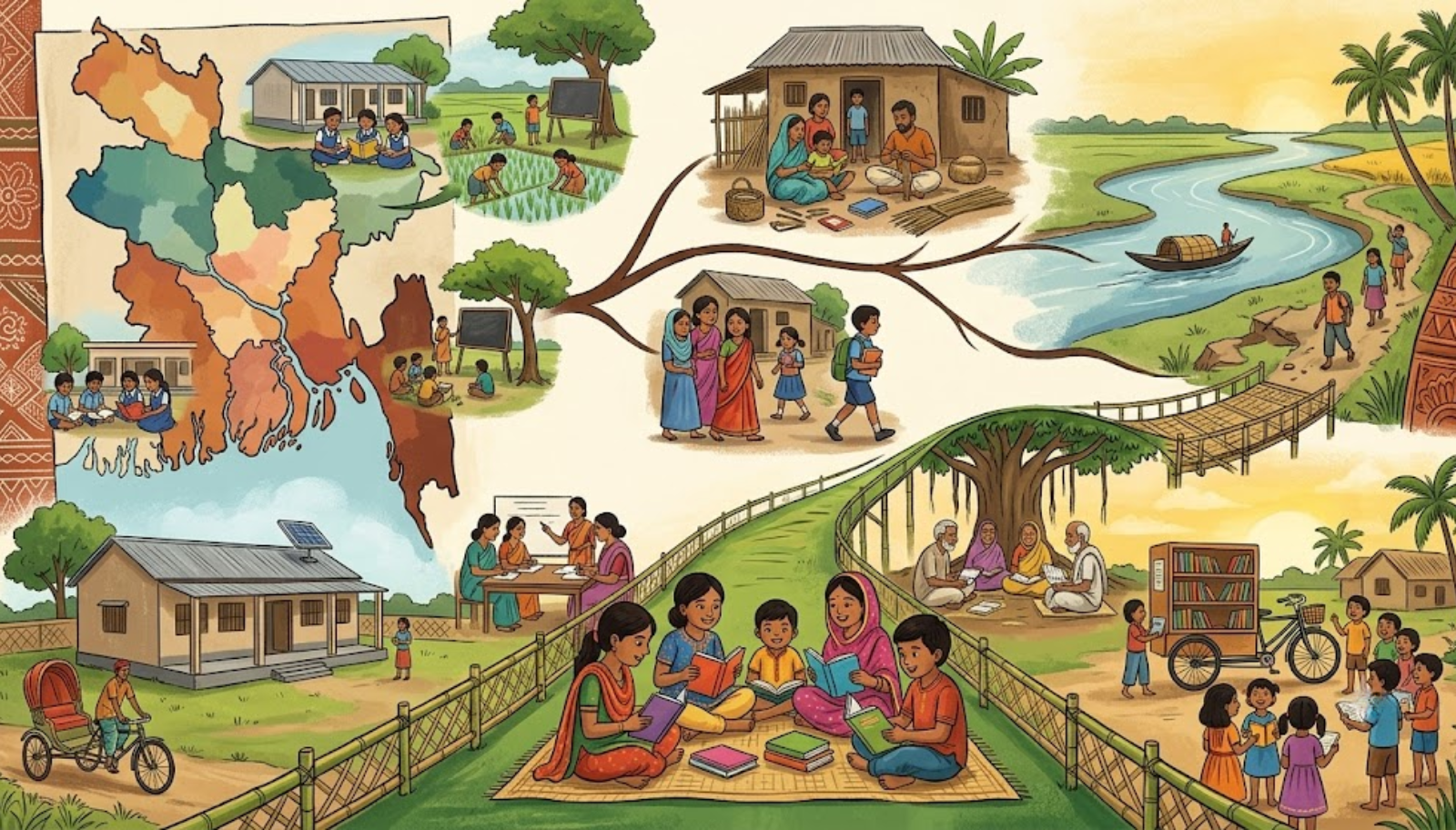
Over the past few decades, Bangladesh has achieved remarkable progress in the education sector. Following independence, the country faced widespread illiteracy, limited educational institutions, and low school participation rates. Today, however, Bangladesh has gained international recognition for its near-universal primary school enrollment and steadily increasing literacy rates. Yet behind this national success lies an important reality: significant regional disparities in literacy.
While the national literacy rate presents a positive picture of educational progress, it often conceals the gaps that exist among different regions, population groups, and social classes. This raises an important question: Is educational development in Bangladesh truly inclusive, or are some regions advancing rapidly while others continue to lag?
To understand this issue in greater depth, several important aspects must be examined.
The Gap Between National Success and Regional Reality
The growth of literacy in Bangladesh has been driven by several factors, including government investment, stipend programs, the promotion of girls’ education, the free distribution of textbooks, and NGO-led educational initiatives. However, these achievements have not been reflected equally across all regions of the country.
Economically active regions such as Dhaka, Chattogram, and Sylhet generally enjoy greater educational opportunities, higher school density, better technological facilities, and higher levels of parental awareness. Consequently, literacy rates in these regions are comparatively higher.
In contrast, geographical barriers remain a major challenge in Rangpur, Mymensingh, coastal Barishal, char areas, and haor-dominated regions. During the monsoon season, reaching school often becomes difficult. Many students become involved in seasonal labor, and educational activities may be disrupted for extended periods. As a result, educational attainment in these areas remains significantly behind that of urban centers.
This reality demonstrates that Bangladesh’s education system has not yet fully overcome the effects of geographical inequality.
The Real Causes of Disparity: Poverty, Language, and Infrastructure
Economic Inequality
One of the primary causes of regional literacy disparities is economic inequality. In many low-income households, education is still viewed as an expense rather than an investment. As a result, families often prefer to involve children in income-generating activities rather than send them to school. This tendency is particularly visible in poorer northern districts.
The situation is even more complex for girls. Child marriage, household responsibilities, and social conservatism often encourage families to prioritize early marriage over education for their daughters.
Linguistic Inequality
Language-based disparities also present a significant challenge. For children in the Chattogram Hill Tracts and among various Indigenous communities, Bengali-medium education is effectively education in a second language. Educational research consistently shows that when children begin learning in an unfamiliar language rather than their mother tongue, their learning progress slows, and the risk of dropping out increases.
Infrastructural Limitations
Infrastructural shortcomings further undermine the quality of education. Remote areas often have fewer schools, persistent teacher shortages, and inadequate classrooms, electricity, and technological facilities. Consequently, despite having a common national education policy, the actual educational experience varies considerably from one region to another.
Long-Term Impact on Development
Literacy disparities are not merely an educational issue; they also pose a major obstacle to overall development. Regions with lower literacy rates generally experience higher levels of poverty. This is because less-educated populations have fewer opportunities for skilled employment and are often confined to low-income occupations. As a result, a cycle of poverty and illiteracy is created, which can persist across generations.
The health sector is also affected. Research shows that educated mothers tend to be more aware of their children’s health, nutrition, and immunization needs. Consequently, regions with lower literacy rates may experience higher levels of child mortality, malnutrition, and other health risks.
Furthermore, awareness of civic rights, access to government services, and political participation are all closely linked to education. When a population lacks adequate literacy skills, it is more likely to be excluded from various opportunities and benefits provided by the state.
Policy Limitations
One of the major limitations of Bangladesh’s education policy is the tendency to apply similar solutions to all regions. The challenges faced by different areas are not the same. The needs of a school in Dhaka are not identical to those of a school located in a char area of Kurigram. Nevertheless, budget allocation, teacher recruitment, and educational administration often follow the same framework across regions.
As a result, areas that are already advanced continue to progress further, while disadvantaged regions remain stagnant. To address this situation, a shift from equal distribution to an equity-based approach is essential, where additional support is provided to the regions that are most disadvantaged.
What Should Be Done?
Considering the issues discussed above, an important question naturally arises: What steps should be taken to address these challenges and reduce regional literacy disparities? Several key measures are necessary.
First, a special education fund should be established for disadvantaged regions.
Second, mother tongue-based multilingual education should be expanded for Indigenous and ethnic minority children.
Third, special incentives should be introduced to recruit and retain teachers in remote and underserved areas.
Fourth, community-based adult education and re-literacy programs should be strengthened in char areas, haor regions, and coastal communities.
Fifth, investment in rural internet infrastructure and digital literacy programs should be increased to reduce the digital divide.
Finally, reliable data collection and analysis should be ensured down to the upazila level so that policy decisions can be based on actual local conditions.
Conclusion
The achievements of Bangladesh’s education sector are undoubtedly commendable. However, an increase in the national literacy rate alone does not guarantee educational justice. When the realities of remote char areas, haor regions, coastal communities, and areas inhabited by Indigenous and ethnic minority populations are taken into consideration, it becomes clear that regional disparities remain a significant challenge.
Literacy is not merely about learning to read and write; it is the foundation of economic opportunity, social empowerment, and civic participation. Therefore, reducing regional inequalities and building an inclusive education system are essential for Bangladesh’s sustainable development and human resource advancement.
Looking beyond national averages and focusing on the most disadvantaged populations, while implementing targeted interventions for their benefit, may well become the most important priority of Bangladesh’s future education policy.