
Aamira Nazeeha Kareem
Hult International Business School
Every day, millions of people in Bangladesh make a quiet decision: find a toilet or wait. A garment worker waits for her text permitted break. A schoolgirl waits until she gets home. A bus driver waits through hours of traffic. Though occasional waiting does little harm, but done routinely, holding urine is associated with urinary tract infections (UTIs), and drinking less water to avoid the toilet adds the risk of dehydration.
Although this is rarely a personal choice, it reflects too few clean, safe and affordable toilets within reach, and a policy system that treats them as an afterthought.
The scale of the gap
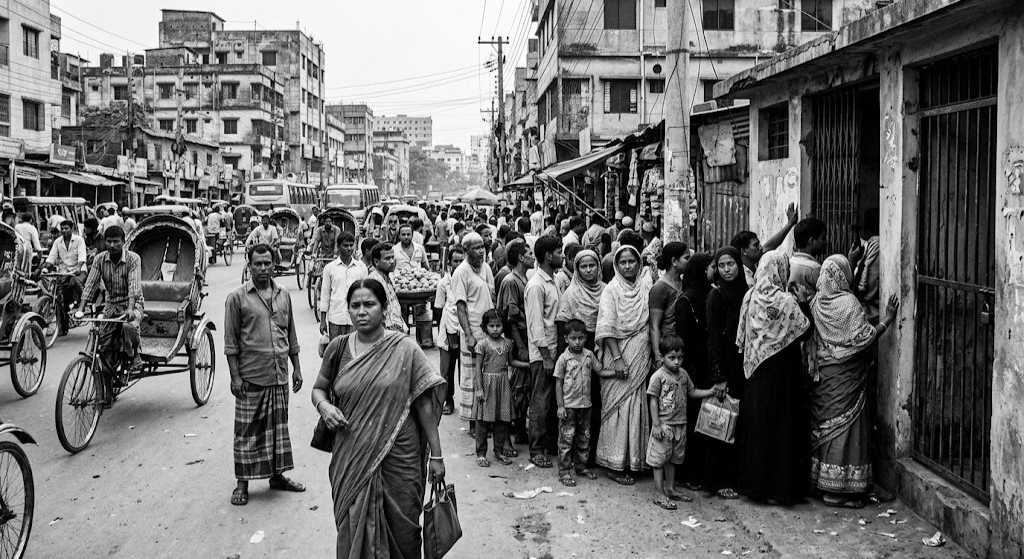
Dhaka, being home to roughly 20 million people, has fewer than 200 public toilets across its two city corporations, and surveys find many of them either locked, broken, unhygienic or unsafe. This burden falls hardest on women. A 2025 WaterAid study found that 35% of urban women avoid public toilets altogether, and nearly three quarters of them drink less water to cope, which is a risky trade in Bangladesh’s heat.
Workplaces and institutions fare a little better. The Bangladesh Labour Act requires every establishment to provide sufficient, separate, clean toilets with water always. Yet, a study of female garment workers found that only about a third could take up to three toilet breaks a day, and garment work was linked to significantly higher odds of UTI rather than low-income work. A BRAC study found separate women’s toilets in only 24% of those surveyed. Outside the cities, households may have latrines, but various outdoor markets, ferry ports, highway stops and union health centers do not.
Who the system leaves out
Most public toilets are built for an able-bodied adult man. Wheelchair users, older people, pregnant women, parents with young children and the hijra community, recognised as a third gender since 2013, find very little designed for them. Ramps, lighting, working locks, water and menstrual waste bins are usually missing, despite the accessibility promised by the Rights and Protections of Persons with Disabilities Act 2013.
Why the current efforts fall short
Today’s response is usually just awareness messages, scattered toilet projects by city corporations and NGOs, and laws that are rarely enforced.
Firstly, responsibilities are scattered. The National Sanitation Strategy assigns public toilets to city corporations and municipalities under the Local Government Division, while health, social welfare, labour, transport and education each hold part of the problem, no single body owns the outcome. Second, there is no reliable data; no public inventory of toilets, whether they work, and no health data linking urinary illness to occupation or toilet access.
Third, good design remains a pilot. Facilities such as the women only toilet at Mohakhali Bus Terminal shows what is possible but arrives project by project instead of a consistent national standard. Lastly, money usually goes into construction instead of upkeep leading to the projects being built deteriorate once the funding ends.
What the Ministries of Health and Social Welfares should do
Push for clear ownership: The Ministry of Health and Family Welfare and the Ministry of Social Welfare should jointly press for an inter-ministerial framework, led by the Local Government Division, with annual public reporting.
Shape an inclusive standard: The Ministry of Social Welfare should ensure women, older people, persons with disabilities with hijra communities help design a national toilet standard, covering lighting, locks, water, menstrual waste disposal, ramps and baby changing spaces.
Map the gaps: The Ministry of Social Welfare, working with city corporations and municipalities, should map the toilets ward by ward, showing location, condition and fees. One estimate suggests Dhaka alone needs 600 to 700 toilets.
Support community-managed toilets: The Ministry of Social Welfare should help fund community-managed toilets with protected cleaning and repair budgets, displaying fees and free access for children and people with disabilities.
Set occupational health standards: The Ministry of Health and Family Welfare should issue guidelines on toilet access and breaks for workplaces, schools and transport and work with labour inspectors to enforce the Labour Act.
Bring bladder health into primary care: The Ministry of Health and Family Welfare should train community clinic staff to treat urinary symptoms sensitively whilst at the same time ensuring that clinics have clean, private toilets and female staff and record occupation in UTI data.
Challenge the Stigma: Social workers under the Ministry of Social Welfare can help families, schools and employers to end the shame women feel in asking for a toilet. NGOs can support but they cannot replace this work.
The SDG connection
This issue sits squarely within SDG 6: Clean Water and Sanitation. Target 6.2 calls for an adequate and equitable sanitation for all by 2030, paying special attention to the needs of women and girls along with those in vulnerable situations. It also connects with SDG 3: Health, SDG 5: Gender Equality, SDG 8: Decent work, SDG 11: sustainable cities, whose target 11.7 calls for safe, inclusive public spaces for women, children, the elderly, and persons with disabilities.
For Bangladesh, the public toilet is where these goals meet. A toilet break is not a luxury, meeting this need does not require vast budgets, but it requires ownership, standards, honest maintenance and the recognition that dignity begins with the most basic of necessities.
References:
Chowdhury, A. A. (2014, December 15). Advancement of transgender’s rights. The Daily Star. https://www.thedailystar.net/advancement-of-transgenders-rights-55529
Government of Bangladesh. (2006). Bangladesh Labour Act, 2006 (Act No. XLII of 2006, as amended 2013).
Government of Bangladesh. (2013). Rights and Protection of Persons with Disabilities Act, 2013.
Jagtap, S., Harikumar, S., Vinayagamoorthy, V., Mukhopadhyay, S., & Dongre, A. (2022). Comprehensive assessment of holding urine as a behavioral risk factor for UTI in women and reasons for delayed voiding. BMC Infectious Diseases, 22(1), Article 521. https://doi.org/10.1186/s12879-022-07501-4
Jannatul, P. (2025, November 19). Removing barriers to women’s access to public toilets is long overdue. The Daily Star. https://www.thedailystar.net/opinion/news/removing-barriers-womens-access-public-toilets-long-overdue-4038221
Joy, N. S. (2026, April 12). Dhaka severely lacks sanitation facilities. The Daily Observer. https://observerbd.com/news/572619
Moran, J., Fitch, T. J., Villanueva, G., Quadir, M. M., Chien, L., & Alamgir, H. (2020). Urinary symptoms and infections among female garment factory workers in Bangladesh. Work, 65(4), 847–856. https://doi.org/10.3233/WOR-203136
Munshi, S. (2026, June 5). Women forced to choose between hydration and health. Dhaka Tribune. https://www.dhakatribune.com/bangladesh/411766/women-forced-to-choose-between-hydration-and
Shafi, S. A., Imam, A. M., Opel, A., & Islam, M. K. (2011, July 15). Making public toilets work – Part II. The Daily Star. https://www.thedailystar.net/news-detail-194379
Sharmin, S. A. (2025, November 19). World Toilet Day: Bangladesh battling unsafe sanitation alongside global crisis. Dhaka Tribune. https://www.dhakatribune.com/bangladesh/396752/world-toilet-day-bangladesh-battling-unsafe
United Nations. (2015). Transforming our world: The 2030 Agenda for Sustainable Development (A/RES/70/1). https://sdgs.un.org/2030agenda