
Tanzina Fardoush
Oniket Research Group
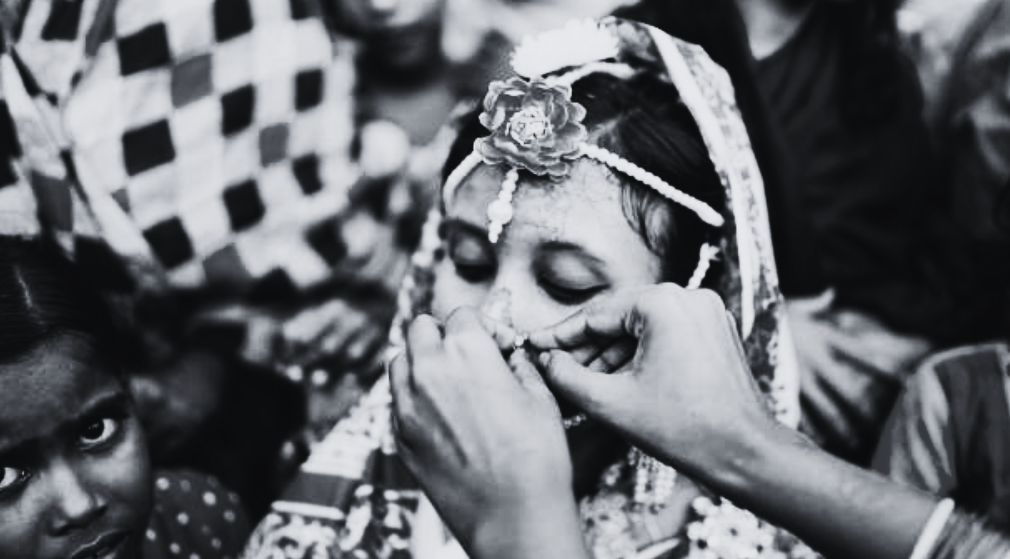
Bangladesh has cut poverty, expanded schooling and reduced maternal deaths, yet half of its young women still marry as children. The 1993 to 94 demographic surveys found that 73 percent of women aged 20 to 24 had married before 18. By 2022 the figure was 51 percent, a fall of only 22 points in nearly three decades, far slower than in India, Nepal or Pakistan.
Wealth and schooling have not delivered the expected drop. Nearly one in three women from the richest households, and one in four with higher secondary education, still married before 18. The problem is not poverty alone. It is also a law that is weakly enforced and rights that citizens do not know they hold.
What the Law Promises, and Where It Wavers
The Child Marriage Restraint Act 2017 sets the minimum marriage age at 18 for women and 21 for men. It punishes adults who marry a child, parents who arrange the union, and registrars who solemnise it, with prison terms and fines. Yet the Act also contains a special provision that permits marriage below these ages with court approval and parental consent, and it sets no minimum age at all.
Critics rightly argue that this loophole invites abuse, because a falsified age or a claim of special circumstances can legitimise almost any union. A law that prohibits child marriage while allowing exceptions without a floor sends a confused message to families and officials alike.
Where Enforcement Breaks Down
Chapainawabganj Sadar has the highest upazila prevalence in the country at 65.7 percent, yet only 18 child marriages were stopped across the whole district in the first six months of 2026. Residents and officials there allege that some kazis charge triple their usual fee to conduct such weddings. Local officials also describe girls facing harassment, scarce jobs and parents who see early marriage as protection.
Where a registrar can profit, a family can lie about age and an official can look away, the law becomes a suggestion. Birth registration is the weakest link. Without a reliable certificate, age becomes a matter of opinion, and opinions bend easily.
Rights Every Citizen Holds
Every girl in Bangladesh is entitled to equal protection, education and bodily safety under the constitution, and to give or withhold consent to marriage. Citizens also have practical tools. Anyone can report an impending child marriage to the Union Parishad chairman, the Upazila Nirbahi Officer, the police or the national helpline 109. Parents have no right to override a child’s welfare, and they should know that penalties fall on them too.
Awareness of these rights remains thin, particularly in rural districts where the wedding is arranged long before any official hears of it. A girl who knows she can refuse, and knows whom to call, holds real power.
What India Has Shown
India offers evidence that legal and social reform together can work. Its Prohibition of Child Marriage Act 2006 made such marriages voidable and strengthened penalties and prevention officers. National family health surveys show the share of women aged 20 to 24 married before 18 falling from about 47 percent in 2005 and 2006 to roughly 23 percent in 2019 and 2021, nearly halving in fifteen years. Alongside the law, states ran conditional cash transfer schemes.
West Bengal’s Kanyashree programme, launched in 2013, pays girls to stay in school and remain unmarried until 18, and evaluations point to later marriage and higher enrolment among participants. Community campaigns, adolescent clubs and local monitoring added pressure. India’s progress is uneven, and some states remain high, so Bangladesh should adapt rather than copy. But the lesson is clear: penalties alone fail, incentives alone fail, and a decline of this speed needs both.
Reforms Bangladesh Needs Now
Reform must begin with the statute. The special provision allowing courts to approve marriages below the legal age, with no floor, should be replaced by an absolute minimum age, because an open exception invites the very practice the law forbids. A clear rule also needs proof of age, so birth registration must become universal and digital, letting officials verify a girl’s age now of marriage. Kazis should be strictly licensed, with automatic cancellation for registering an underage union and a published fee schedule, so no one profits from looking away.
Rules on paper mean little without local action. Union level prevention committees need real authority and budgets, so a warning about an impending wedding triggers a response within days. Conditional stipends that reward families for keeping girls in school and unmarried should go first to Rajshahi and Khulna, where almost every upazila exceeds 60 percent prevalence. Since girls with no school and no work are the most likely to be married off, safe jobs and skills training must expand too.
Social pressures need an answer as well. Many parents marry daughters young out of fear for their safety, so harassment on roads and around schools must be treated as central, not peripheral. Finally, imams and local leaders should be partners rather than opponents, because norms shift fastest when trusted voices speak for change.
Section 19 requires parental consent or, where applicable, the consent of a legal guardian in addition to a court order. However, the provision does not explicitly identify the minor’s free and informed consent as a separate requirement.
This raises few important questions concerning the protection of children’s rights. Does parental consent necessarily mean that the girl herself agrees to marriage? How should consent given under family pressure, fear of social stigma, or insecurity be evaluated? If a girl expresses her unwillingness to marry, how much weight should be given to her views?
A reasonable position is that parental consent and a child’s own wishes are two distinct matters. In determining the child’s best interests, her views should be heard in accordance with her age and maturity, and she should be given an opportunity to express herself freely, without pressure or coercion. The court’s assessment should give due consideration to her safety, education, health, prospects, and the risk of forced marriage.
Sylhet has demonstrated that change is not impossible. In every upazila of the region, the child marriage rate remains below 43 percent. Despite limitations in educational opportunities and women’s employment, this situation suggests that changing social values and traditional practices can play an important role in reducing child marriage. However, the precise factors responsible for this regional difference are not yet fully understood.
Bangladesh’s major challenge now is to systematically foster, in other regions of the country, the social conditions that may have contributed to the situation observed in Sylhet. The goal must be to build a society in which marrying off girls at an early age is no longer considered normal or socially expected. Achieving this requires clear legislation, impartial and effective law enforcement, citizens who are aware of their rights, and the creation of meaningful alternatives for girls. Without these measures, the legal minimum age of 18 will remain merely a promise written on the pages of the law rather than becoming a source of real protection in a child’s life.
The Choice Ahead
Sylhet shows that change is not impossible. Every upazila there remains below 43 percent, even with weaker schooling and female employment, which suggests social norms can shift for reasons no policy has yet fully captured.
The task for Bangladesh is to build deliberately what Sylhet seems to have by accident: a society in which marrying daughter young is no longer expected. That requires a clear law, honest enforcement, informed citizens and real alternatives for girls. Until then, the age of 18 will remain a promise printed in statute, not protection lived by a child.



