
Rudaina Bashir
Brunel University, UK
Bangladesh’s conflict zones are not one place but several: the Chittagong Hill Tracts, the Teknaf and Naikhongchhari frontier facing Rakhine, the Rohingya camps of Cox’s Bazar, and the long boundary with India. Their residents face overlapping insecurities: militarized administration, armed group activity, land disputes, border violence and the burden of hosting displaced people.
Constitutional guarantees of life, liberty and equal protection of the law, found in Articles 31 and 32, do not weaken with distance from Dhaka. Whether they hold at the periphery is the real test of a democratic government.
A Shift in Approach
The current government has shown a more pragmatic temperament, especially in how it frames the frontier. Earlier administrations treated the borderlands mainly as a security problem managed quietly by the army and border forces. The present approach recognizes that stability also rests on diplomacy, local legitimacy and humanitarian management. Bangladesh cannot control events in Rakhine or along the Indian boundary, only how they reach its own citizens.
On the Myanmar frontier, where the Arakan Army’s control has redrawn the diplomatic map, pragmatism keeps open a channel on incidents, humanitarian access and security assurances. Insisting that Rohingya return be safe and voluntary sets a rights-based condition on a process that could otherwise be rushed, and it reflects the principle against forced return even though Bangladesh is not a party to the Refugee Convention. Domestically, greater openness about frontier security and a willingness to hear hill communities on land, representation and the 1997 Accord begin to repair trust eroded by decades of secrecy. Yet listening is not legislating. These steps create a climate for protection but are not yet enforceable rights.
Where Protection Falls Short
Three deficits stand out, each a failure of remedy rather than intention. The first is implementation. The 1997 Chittagong Hill Tracts Accord remains only partly applied, especially on land dispute resolution, the strength of hill councils and the rehabilitation of displaced families. Where land title is unsettled, every episode of settler tension or arson becomes a crisis of trust, because the underlying entitlement was never adjudicated.
The second is accountability. Allegations of abuse by security personnel and attacks on indigenous villages too often end without credible prosecution. Impunity does more than deny justice to victims; it teaches communities that protection depends on who they are.
The third is recourse at the border. Residents of Teknaf and Bandarban lack reliable early warning, compensation and legal remedy when fighting spills over from Myanmar. Independent monitoring is thin: a human rights commission with real field access and routine public reporting to parliament has yet to take shape.
Neighbors, Pressures and Citizen Risk
Myanmar shapes the problem more than any other outside factor. The Arakan Army now holds the entire 271-kilometre frontier, so Dhaka must manage border security, refugee flows and citizen safety alongside an armed actor that no government formally recognizes. Junta airstrikes, stray shelling, new arrivals, forced recruitment of young Rohingya by armed factions and the movement of weapons and narcotics all land on border villagers. Security agencies fear that ethnic ties across the hills could draw the Arakan Army into domestic affairs. That anxiety is understandable, but it invites heavy handed responses that damage the rights of hill communities. Repatriation has stalled, with little outside pressure on Naypyidaw to create conditions for return.
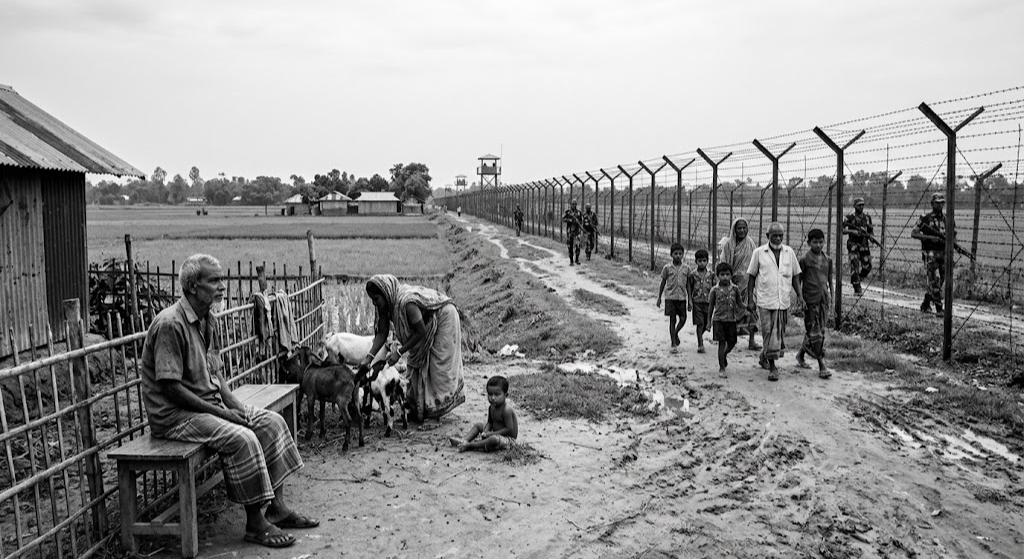
India’s influence is equally consequential. Reports of lethal force by Indian border personnel, forced pushbacks across the line and disputes over fencing leave frontier families exposed. Strained political relations since 2024 have weakened routine channels for resolving such incidents, so ordinary citizens absorb the cost of unresolved bilateral friction. Where interstate relations are brittle, citizen rights become a casualty unless institutions protect them independently.
From Goodwill to Guarantees: The Ministry’s Agenda
The government has recognized that frontier security and citizen rights are linked, a firmer foundation than earlier denial or militarization. The foreign ministry can convert goodwill into protection by putting citizens at the center of each track. With Myanmar, a bounded channel supported by the United Nations, limited to humanitarian access, incident management and assurances against interference in the hills, would reduce surprises while keeping sovereignty unambiguous. With India, a standing joint mechanism covering restraint in the use of force, prompt joint investigation of deaths and compensation for victims’ families would give frontier citizens a remedy that ad hoc protests never have. Neither will hold without wider backing, so Dhaka should work through ASEAN, the United Nations and the Organization of Islamic Cooperation to hold Myanmar’s actors accountable and sustain funding for refugees and host communities.
Domestic institutions must match these external tracks: early warning and compensation procedures for border residents, an independent and funded human rights commission, and a time bound schedule for the Accord. Publishing an annual account of casualties and rights incidents among border citizens would let diplomacy be judged by outcomes, not statements. A government that pairs domestic reform with disciplined diplomacy can make the borderlands a model of protected citizenship rather than a standing source of anxiety.