
Farah Zahir
Managing Editor, The Oniket Bulletin
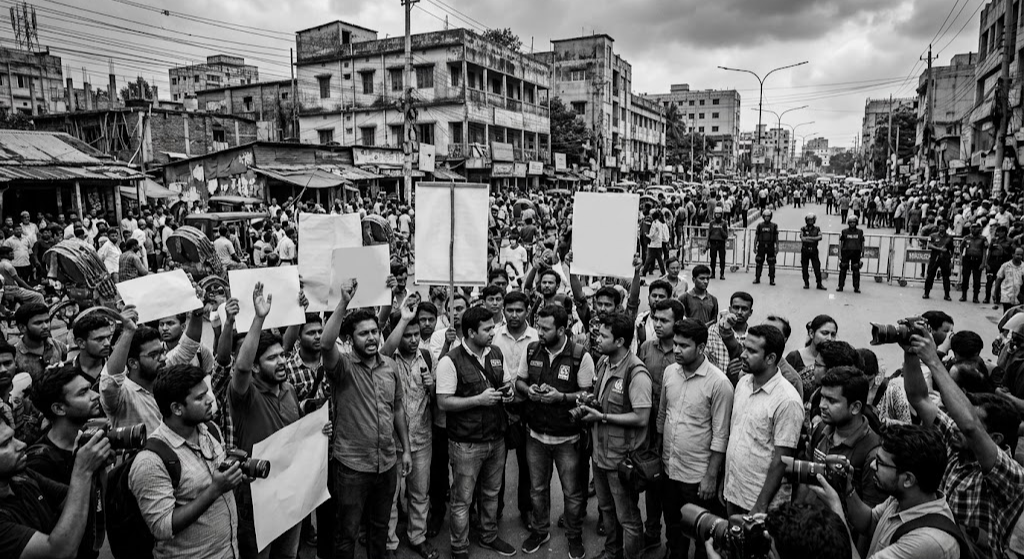
Matiur Rahman’s article, “How much longer must we wait for press freedom?”, is an abridged version of a speech he gave at the Bay of Bengal Conversation 2026. The editor and publisher of Prothom Alo traces his demand for a free press from a student protest on February 1, 1962, to the present day.
He describes pressure on the media under the interim government and the previous authoritarian rule, and he urges the BNP government, elected on February 12, 2026, to honour its promises of media reform. The argument is passionate and grounded in lived experience. It also leaves several gaps that policy can fill.
Heavy reliance on personal testimony
The article draws mostly on the author’s own experience and that of his newspaper. The attack on the Prothom Alo office in December 2025, the withdrawal of advertisements, the nearly 80 cases and the pressure to give up ownership are serious and vivid. They are, however, one institution’s story. The author says managements changed, editors were replaced and many journalists were forced out of their jobs, but he gives no figures, names or cases. Without numbers on journalists attacked, dismissed, prosecuted or silenced, readers cannot tell whether his experience is typical or exceptional.
Policy and SDG link: The government could set up an independent, public database of attacks, cases and dismissals involving journalists, maintained by the proposed Media Commission. This serves SDG 16 (Peace, Justice and Strong Institutions), notably Target 16.10, which calls for public access to information and protection of fundamental freedoms. Indicator 16.10.1 specifically counts killings, abductions, arbitrary detentions and torture of journalists. Bangladesh cannot report on it without reliable data.
An uneven lens on different governments
The article is sharply critical of the interim government and the Awami League administration but notably warm toward the BNP. Its evidence for the BNP’s record is the author’s own access to leaders during the 1991 to 1996 and 2001 to 2006 terms, including heated but unpunished arguments with Begum Khaleda Zia. That is a thin basis. Access for a prominent editor is not institutional protection for ordinary reporters, and the article does not ask whether other journalists remember those years differently. Optimism about the present government rests mainly on manifesto pledges, including Point 11 of the 31-point programme, although the author admits no significant steps have been taken. Pre-election promises are weaker than conduct in office.
Policy and SDG link: Parliament could require the government to report publicly each year on progress against its media pledges. This fits Target 16.6, which seeks effective, accountable and transparent institutions at every level.
Missing details on reform
The Media Reform Commission is said to have proposed short- and long-term measures with broad consensus, but the article never lists them. Readers learn the proposals were not implemented, not which ones matter most or in what order. The Information Ministry’s interest in auditing newspapers and clearing old bills is mentioned without saying what the audit would examine or why it is contentious. The concern over cyber law is equally vague: which provisions threaten journalism, how the government’s approach has shifted, and what alternative is preferred all go unstated. A call for action is stronger when it names actions, owners and deadlines.
Policy and SDG link: The government could publish a dated implementation schedule for the Commission’s recommendations and review cyber legislation with editors and journalists’ unions in the room. Target 16.3 (rule of law) and Target 16.b (non-discriminatory laws and policies) both apply, since vague speech provisions invite selective use.
Structural and ethical dimensions left out
Press freedom is framed almost entirely as a matter of state and mob pressure. The article hints at deeper problems without exploring them: reliance on advertising, owners’ exposure to political and security pressure, and an industry described as unstable. It does not discuss how government advertising should be shared fairly, how concentrated ownership affects editorial independence, or how digital platforms and online hate campaigns fit in. It also speaks of an independent and responsible press without defining responsibility or considering the media’s own part through ethics, self-regulation and public trust. A free press earns protection partly through credibility, and readers would benefit from the author’s view on that.
Policy and SDG link: Clear, published rules for allocating state advertising, disclosure of media ownership, and a stronger, independent Press Council would address these points. They support Target 16.6 on transparent institutions and Target 16.10 on public access to reliable information. Target 5.b, which promotes enabling technology and equal participation, also bears on online harassment of women journalists.
Accountability and voices not heard
The article states that officials gave no effective instructions to security forces during the December 2025 arson, and that police cleared the way for firefighters only after the damage was done. These are grave claims, but the article mentions no investigations, prosecutions or official responses. Other voices are also absent: regional and local journalists, women reporters, and smaller outlets without the resources and prominence of Prothom Alo and The Daily Star, who may face threats with far less protection. The closing claim that the basic issues remain where they were in 1962 is rhetorically strong but flattens real differences between military rule, authoritarianism, an interim period and an elected government.
Policy and SDG link: An independent inquiry into the December 2025 attack, with findings made public, would test Target 16.3 on equal access to justice. The promised special cell against harassment of journalists should have a presence outside Dhaka, in line with Target 16.7 on inclusive and participatory decision-making and Target 5.5 on women’s participation and leadership.
A valuable intervention, stronger if the gaps are answered
The article matters. It comes from a figure with decades of standing, it links present anxiety to a long national struggle, and it holds a new government to its commitments, including a Media Commission, legal reform and a special cell against harassment of journalists. Its central question carries real moral weight. Supporting evidence, a reform agenda with benchmarks, attention to ownership and advertising, frank reflection on professional responsibility and wider voices would turn a moving appeal into a basis for negotiation between journalists, government and the public. The article opens the conversation well. A fuller account would help it reach conclusions.
Reference:
https://www.thedailystar.net/opinion/views/news/how-much-longer-must-we-wait-press-freedom-4296346