
A comparative follow up to “Bangladesh’s Path to Sustainable Agricultural Transformation,” Oniket Bulletin, June 6, 2026
Sanooch Natha
Thammasat University, Thailand
Two Rice Nations at Different Stages
The original article argues that Bangladesh must shift from chasing immediate yield gains to a sustainable, inclusive, and resilient model of agriculture. It points to shrinking arable land, soil degradation, groundwater stress, and monoculture rice systems as the pressures eroding the resource base.
Thailand makes a useful mirror (FFTC-AP, 2018). It is also a rice producing country with a large smallholder population, yet it has moved further into mechanization, diversification, and agro processing, and it is now confronting the environmental costs of that intensification. Bangladesh can learn from both Thailand’s progress and its unfinished problems.
Technology in the Field
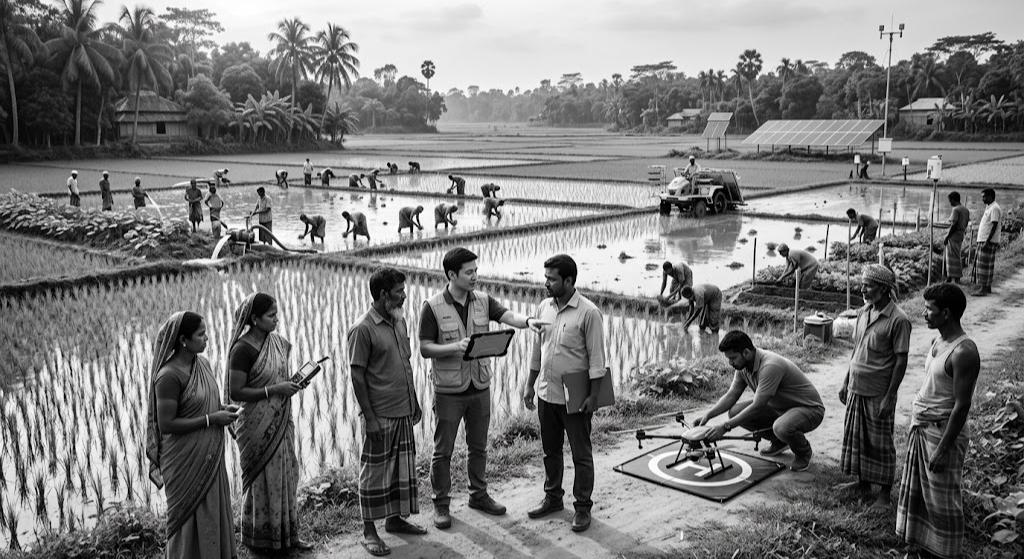
Thailand has adopted mechanization and digital tools more widely than Bangladesh, from laser land levelling and machinery hire services to drones and satellite and weather data. These tools have raised efficiency and eased labor shortages as farmers age. Bangladesh is earlier on this path, and the original article’s calls for precision agronomy, integrated pest management, and digital advisory platforms remain unevenly realized.
The comparison suggests technology reaches smallholders only when it is shared rather than individually owned. Bangladesh’s proposed custom hiring centers fit this lesson well. Paired with stronger links between researchers and extension workers, and advisory services delivered through ordinary mobile phones, they would let small plot farmers use precision methods without costly equipment. Public investment should favor shared machinery, accessible data, and trained service providers over technology aimed only at larger farms.
Keeping the Land and Water Productive
Thailand’s experience shows what happens when intensification outpaces environmental care. Crop residue burning, heavy chemical use, and water stress have created air quality and soil health concerns, prompting efforts to promote low carbon rice, residue management, and efficient irrigation. Bangladesh faces different pressures, including salinity intrusion, flooding, and falling groundwater.
The lesson is about timing. Bangladesh can build climate smart practices into its growth now rather than retrofit them later, making salinity tolerant varieties, alternate wetting and drying, conservation agriculture, and water efficient irrigation normal practice. Soil health programmes, managed aquifer recharge, sustainable groundwater governance, and community based early warning systems would reinforce them. Thailand’s problems are a reminder that productivity targets without environmental safeguards eventually return as costs to farmers and public health.
Benefits from the Tools
Technology can widen gaps as easily as it narrows them. In Thailand, better connected farmers captured much of the gain from mechanization and export markets, while older, poorer households struggled with debt and limited access. Bangladesh faces the same risk, compounded by the gender gaps in land, credit, and technology access that the original article identifies.
Reforms should therefore build inclusion into every technology programme. Women farmers need equal access to training, inputs, and credit, and land policy should secure tenure while protecting smallholders and tenants as mechanization spreads. For rural youth, vocational and digital training matters most when linked to real enterprises in processing, logistics, and advisory services, making farming a modern career rather than a last resort.
Thailand has progressed further on goals related to hunger, poverty, and rural services, helped by higher incomes and earlier structural change, though it still faces pressure on environmental targets and rural inequality (FFTC-AP, 2018). Bangladesh has secured major gains in food availability, but the original article is candid that sustainability and inclusion remain unfinished. Stronger agricultural statistics, land use data, and monitoring systems would help, with indicators that show not only output but also who benefits and how natural resources are changing.
A Practical Path Forward
The comparison points toward a reform path that plans technology, sustainability, and inclusion as one agenda. Investment in cold chains, storage, rural roads, and small-scale processing would raise the value of diversified crops, while cooperatives give farmers the bargaining power to use that infrastructure well. Affordable credit and crop insurance for smallholders and women would let them adopt new methods without unmanageable risk, and subsidy reform rewarding productivity and environmental performance, alongside coordination across agriculture, health, water, and environment, would keep policy coherent.
Thailand shows how far technology and diversification can carry a rice economy, and where intensification begins to strain land, air, and rural livelihoods. Its mechanized, export-oriented farming raised output, yet it left ageing smallholders, rural debt, and environmental costs that now demand expensive correction.
Bangladesh has the advantage of arriving later. Precision agronomy, integrated pest management, and digital advisory platforms can raise yields while reducing environmental footprints, provided extension services carry them to the field. Climate smart practice, from salinity tolerant varieties to water efficient irrigation, should become routine, and shared machinery through custom hiring centers can bring mechanization to small plots without displacing tenants.
None of this will last unless the institutions around the technology are fair. Cooperatives, affordable credit, and crop insurance, directed especially to women and smallholders, would let farmers adopt new methods without unmanageable risk, while training tied to real rural enterprises could make farming a credible career for the young.
Built together from the outset, these elements would spare Bangladesh the costly retrofitting Thailand now faces, producing a farming system that is productive, resilient, and fair.
Reference:
Bangladesh’s Path to Sustainable Agricultural Transformation,” Oniket Bulletin, June 6, 2026.
Duangbootsee, U. (2018) Thailand’s Large-scale Farming Model: Problems and Concerns, FFTC-AP, https://ap.fftc.org.tw/article/1347



