
Dr. Naima Parvin
Coventry University, UK
Rethinking the Blue Economy
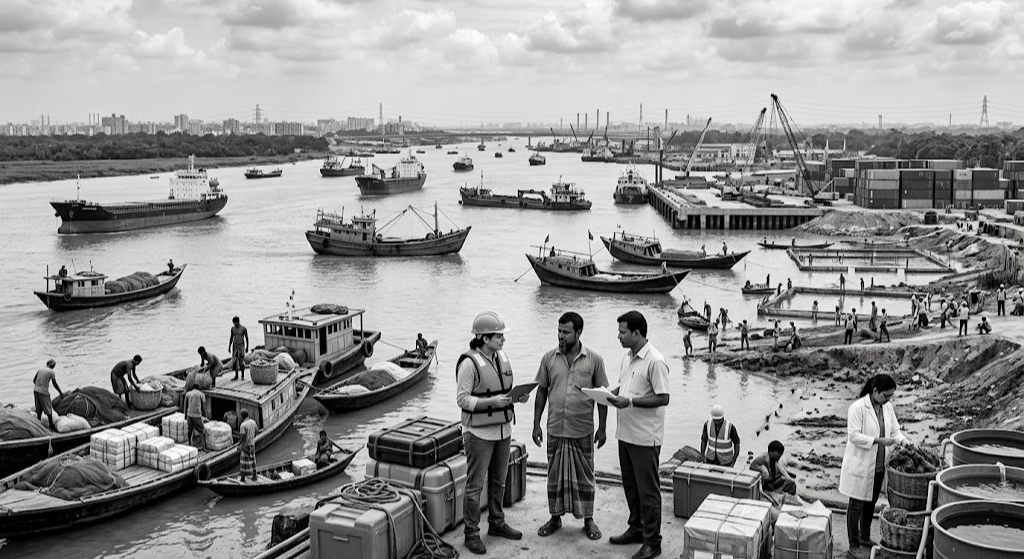
The Blue Economy is often associated with oceans, ports, shipping, and offshore resources. In Bangladesh, however, such a view captures only part of the picture. As one of the world’s most riverine nations, Bangladesh draws its economic and ecological strength not only from the Bay of Bengal but also from its vast network of rivers, wetlands, estuaries, floodplains, and inland fisheries. A truly transformative Blue Economy must therefore embrace both marine and inland aquatic resources.
This broader perspective is important because water shapes livelihoods across all eight divisions of the country. From coastal fisheries and maritime trade to freshwater aquaculture and wetland ecosystems, Bangladesh’s water resources support food security, employment, trade, and environmental sustainability. The Blue Economy should thus be viewed not as a coastal agenda, but as a national development strategy that links economic growth with ecological stewardship.
A Blue Economy Across Eight Divisions
While Chattogram remains the maritime gateway of Bangladesh through its ports, shipping activities, fisheries, and tourism destinations, its significance extends beyond logistics. The region has the potential to become a centre for marine innovation, maritime services, and blue technology, helping Bangladesh move up the value chain in ocean-based industries.
Khulna offers a different but equally important model. The Sundarbans, along with the region’s shrimp and crab industries, demonstrate how ecological conservation and economic development can complement one another. The region reminds policymakers that healthy ecosystems are productive economic assets rather than barriers to growth.
Barishal’s extensive waterways, fisheries, and emerging tourism sector reveal substantial untapped potential. Yet the region also illustrates that natural resources alone do not guarantee prosperity. Without supporting infrastructure, market access, and investment, economic opportunities remain underutilised.
The inland divisions further strengthen the case for a broader interpretation of the Blue Economy. The haor ecosystems of Sylhet and Mymensingh support some of the country’s most productive freshwater fisheries while also providing critical ecosystem services. Similarly, Rajshahi and Rangpur benefit from river-based livelihoods, aquaculture, and inland transport networks that contribute to local economic activity and food production.
Meanwhile, Dhaka serves as the institutional hub of the Blue Economy. Through policymaking, research, education, and financial services, the capital provides the knowledge and governance structures necessary to connect regional strengths into a coherent national strategy.
From Exploitation to Stewardship
A common weakness in resource-based development strategies is the tendency to focus on extraction rather than sustainability. The long-term success of Bangladesh’s Blue Economy will depend less on how much wealth can be extracted from water resources and more on how effectively those resources are managed.
Fish stocks, wetlands, mangrove forests, and coastal ecosystems are renewable assets that require protection and reinvestment. Degradation of these resources may generate short-term gains but ultimately undermines livelihoods and economic resilience. Climate change further reinforces this reality. Rising salinity, biodiversity loss, river erosion, and extreme weather events are placing increasing pressure on aquatic ecosystems across the country.
Consequently, environmental sustainability should not be viewed as a separate objective. It is the foundation upon which the future of the Blue Economy will depend.
Policy Directions for a Sustainable Blue Future
Perhaps the most pressing challenge is governance. Water-related sectors are often managed through separate institutions with limited coordination. Fisheries, shipping, tourism, environmental management, and local development frequently operate in isolation despite relying on interconnected ecosystems. A more integrated governance framework would enable better planning, reduce policy fragmentation, and improve resource management.
A second priority is balanced regional investment. National discussions often concentrate on ports and coastal infrastructure, yet significant opportunities exist in inland fisheries, wetland conservation, river transport, and aquaculture value chains. Expanding investment beyond coastal regions would not only increase economic output but also reduce regional inequalities and create more inclusive growth.
Human capital development is equally critical. The future Blue Economy will require expertise in marine science, fisheries management, aquaculture technology, environmental monitoring, logistics, and climate adaptation. Universities and research institutions should therefore play a greater role in generating knowledge and supporting innovation. Bangladesh’s competitive advantage should come not only from its resources but also from its capacity to manage them intelligently.
Most importantly, local communities must remain at the centre of policy design. Fishers, aquaculture producers, processors, and women engaged in aquatic value chains are the primary custodians of many water resources. Improving their access to finance, technology, training, and markets would strengthen both livelihoods and sustainability outcomes.
One Blue Future
The Blue Economy of Bangladesh extends far beyond the shores of the Bay of Bengal. It flows through the rivers of Rajshahi, the wetlands of Sylhet, the waterways of Barishal, the mangroves of Khulna, the maritime corridors of Chattogram, and the policy institutions of Dhaka. Its strength lies in the interconnected nature of these diverse ecosystems and communities.
The real challenge is no longer identifying opportunities, but ensuring that development remains inclusive, sustainable, and nationally integrated. If managed with this broader vision, the Blue Economy can become a powerful driver of employment, food security, environmental resilience, and regional development. Ultimately, Bangladesh’s blue future will be strongest when all eight divisions share in its benefits.
References
Failler, P., Hussain, M. G., Karim, A. A., Alam, M. K., Sarker, S., Rouf, M. A., et al. (2020). The Future of the Blue Economy in Bangladesh. Bangabandhu Sheikh Mujibur Rahman Maritime University. [bsmrmu.edu.bd]
Patil, P. G., Virdin, J., Colgan, C. S., Hussain, M. G., Failler, P., & Vegh, T. (2018). Toward a Blue Economy: A Pathway for Bangladesh’s Sustainable Growth. Washington, DC: World Bank Group. [openknowle…ldbank.org], [documents1…ldbank.org]
UNCTAD. (2026). Sustainable Ocean and Blue Economy. United Nations Conference on Trade and Development. [unctad.org]
UNCTAD. (2025). Global Trade Update: Sustainable Ocean Economy. United Nations Conference on Trade and Development. [unctad.org]
World Bank. (2022). Creating a Green and Sustainable Growth Path for Bangladesh. World Bank Group. [worldbank.org]
Buhiyan, A. A. H., Al Muntasir, M. F., & Orpa, S. H. (2025). “Navigating the Blue Economy in Bangladesh: Strategic Prospects, Challenges and Pathways toward Sustainable Maritime Growth.” GSC Advanced Research and Reviews, 23(3), 366-379. [gsconlinepress.com]
Islam, M. S., & Rahman, M. M. (2024). “Blue Economy of Bangladesh and Sustainable Development Goals (SDGs): A Comprehensive Assessment.” Discover Sustainability, Springer. [link.springer.com]