
Farah Zahir
Managing Editor, The Oniket Bulletin
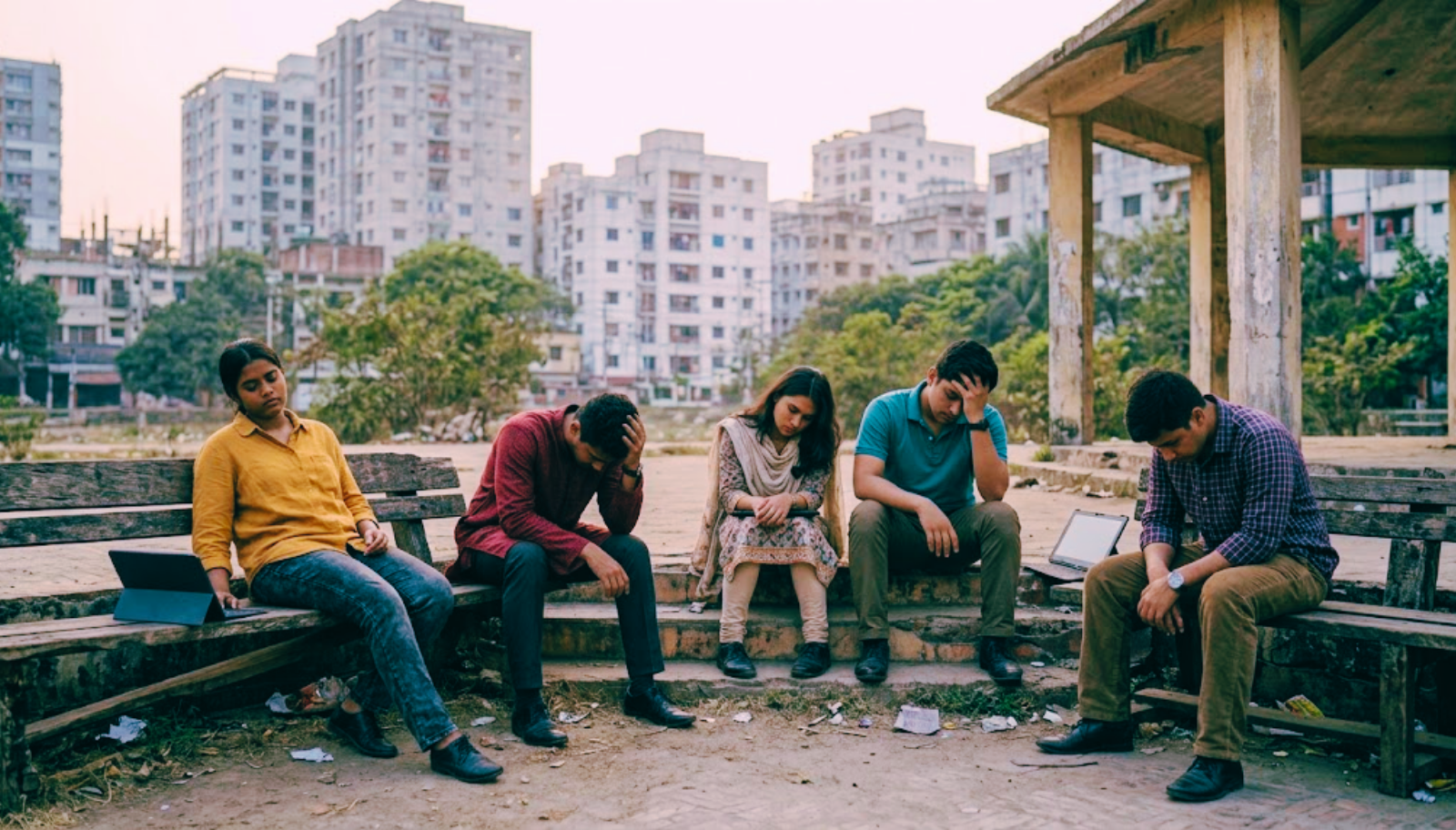
Across Bangladesh’s advertising agencies, software firms, design studios, and media houses, employers increasingly describe a similar frustration. Fresh graduates arrive with degrees, sometimes strong academic transcripts, yet struggle to originate ideas, sustain long projects, or take ownership of ambiguous problems. The gap is not intelligence. It is preparation. Many young professionals were trained to answer fixed questions correctly rather than to explore open-ended ones, and creative or skill-based industries run almost entirely on the latter.
This shows up as low initiative, quick discouragement after criticism, and a tendency to treat work as a series of tasks to complete rather than a craft to build. Employers often read this as laziness. A more accurate reading is that many young workers were never taught how to sit with difficulty long enough to produce something original.
The Roots in Basic Education
Much of this traces back to primary and secondary schooling built around memorization and examination performance rather than problem solving, curiosity, or collaboration. Students who spend twelve to fourteen years being rewarded for reproducing textbook answers rarely develop the tolerance for failure that creative work demands. Art, music, debate, design thinking, and independent research remain marginal subjects in most schools, treated as extracurricular rather than foundational.
By the time these students reach universities and then workplaces, the skill gap is already structural. They can pass exams but have rarely been asked to defend an original idea in front of skeptical peers, iterate on a failed prototype, or manage a project without a fixed answer key. Employers inherit this gap and then absorb the cost of it in missed deadlines, generic output, and staff who need constant direction.
Social Media and the Compression of Patience
Layered onto this educational gap is a second force: near constant social media use. Short form content trains attention toward rapid reward, instant validation, and comparison against curated versions of other people’s success. Many young professionals now measure their own career progress against influencers and peers online rather than against the actual demands of their craft, which breeds impatience with the slow, unglamorous repetition that skill building requires.
This compressed attention span collides directly with creative industries, where breakthroughs usually follow long periods of unremarkable, disciplined effort. A generation accustomed to instant feedback loops often abandons difficult projects at exactly the point where sustained effort would have paid off.
Fraud, Betrayal, and the Erosion of Commitment
A more troubling pattern has also emerged in professional conduct itself. Reports of young employees fabricating credentials, plagiarizing creative work, taking on multiple jobs simultaneously without disclosure, or abandoning employers mid project for a marginally better offer have become more common. Loyalty to a firm or a craft, once treated as a basic professional virtue, is increasingly treated as optional or even naive.
Some of this reflects genuine economic pressure in a competitive job market. But much of it also reflects a values shift, where visible success online is prized over the slower, quieter accumulation of trust and reputation that used to define a career. Betrayal of employer confidence, once rare enough to be scandalous, is now often discussed almost casually among peers as a normal career tactic.
Social Consequences
The consequences extend beyond individual workplaces. When commitment and honesty erode at the entry level of a workforce, firms respond by tightening surveillance, shortening contracts, and reducing investment in junior training, since the expected return on that investment falls. This creates a feedback loop, employers trust young workers less, invest less in them, and those workers in turn feel less loyalty, reinforcing the very behavior employers fear.
At a societal level, this weakens Bangladesh’s ability to build durable creative institutions, agencies, studios, and firms with a distinct identity built over decades, because the people who might have carried that identity forward keep leaving or cutting corners.
Contrast With the 1980s and 1990s
The 1980s and 1990s in Bangladesh, despite far fewer resources, produced a different professional culture. Advertising agencies, publishing houses, and early private enterprises were often built by small teams who stayed with one organization for years, sometimes decades, gradually accumulating craft knowledge that became institutional memory. Innovation in that era, whether in textiles, print media, or early private banking, tended to emerge slowly through apprenticeship style learning under senior practitioners, not through rapid job switching.
Business development in those decades also relied heavily on personal reputation within tight professional circles, where a single act of dishonesty could end a career permanently. That social enforcement mechanism, imperfect as it was, encouraged a baseline of reliability that many industries now struggle to replicate at scale.
Where University-Level Youth Fit In
This is precisely where Bangladesh’s universities can shift from bystanders to active participants. The United Nations’ Sustainable Development Goals offer a ready framework for this shift rather than an abstract policy exercise. SDG 4 (Quality Education), specifically its target on relevant skills for employment and entrepreneurship, points directly to the need for problem-based and creative learning inside university curricula, not just after graduation. SDG 8 (Decent Work and Economic Growth) speaks to the same youth employment and productivity gap employers describe daily. SDG 9 (Industry, Innovation and Infrastructure) reinforces the case for building the kind of resilient, innovation-driven institutions the 1980s and 1990s once produced organically.
Framing career readiness as part of this global agenda, rather than a personal failing, gives university students some concrete, internationally recognized reason to invest early in original thinking, sustained effort, and professional integrity.
A Necessary Caveat
None of this should be read as a blanket verdict on an entire generation. Many young Bangladeshi professionals are highly disciplined, and today’s job market is more precarious and more competitive than it was in the 1980s or 1990s, which itself explains some of the instability in commitment. The comparison across decades also risks nostalgia, since earlier eras had their own corruption, nepotism, and limited opportunity that simply went less documented.
Conclusion
Still, the pattern employers describe, competent but uncommitted, credentialed but uncreative, is real enough to demand attention. Addressing it will require rebuilding creative and problem-solving capacity earlier in schooling and rebuilding a professional culture where sustained craft and basic honesty are once again treated as a competitive advantage rather than an old-fashioned constraint. Universities have a clear, SDG-aligned opening to lead that rebuild before students ever reach the workplace.
Read also –