
Prof. Dr. Tanvir Fittin Abir
Daffodil University
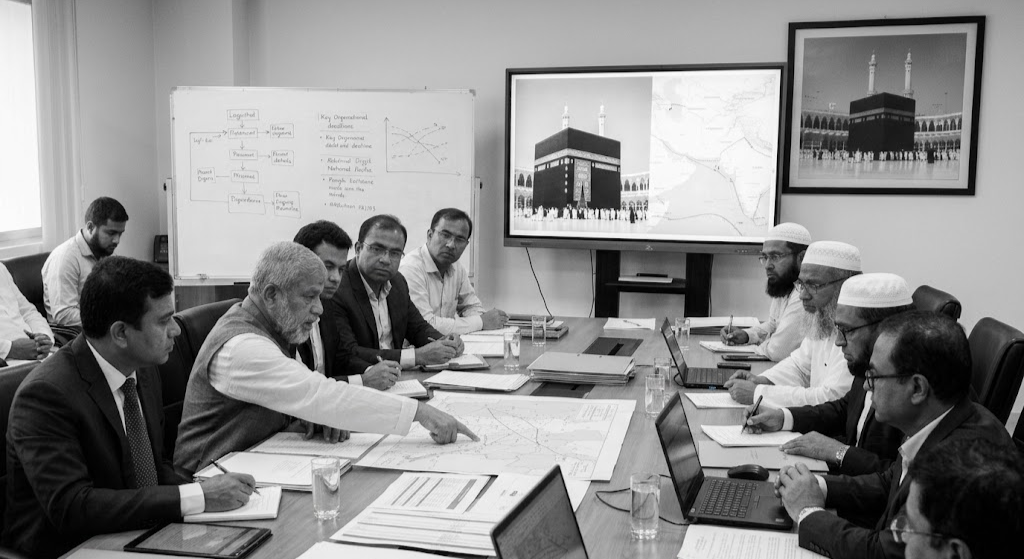
In Bangladesh, the preparation of Hajj should be religious and at the same time credible to public administration. Recent incidents have shown that the region can be insecure, impacting on civilian travel, as evidenced by attacks on Saudi airports and related airline cancellations. Suspensions in Riyadh and for some carriers in Jeddah and Madinah, were reported by Reuters (2026). These are developments and do not define what conditions will be in Hajj 2027, necessitating contingency planning. Unlike Bangladesh, other nations should avoid prediction and accept that uncertainty is the only thing that can be prepared for.
Capacity Before Quota Expansion
For the year 2027, Bangladesh has been allotted with 78,500 seats for Hajj. According to bdnews24.com report dated 2 October 2026, 75,982 people have registered; 5,090 of them are managed by the government and 70,892 are managed by private operators. There were requests for additional 20,000 places from agencies. These figures are of course historical and not to be displayed as current totals without checking. More significantly, that there should be more places based on proven ability, such as accommodation, transport, medical support and emergency arrangements. An increase in the number of people could shift institutional risk to pilgrims if there were no improvements in services.
The ministry ought to conduct a capacity assessment prior to expansion. The additional groups require identifiable beds, transport and trained guides and medical referral systems. Operation readiness cannot be determined by the demand of the commercial market. Bangladesh should demand with confidence from Saudi counterparts and be honest with the prospective pilgrims regarding the realities.
Protecting Household Savings
For a lot of Bangladeshi families, it’s years of saving for pilgrimage. When the unexpected bill comes, unexpected hardship and lack of trust are the results. Airfare, accommodation, meals, transport, service charges, contingency provisions should be separately indicated in the package. Any change should include a justification, the approval process and consequences for pilgrims who are unable to afford the change.
Improvised collections during disruption should be replaced by a centrally-coordinated emergency reserve. Publication of spending and audit rules. Agencies to state the terms of cancellation and refunds in writing before taking money, with money being safeguarded or bank guarantees in place. Contracts should make clear how the exchange rate will be adjusted as well as deferred payments or places to carry over without assuring that this will automatically occur the following year.
Flights and Decision Points
The published roadmap has been released for issuance of visas from January 28, 2027, and flights from April 8, 2027, which is expected to be around the 15th of May (Bangladesh Sangbad Sangstha, 2026). These are still tentative dates, not guaranteed to be free of disruptions.
Dhaka needs to discuss written airline airport capacity commitments, replacement and flexibility between authorized Saudi airports. Alternative routes will need to be approved by regulators and granted operational clearance; another airport does not necessarily qualify as safe. The reviews should start before hard payments occur and should be ongoing until the person leaves. An aviation, diplomatic and security assessment may be combined at a March checkpoint. A decision should be made in the context of departure schedule and participation, which consider that Bangladesh cannot change the timing of Hajj.
Insurance and Emergency Responsibility
Care is needed when buying insurance. It is reported that conventional travel insurance contracts usually exclude losses as a result of armed conflicts (The Guardian, 2026). Bangladesh needs to have a written confirmation of coverage, exclusions, medical evacuation and claims procedure. If commercial cover is not available, the authorities will have to inform the people about the available public funding cover. No pilgrim must take an insurance certificate for a guarantee of security.
There must be a joint coordination mechanism that should link Dhaka, Bangladesh embassy in Riyadh, consulate in Jeddah, airlines and Saudi authorities. It must allocate the responsibility for the provision of shelter, referral to hospital, missing pilgrims and repatriation. Exercises should involve communication failures, and extended disruption such as providing assistance when evacuation flights are not available.
For instance, in case of cancellation of a flight with 400 pilgrims, the answer should include who is responsible for making arrangements for pilgrims, who pays for the same, who brings medicines and when the families will be notified. This should be practiced in conjunction with agencies and airlines. A clearer statement of a decision maker who will take ownership of the process and an agreement on funding source is better than a vague statement of “coordinating”.
Ashkona and Inclusive Support
The beginning is at home. Ashkona Hajj camp should include a long-term plan in all its aspects involving water, sanitation, food, backup power, and essential medicines and accessible sleeping areas. Overflow lodging should be booked in advance. Pilgrims should be provided with confirmed reports before flights change, even if it means that there is no need to be concerned about crowding.
Medical screening should be done before payment and Saudi eligibility and vaccination criteria should be confirmed for the corresponding season. Individual support arrangements are required for older travellers, persons with a disability and those with a chronic condition. Women need to be able to have a female guide, medical support and private room. Training should incorporate rituals and practical information on crowd and heat conditions, as well as what to do if separated from the group. For those with low levels of literacy, you can use Bangla audio, illustrations and demonstrations. Identification should include key emergency contact details and ensure private medical details are not included. Families should also have consistent communications channels to receive updates.
Accountability That Pilgrims Can See
There should be a public dashboard which clearly separates the numbers of registrations from those completed visas from those of confirmed seats from those of actual departures. Agency complaints must be tracked, deadline for responding and appeal process. A review of contractual delivery with penalties to follow on the basis of fair investigation. Performance reports should include the number of unresolved complaints, recovery time for refunds and services provided, and the number of departures.
But Bangladesh can’t fight regional wars but they can prepare it like a good quality fighting. For Hajj management it is important to safeguard the savings, express uncertainty and help vulnerable travellers. Faith needs an administration where responsibility is made visible, before it becomes apparent when a crisis happens.
References
Bangladesh Sangbad Sangstha. (2026, June 8). Govt releases Hajj 2027 roadmap asks completion of registration by Sept 26.
bdnews24.com. (2026, October 2). Bangladesh Hajj agencies seek 20,000 more pilgrim slots as quota fills up.
Reuters. (2026, October 13). Airlines cancel flights to Saudi Arabia after Riyadh airport attacks.
The Guardian. (2026, May 16). ‘The Iran war left my insurance policy void’: How the conflict is affecting travellers.