
Sumaiya Hasi
Commissioning Editor, Oniket Research Group
Few figures in Bengali literature have brought science, art and literature together with the same rare brilliance as Sukumar Ray. The hand that composed Brahmo devotional songs accompanied by the violin and pakhawaj also pursued original research into printing technology. From observing constellations in the night sky while sitting on a rooftop to creating imaginary worlds with colours, watercolours and ink on canvas, Ray grew up in a family environment where curiosity and intellectual exploration were part of everyday life. That rich tradition helped shape his remarkable imagination.
Inspired by his father, Upendrakishore Ray Chowdhury, a man of extraordinary versatility, Sukumar began composing rhymes aloud, drawing pictures and practising photography from an early age. He graduated from Presidency College in Calcutta with a BSc, earning double honours in Chemistry and Physics. Rather than keeping his scientific knowledge confined to the laboratory, he sought ways to apply it to artistic work. Five years after completing his degree, in 1911, he travelled to Britain to pursue advanced studies in printing technology.
Britain, Rabindranath Tagore and the ‘Monda Sammelan’
Sukumar Ray’s journey to Britain coincided with a significant moment in Bengali literary history. Rabindranath Tagore also travelled to London around the same time, carrying the manuscript of his English translation of Gitanjali. A young admirer of Tagore, Sukumar helped introduce the poet to British intellectual circles through an English essay titled The Spirit of Rabindranath, which he presented at a meeting of London’s well-known Quest Society.
While studying at Presidency College, before leaving for Britain, Sukumar had established the Nonsense Club, whose house publication was called Saare-Batrish-Bhaja. After returning to India, he founded a lively literary gathering in 1915 known as the Monday Club, affectionately and humorously referred to by him as the Monda Sammelan. Its regular members included several prominent literary and cultural figures of the time, among them Satyendranath Dutta, Ajit Kumar Chakravarty, Suniti Kumar Chatterji and Atulprasad Sen.
His interests extended beyond literature and science into politics and the performing arts. At Santiniketan, he performed alongside Rabindranath Tagore and Abanindranath Tagore in the play Goray Galad. During the Swadeshi movement, he also composed several patriotic songs and sang them himself.
Sandesh and a World of Imaginary Creatures
The children’s magazine Sandesh began publication in 1913 under the editorship of Upendrakishore Ray Chowdhury. Following his father’s untimely death in 1915, Sukumar assumed full editorial responsibility for the magazine. From 1915 to 1923, he edited Sandesh for eight consecutive years, bringing to the task both meticulous craftsmanship and deep affection for its young readers.
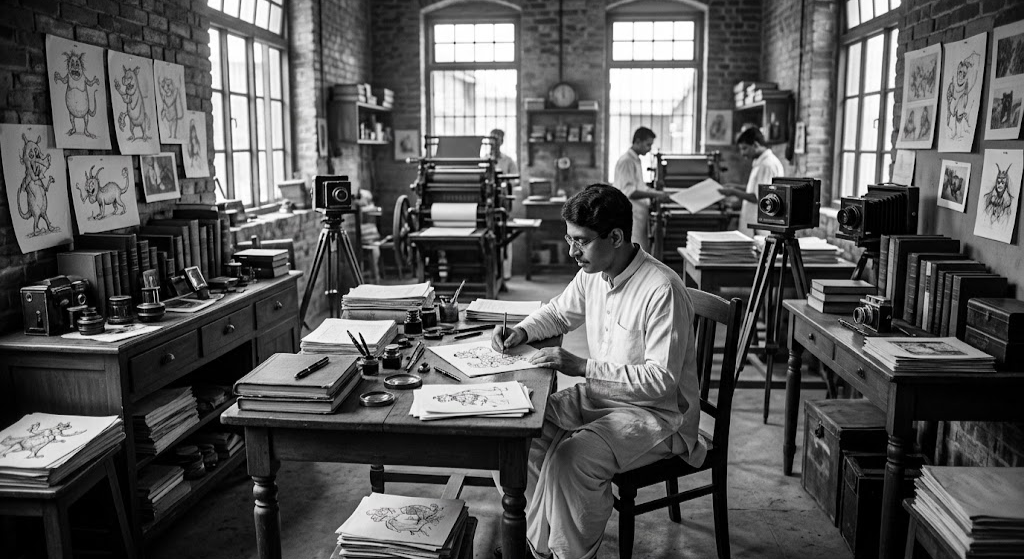
Boundless imagination and an unmistakable sense of humour lie at the heart of Sukumar Ray’s writing. Few writers in Bengali literature have invented creatures as delightfully bizarre as his. His imaginary world includes figures such as Chillanosaurus and Gomratheryum, along with the extraordinary Hashjaru, a creature formed by combining a duck and a porcupine.
One of his famous rhymes captures the delightful absurdity of these creations:
“Once there was a duck, once a porcupine too,
How they became a ‘Hashjaru’, I haven’t a clue.
The heron told the tortoise, ‘What a marvellous sight!
Our new ‘Bakchhap’ looks absolutely right!’
The lizard with a parrot’s face began to feel alarmed:
Would it have to eat raw chillies once its insects were gone?”
Translation of the original Bangla verse.
Beneath the laughter lay a sharp critique of blind imitation, hypocrisy and irrational social conventions. Ray never treated children as passive listeners who would accept whatever adults told them. He regarded them as alert, intelligent readers capable of recognising absurdity and thinking for themselves.
Printing Precision and the Standards of Children’s Literature
Sukumar Ray accepted no compromise when it came to the quality of children’s books. He believed that grammar, spelling, rhythm and presentation had to meet exacting standards. A misspelling or misleading piece of information encountered in childhood, he understood, could remain in a young reader’s mind for years.
After returning from Britain with knowledge of modern printing technology and photographic processes, he revitalised the family printing business, U. Ray & Sons. He brought together four distinct talents: writer, illustrator, editor and printing specialist. His rhymes preserved the natural musicality of the Bengali language, while the apparent simplicity and ease of his sentences concealed painstaking revision and considerable labour.
His work demonstrated that writing for children demanded no less care or artistic discipline than writing for adults. The humour might appear effortless, but the craft behind it was anything but casual.
An Untimely Death and Creativity in the Shadow of Mortality
A literary talent of such distinction was granted a tragically short life. Sukumar Ray died of kala-azar on 10 September 1923, aged just 36. During the final two and a half years of his life, he spent long periods confined to his sickbed. His illness, however, did not extinguish his creative spirit.
While seriously ill, he wrote Ha Ja Ba Ra La in 1922, a work that would become one of the enduring classics of Bengali literature. He also began a theoretical study of alliteration in Bengali poetry, titled Shri Shri Barnamala Tattwa. His premature death left the work unfinished.
Even as death approached, he continued to write verses filled with irrepressible humour:
“The ancient moon, the icy moon,
Horse eggs tied in a bundle soon.
Sleep’s deep shadows gather near,
My song’s last chapter ends here.”
Translation of the original Bangla verse.
The ability to create such playful, spirited literature while standing at the threshold of death is a rare achievement in literary history. His distinguished son, filmmaker Satyajit Ray, later reflected on this extraordinary quality of his father’s work, observing that he knew of no other creator of humour who had managed such wit at the boundary between life and death.
Sukumar Ray’s Legacy in the Present Day
Children’s literature is often treated as separate from mainstream literature, or as a less significant branch of it. Hastily produced books, inadequate proofreading and the dominance of digital screens have also contributed to a growing distance between children and the richness of their own language and literary traditions.
Sukumar Ray showed how simple work could be without being simplistic, humorous without being shallow, meticulously crafted without losing its spontaneity, and profoundly intelligent without relying on conventional moral lessons.
His legacy offers an important lesson for today’s writers, publishers, parents and educators. Encouraging reading at home, maintaining professional standards in publishing, and giving children’s literature the recognition it deserves are essential to keeping his spirit alive.
The magic of Sukumar Ray lay not merely in making children laugh. He opened a world in which language could break free from convention, imagination could challenge accepted wisdom, and nonsense could reveal the absurdities of everyday life. Passing that gift on to the next generation requires the same curiosity, craftsmanship and respect for young minds that defined his work.