
Arif Reshad
University of Essex
Non-governmental organizations were meant to fill the gaps that the state could not reach: rural credit, agricultural extension, maternal health, disaster relief. In Bangladesh, over the past two decades, this mission has repeatedly bent toward a different purpose, that of rewarding politically loyal communities and neglecting or punishing those associated with the opposition. The result is a civil society sector whose credibility rests less on impartial development outcomes and more on its proximity to whichever party controls the state machinery.
Two Decades of Politicized Oversight
The instrument at the center of this pattern has been the NGO Affairs Bureau, which sits under the Prime Minister’s office and controls registration, project approval, and access to foreign funding for any organization receiving grants from abroad. Because nearly every sizable development NGO in Bangladesh depends on foreign donor money, the Bureau’s discretion over approvals has functioned as a quiet but powerful lever of political control.
Through the 2000s and 2010s, this discretion was used with increasing assertiveness. In 2012 the government announced the cancellation of registration for roughly six thousand NGOs on grounds of inactivity or alleged links to activities deemed hostile to the state, and in later years hundreds more were axed in similar sweeps. Legal changes reinforced the trend.
A 2016 law regulating foreign donations gave the Bureau explicit authority to reject or cancel projects found to include remarks judged inimical or derogatory toward the government, parliament, or constitution, terms broad enough to capture almost any critical commentary. Human rights organizations such as Odhikar experienced this directly, spending years unable to renew a registration that the Bureau insisted was invalid because the group’s reporting on extrajudicial killings and enforced disappearances was said to damage the country’s image abroad.
Patronage, Punishment, and Regional Imbalance
Beyond outright deregistration, the more everyday form of bias has been the direction of development spending itself. NGOs aligned with or tolerated by the ruling party found it easier to secure project clearance, land access, and cooperation from local administration for microfinance, agricultural, and rural infrastructure programs. NGOs, seen as sympathetic to the opposition, or simply unwilling to publicly align, faced slower approvals, selective audits, and difficulty renewing licenses.
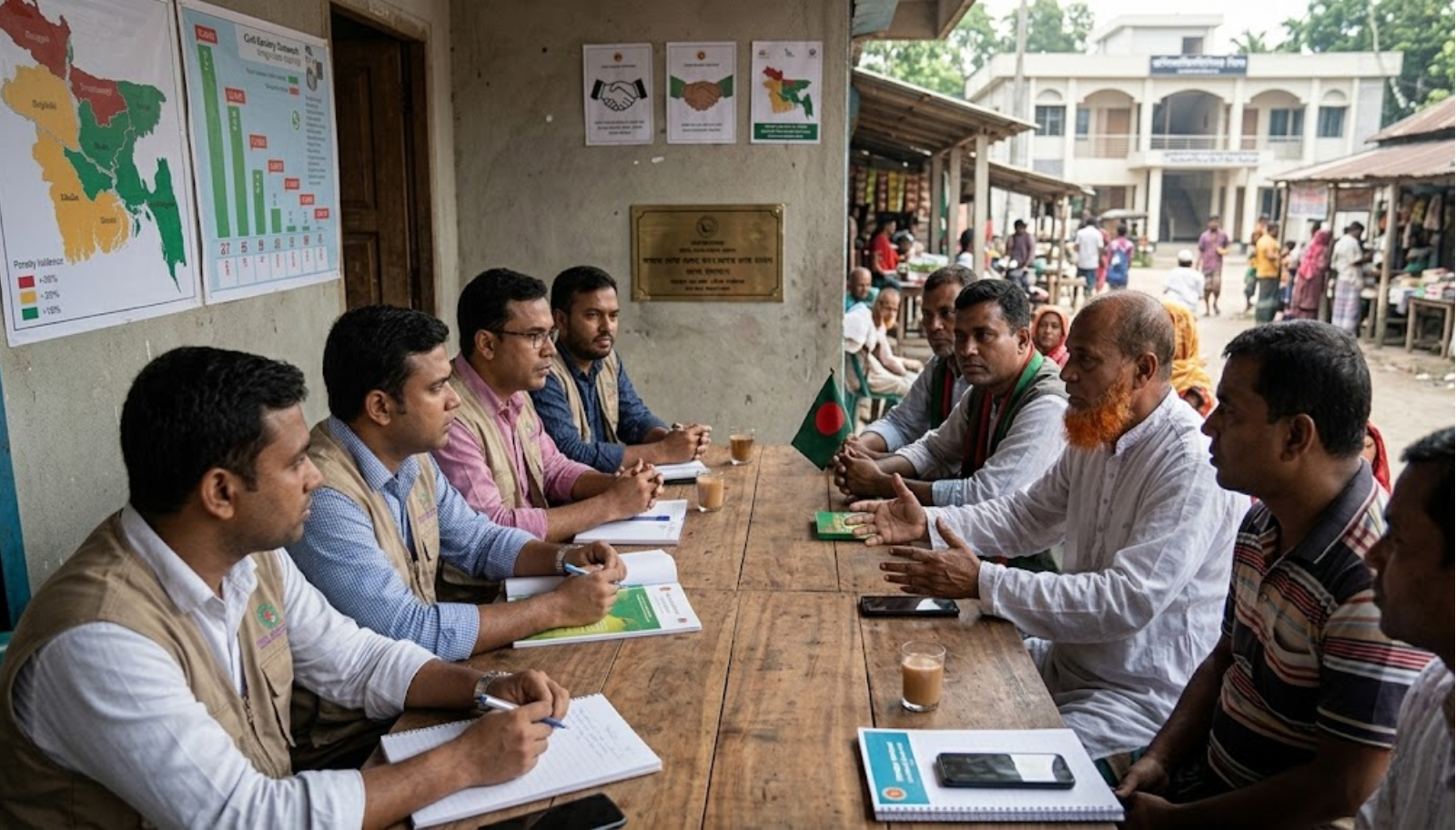
Because ruling party strongholds tend to cluster geographically, this pattern has translated into visible regional imbalance: certain districts have received a denser concentration of microfinance branches, agricultural extension programs, and disaster response infrastructure, while opposition leaning districts lagged, reinforcing exactly the kind of uneven development NGOs were originally created to correct.
The politically charged treatment of Grameen Bank and its founder during the 2010s, when the government moved to restructure the bank’s leadership and ownership amid an openly adversarial relationship with its founder, illustrated how even an internationally celebrated microfinance institution was not immune from being treated as an instrument of political contest rather than a neutral development actor.
Three Reforms
Three structural changes would meaningfully reduce this politicization. First, registration and project approval authority should be shifted out of the Prime Minister’s office and into an independent statutory commission, with fixed tenure appointees drawn through a transparent, cross party selection process, so that no single government controls the gate through which development funding passes.
Second, the vague standards currently used to justify deregistration, language such as activities harmful to the image of the state, should be replaced with narrowly defined, judicially reviewable criteria limited to financial fraud, verified security threats, or a clear breach of an organization’s stated charitable purpose, removing the discretion currently used to target critical or opposition adjacent groups.
Third, development funding data, including which districts and which political constituencies receive NGO backed agricultural, microfinance, and infrastructure spending, should be published in a mandatory, disaggregated public registry, allowing independent researchers and election monitors to detect regional favoritism as it happens rather than years later.
Conclusion
None of these reforms require weakening the state’s legitimate interest in preventing money laundering or extremist financing through the NGO sector. What they require is separating that legitimate regulatory function from the political incentive, present under every elected government to date, to use civil society funding as a tool of reward and punishment. Until that separation exists, Bangladesh’s development NGOs will continue to mirror the country’s partisan fault lines rather than heal them.