
Farah Zahir
Editor, Oniket Research Group
The purpose of this article is to examine the growing structural challenges facing Bangladesh’s book publishing industry and to assess how its weaknesses increasingly resemble those affecting the country’s newspaper sector. A recent Oniket Bulletin analysis, “The Printed Press at a Crossroad,” described editorial newspapers battling collapsing circulation, vanishing advertising revenue and an eroding sense of purpose, as social media absorbed both readers and advertising expenditure. Book publishing is a different market, but it is facing a strikingly similar combination of weak reading habits, a shrinking revenue base and a business model dangerously dependent on a single seasonal event.
The article examines the scale of Bangladesh’s publishing industry, its heavy dependence on the annual Ekushey Book Fair, the sharp decline in sales and participation during the 2026 fair, and the structural problems reported by publishers. These include limited reading habits, weak distribution outside Dhaka, rising production costs, a shortage of skilled editors and proofreaders, and the absence of sustained demand throughout the year. The article also considers the limitations of current government support and explains why the publishing industry should be viewed not only as a cultural and commercial sector but also as part of the country’s educational infrastructure.
The article suggests that Bangladesh needs a broader and more sustained policy response. Government support should extend beyond temporary measures such as waiving book fair stall rents and should focus on building distribution infrastructure, strengthening editorial and translation training, expanding library funding, introducing reading promotion programmes, creating partnerships between publishers and schools, and developing year-round demand for books. Greater coordination between the Cultural Affairs Ministry, the Education Ministry, universities, schools and publishers could help transform the publishing sector into a more durable cultural, commercial and educational foundation.
A Market Built Around One Month
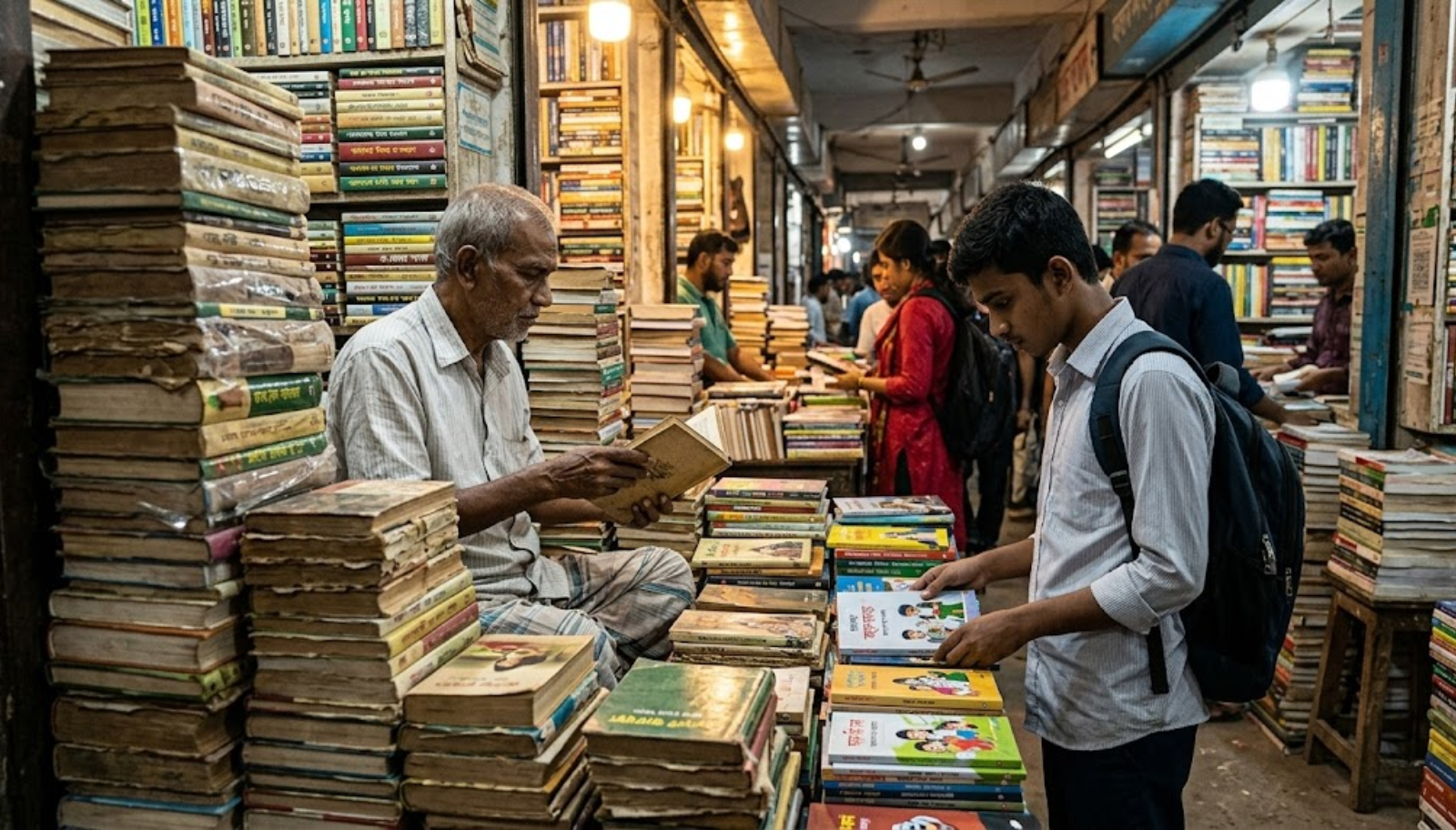
The scale of the industry looks impressive on paper. Roughly twelve hundred publishing houses operate across the country, about four hundred producing trade and creative titles, six hundred fifty focused on educational material, and one hundred fifty publishing religious texts, within a sector valued at close to one and a half billion dollars. But the International Publishers Association reports that ninety-nine percent of that revenue comes from domestic sales, concentrated almost entirely around the annual Ekushey Book Fair. For literary Bangla publishing especially, the fair functions as the beginning and the end of the sales calendar. Authors time manuscripts to its February launch, and little retail activity survives beyond it.
That fragility turned into crisis in 2026. Political scheduling conflicts pushed the Amar Ekushey Boi Mela into the middle of Ramadan, forcing the government to compress the traditionally month long, twenty-eight-day fair into just eighteen days. Participation fell from seven hundred twenty-one organisations in 2025 to five hundred eighty-four this year. Total sales collapsed to an estimated Tk 17 crore, roughly $1.55 million, down from Tk 40 crore in 2025 and Tk 60 crore in 2024, a decline exceeding seventy percent. Major publishing houses scaled back sharply: Adarsha Prokashoni planned only around thirty new titles against sixty the year before, while Anannya managed barely thirty, compared with one hundred thirty previously.
Publishers Sound the Alarm
The industry’s concerns run deeper than one disrupted fair. Ahead of the 2026 event, two hundred sixty-two creative publishers, including major houses such as Kakoli, Anyaprokash, Anannya, Adorn, Prothoma Prokashon, Eti Prokashon, Adarsha and Laboni, jointly petitioned authorities to reschedule the fair, warning of severe damage to an already fragile sector. Their spokesperson cited figures that lay bare the market’s condition: Bangladesh ranks ninety seventh among one hundred two countries on the Global Reading Index; roughly ninety five percent of books published nationally have a first print run of three hundred copies or fewer; and nearly seventy percent of those copies go unsold. Publishers said they continued releasing new titles despite a sixty percent sales decline over eighteen months, not as sound business strategy, but as an act of sacrifice for the culture itself.
University Press Limited’s Mahrukh Mohiuddin has pointed to a separate structural weakness, a severe shortage of skilled editors, proofreaders and reviewers capable of handling literary and academic manuscripts, compounded by a distribution network that barely extends beyond Dhaka. Outside the capital, most bookstores stock textbooks and examination guides rather than fiction. Rising costs have deepened the squeeze: paper and ink prices roughly doubled between 2020 and 2022, eating into already thin margins.
Where Government Intervention Falls Short
The Cultural Affairs Ministry did respond that waiving stall rents entirely for the 2026 fair, a more generous concession than the fifty five percent reduction initially proposed, and Bangla Academy has floated further relief, including post fair pop-up events. But these measures treat symptoms, not the underlying disease. The real gap is structural: there is no government backed distribution infrastructure connecting publishers to readers outside Dhaka, no formal training pipeline for editors and translators, and no sustained mechanism to build reading habits among students and young adults.
This is where the Education Ministry could play a far larger role than it currently does. School curricula, library funding and reading promotion programmes fall largely within its remit, and none of the current fair focused relief measures touch it. A coordinated push, mandatory school library budgets, reading hour requirements, partnerships between publishers and public schools, and translator training programmes run jointly with universities, could build the sustained, non-seasonal demand this industry lacks.
The connection to Sustainable Development Goal 4, quality education, is direct. SDG 4 commits to ensuring inclusive, equitable education and promoting lifelong learning opportunities, which depends on functioning literacy ecosystems, not just enrolment numbers. A publishing sector this concentrated around one fair, this thin in distribution and this short of trained editorial talent cannot sustain the reading culture SDG 4 assumes. Framing book publishing as education infrastructure, rather than purely a cultural or commercial concern, would justify sustained public investment beyond rent waivers.
Bangladesh’s literary sector retains genuine depth and a real readership, visible each year in the crowds the Boi Mela still draws. Converting that depth into a durable commercial and educational foundation depends on decisions in Dhaka’s ministries, decisions on distribution, training and year-round investment, that, like those facing the country’s newspapers, cannot be postponed any further.
Reference: