Farah Zahir
Editor, Oniket Research Group
Overview
Bangladesh carries a literary heritage of remarkable depth. From the poetry of Rabindranath Tagore to the novels of Humayun Ahmed, the country has long nurtured a reading culture shaped by language, emotion, and a fierce sense of identity. That culture, however, has struggled to find its footing in the digital age. Despite a young, increasingly connected population and a rapidly expanding mobile internet base, the e-reading ecosystem of Bangladesh remains fragmented, under-resourced, and slow to respond to the needs of a modern, bilingual readership. This bulletin examines the structural gaps in the existing digital reading landscape, identifies the communities left behind, and explores how shobdomukur.com, Bangladesh’s first and only bilingual online library, is charting a qualitatively different course.
The Online Bookstore Model: Convenience Without Culture
The most visible pillars of Bangladesh’s digital book market are the online bookstores: Rokomari, Boi Bazar, Ekushey Book Fair, Pathak Shamabesh, and Boi Mela. These platforms have made a real and practical contribution to accessibility. In a country where visiting a physical bookstore often means braving Dhaka’s legendary traffic or waiting for the annual Ekushey Book Fair, the ability to browse and order books from home is a genuine improvement in reader experience.
The gap, however, lies in what these platforms have chosen not to be. They are commerce platforms, not reading platforms. Their interfaces follow generic e-commerce templates. Recommendation engines are weak. Community features are almost entirely absent. The experience of shopping on these sites resembles buying household goods far more than it resembles entering a literary space.
More critically, the e-book catalogues on these platforms are either non-existent or treated as secondary concerns. The overwhelming focus remains on physical book sales, which means that while ordering a book online has become easier, reading one digitally remains cumbersome and underserved. The market has been given convenience without imagination.
E-Book Platforms: Infrastructure Built on a Narrow Foundation
Dedicated e-book platforms do exist in Bangladesh, and they deserve recognition for establishing the basic infrastructure of digital reading in a difficult environment. Boighor, developed by EB Solution Limited, offers access to over a thousand titles at nominal cost, with payment available through bKash and support across Android and iOS devices. Sheiboi, by Raven Systems Limited, provides approximately five hundred free titles alongside a larger paid catalogue, with carrier billing through Robi and Airtel as well as standard card payments.
Both platforms have made sincere efforts to respect copyright and honour royalty agreements with writers and publishers, which in a market as saturated with piracy as Bangladesh’s is no small achievement. The technical groundwork they have laid matters.
The limitations, however, are equally significant. Catalogue depth remains thin when measured against international standards. Reading on mobile screens through app interfaces, without e-ink device support and without offline reading functionality, reduces usability and causes eye strain over prolonged sessions. These are not minor inconveniences; they are structural barriers that shape whether a reader returns to a platform or abandons it.
The most consequential gap, though, is linguistic. Both Boighor and Sheiboi operate exclusively in Bangla. This renders them inaccessible to a growing bilingual readership that includes diaspora communities in the United Kingdom, North America, and the Middle East, English-medium students in Dhaka and Chattogram, and international readers with an interest in Bangladeshi literature. A platform that cannot speak to these readers cannot serve them and cannot carry Bangladeshi literature to the world.
The numbers make the scale of the challenge plain. Boighor reports approximately twenty thousand subscribers in a nation of more than 170 million people. The e-book format in Bangladesh has barely moved beyond the experimental stage.
The Piracy Problem: A Market Undermined from Within
No honest assessment of digital reading in Bangladesh can sidestep the issue of piracy. Pirated PDF copies of virtually every popular Bangla book circulate freely across social media platforms, messaging applications, and unregulated websites. For readers with constrained purchasing power, the temptation is understandable. For writers and publishers, the damage is real and ongoing. Legitimate e-book platforms find themselves competing against free, even as they invest in copyright compliance, royalty payments, and editorial standards.
The government has done little to enforce intellectual property protections in the digital domain, and the cultural normalisation around book piracy remains deeply entrenched. This is not simply an enforcement problem; it is a cultural one, and it will require both legal action and sustained public awareness efforts to shift.
Until it is addressed meaningfully, the economic viability of any legitimate e-reading platform in Bangladesh will remain fragile. This is a gap that responsible platforms must find ways to navigate, through value propositions strong enough to compete with free, and through models that make legitimate access feel like the obvious and appealing choice.
Identifying the Core Gaps
Drawing together the evidence above, four structural gaps define the current digital reading landscape in Bangladesh.
The bilingual gap is perhaps the most consequential. No existing platform serves readers who move between Bangla and English, which means diaspora communities, bilingual students, and international readers interested in Bangladeshi literature are systematically excluded. Literature that belongs to the world remains locked behind a single language.
The depth gap is visible in catalogue size. Existing e-book platforms offer a fraction of the titles available on international platforms such as Kindle or Apple Books. Without depth, reader loyalty cannot be built, and the case for subscribing over searching for a pirated file remains weak.
The experience gap is felt every time a reader opens an app on a mobile screen and confronts an interface that was not designed with sustained literary engagement in mind. The absence of e-ink support, offline functionality, and thoughtful reading interfaces tells readers, implicitly, that their comfort is not the priority.
The culture gap may be the subtlest but is arguably the most important. None of the existing platforms treat reading as a cultural act. They are transactional spaces. What has been missing is a platform built around the idea that engaging with literature is a way of understanding oneself, one’s heritage, and one’s place in the world.
Shobdomukur.com: A Bilingual and Multimodal Response
Shobdomukur.com was not built simply to fill a market gap. It was built from a conviction: that a beautiful and examined life is shaped by creative thinking, timely knowledge, refined taste, and the continuous nurturing of a balanced mind. From that conviction emerged Bangladesh’s first bilingual online library, offering literary and intellectual content in both Bangla and English, and presenting life through the lived experiences, emotions, and realities of people rather than through the cold logic of a content catalogue.
The bilingual model is not merely a technical feature. It is a philosophical commitment. It acknowledges that Bangladeshi literature deserves a global audience, and that Bangladeshi readers deserve seamless access to both their own literary traditions and the wider world of letters. A diaspora reader in London or New York who reads English more comfortably than Bangla finds, in Shobdomukur, an entry point into the literary heritage of her ancestry. A Dhaka university student studying in English finds access to Bangla literary works that would otherwise remain behind a linguistic wall.
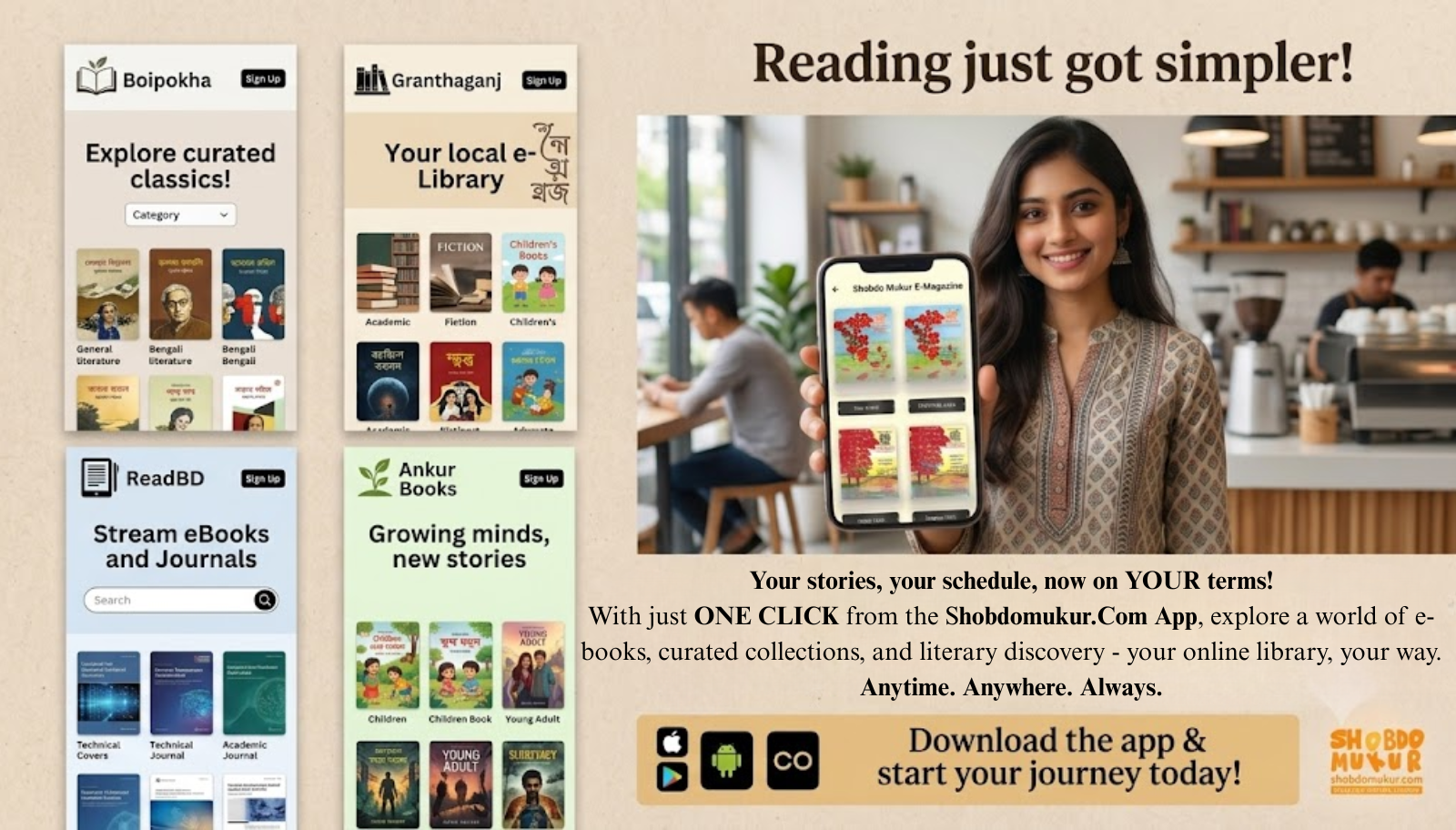
At the heart of the platform sits the monthly Shobdo Mukur e-magazine, a publication that approaches life with breadth and accessibility. Economics and entertainment, law and literature, technology, fashion, cooking, travel, interior design, personal development: every subject is handled in a manner designed to open new pathways in everyday life rather than to overwhelm or exclude. The magazine does not offer merely information but solutions; not merely perspectives but ways of thinking and living. It is, as the platform’s own ethos describes it, a reflective surface where thoughts, perspectives, and dreams come alive.
Within the library lives a further dimension of depth: Monon Mukur Media E- Publications. This is the editorial and publishing arm of Shobdomukur, and it represents a genuine departure from the passive catalogue model of its competitors. Here, readers discover curated e-books including single-author stories and poetry collections by both emerging and established writers, each book carrying its own artistic identity. Carefully compiled essay collections on eminent figures of Bangla art and literature, written by some of today’s most promising authors, sit alongside a rich selection of stories, poems, and essays from literary magazines including Kothar Kagoj. The platform also features selected e-books from two of Bangladesh’s established publishing houses, Student Ways and Aajob Prokash, broadening the catalogue through meaningful editorial partnerships rather than indiscriminate aggregation.
This distinction between curation and aggregation is important. Shobdomukur does not simply distribute existing content. It edits, commissions, and publishes, positioning itself as both a reading destination and a literary publication house. That dual identity separates it from every other platform in the Bangladeshi market.
Reader Experience and Multimodal Design
One of the clearest gaps in the existing e-reading landscape is the experience gap, and it is here that Shobdomukur’s multimodal approach offers a meaningful contrast. Rather than forcing readers into a single format or a single device type, the platform is designed to meet readers where they are, whether that is on a desktop browser, a mobile phone, or any other connected device, and whether they are reading long-form literary essays, browsing the monthly e- magazine, or engaging with a curated e-book collection.
The platform’s web portal is built around the reader rather than around the content delivery system, a distinction that sounds small but shapes everything about the experience. Content is presented with care for readability, for aesthetic coherence, and for the sense that this is a space designed for people who take reading seriously and who expect to be taken seriously in return. And the multimodal dimension also extends to the range of content types available.
Privacy, Data Security, and Reader Trust
In a digital environment where reader trust is hard to earn and easily lost, Shobdomukur’s approach to data privacy and security deserves attention. The platform collects only what is necessary: name, email, billing address, and basic usage data such as pages visited and device type. Payment processing is handled entirely by Stripe for international transactions and SSLCommerz for readers within Bangladesh, both of which are secure, reputable third parties with their own published privacy policies. Shobdomukur does not store card details or access full payment data.
The platform uses cookies to enhance user experience and analyse behaviour, and readers retain full control through their browser settings. Personal information is never sold or rented to third parties for marketing purposes. Readers can access, update, or request deletion of their data at any time, and the platform operates a straightforward unsubscribed process for newsletters. Shobdomukur is also designed for adult readers and does not knowingly collect data from children under thirteen.
This is the kind of responsible, transparent data practice that a platform asking for a subscription and a reader’s trust ought to maintain, and it is worth noting explicitly in a landscape where such transparency is not always the norm.
The Road Ahead
Shobdomukur’s promise is genuine and its vision is clear, but the road ahead requires honest acknowledgement of what remains to be done. Subscription-based models face deep cultural resistance in a market where pirated content remains widely available and free. The bilingual catalogue, while distinctive, must grow substantially to provide the depth that sustains reader loyalty over time. User experience across all devices must continue to be refined to match the standards that readers accustomed to Kindle, Apple Books, or international literary platforms have come to expect. Discoverability, particularly for the diaspora and international readers the platform hopes to serve, will require deliberate investment in search optimisation, social media presence, and cross-border literary community building.
None of these challenges is beyond reach. Each requires sustained investment, editorial ambition, and a commitment to treating the reader as a thoughtful person in search of meaning, not merely a consumer in search of content.
Bangladesh’s digital reading landscape stands at a genuine inflection point. The online bookstores have demonstrated that demand exists. The existing e-book platforms have proved that digital reading is technically feasible. Piracy has revealed both the appetite for reading and the barriers that drive people toward free alternatives. What has been missing, until now, is a platform that understands reading as a cultural act rather than a commercial transaction, and that sees Bangladeshi literature as a bilingual heritage capable of speaking to the world.
Words, as Shobdomukur’s own founding vision puts it, never truly disappear. They echo in a mirror, and within that echo, we discover our own identity. The platform’s dream is to carry the power of life, knowledge, culture, and beauty in the Bangla language to every corner of the world, and in doing so, to help build a more conscious, creative, and humane society. That is not a small ambition. It is, in fact, exactly the ambition that a platform built on words ought to have.