
Desk Report
Oniket Desk
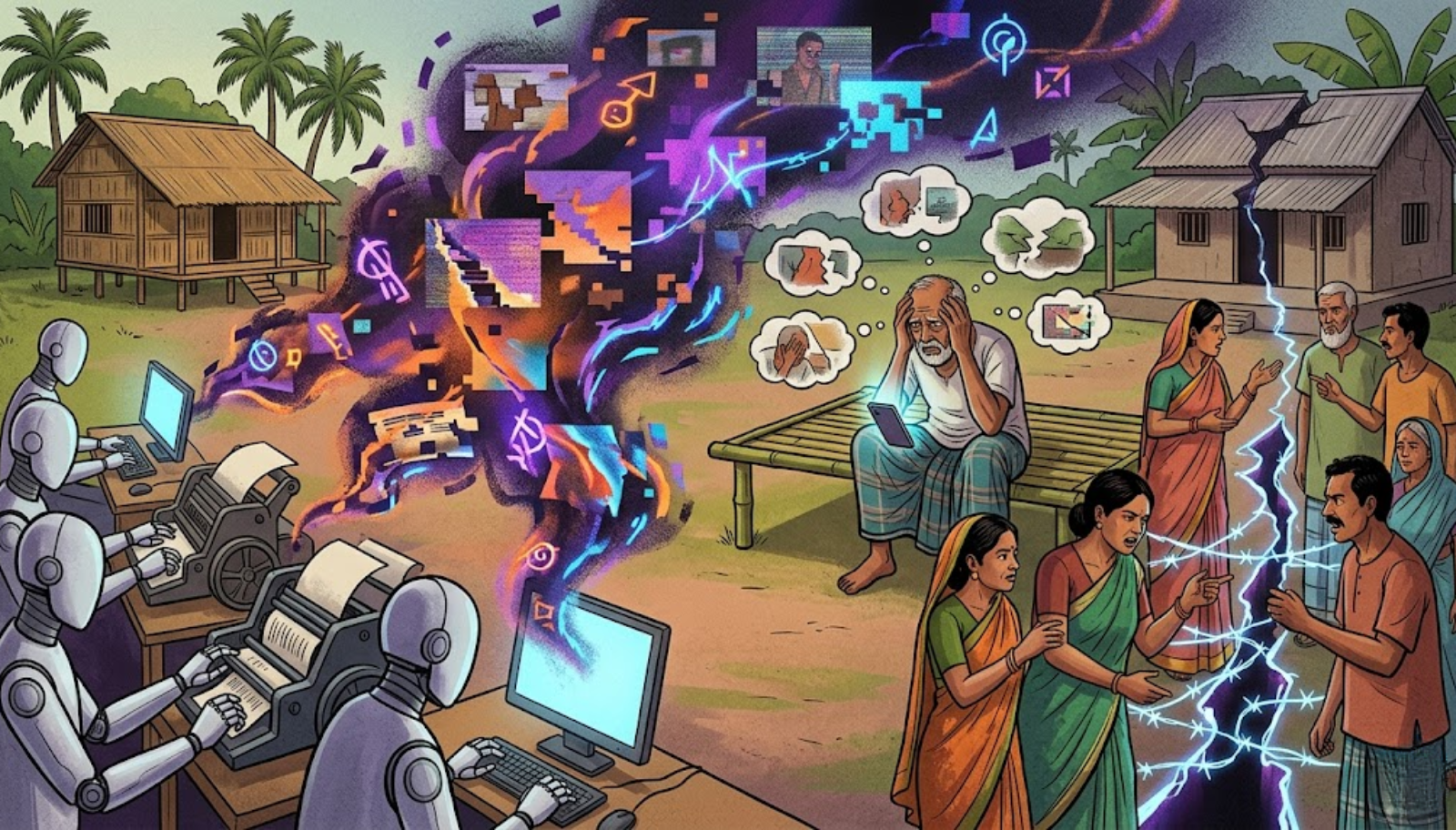
Bangladesh is fighting two simultaneous crises in the information space. One is visible, and the other is largely invisible. The visible crisis is the torrent of fake news, AI-generated deepfakes, and coordinated bot propaganda that floods its social media platforms daily. The invisible one is what this torrent is doing to the minds, emotions, and social bonds of the 50 million Bangladeshis who consume it.
Together, they constitute a public health and democratic emergency that the country’s institutions have been painfully slow to recognise, let alone address.
Stress, Anxiety, and the Psychology of Misinformation
The psychological consequences of chronic misinformation exposure are well documented globally but poorly measured domestically. In Bangladesh, where Facebook functions as the primary news medium for a large segment of the population, the daily encounter with fabricated images, manipulated videos, death hoaxes, and inflammatory narratives creates a state of sustained cognitive distress.
When individuals cannot reliably distinguish truth from falsehood and research indicates that over 60 percent of Bangladeshi social media users trust the misinformation they encounter, the result is a condition of chronic uncertainty that psychologists associate with heightened anxiety, sleep disruption, and social withdrawal.
Young people and first-time voters are particularly vulnerable. Adolescents and young adults, whose critical faculties are still developing, are disproportionately targeted by emotionally manipulative content designed to provoke outrage rather than inform. They judge the severity of information by how it feels, not by its verifiability. The result is a generation increasingly prone to reactive emotional states (anger, fear, and mistrust) that are not grounded in reality but are no less psychologically damaging for being manufactured.
The cumulative effect of this environment is a population under informational siege, with no reliable institutional refuge. When mainstream media logos are routinely forged to lend credibility to fabrications as occurred repeatedly during the political upheaval of 2024, when fake photo cards bearing the mastheads of Prothom Alo, Somoy TV, and others went viral, even trust in legitimate journalism collapses. This erosion of epistemic safety is a form of structural stress inflicted on an entire society.
Social Division and the Architecture of Hate
The social consequences of bot-driven propaganda are equally grave. Bangladesh’s history of religious and ethnic coexistence, always fragile, has been systematically targeted by coordinated disinformation campaigns designed to inflame communal tensions. AI-generated images of burning temples, fabricated videos of minority women being abducted, and recycled footage from entirely unrelated incidents in other countries have all been weaponised to portray Bangladesh as a nation descending into sectarian violence.
The goal is not merely to deceive; it is to mobilise. And it works: studies confirm that negative reactions to misinformation in Bangladesh outnumber positive ones by seventeen to one, and that coordinated online hate speech has directly preceded documented incidents of mob violence, arson, and extrajudicial killings in the physical world. Online propaganda does not stay online. It bleeds into streets, neighbourhoods, and communities, fracturing the social fabric one viral post at a time.
Policy Challenges: Information, Journalism, and Mass Media
Bangladesh’s policy response to this crisis has been characterised by reactive legislation, institutional under-capacity, and a confusion between suppressing dissent and combating disinformation. The country has only 40 to 50 professional fact-checkers for a population of 170 million, a capacity gap that is not merely inadequate but structurally untenable in an era of generative AI that can produce convincing synthetic media at industrial scale. YouTube and X operate without accredited fact-checking programmes in Bangladesh, unlike Facebook, leaving critical blind spots in the verification infrastructure.
Legislation introduced hastily in pre-election periods has lacked stakeholder consultation, clear definitional boundaries between harmful misinformation and legitimate political speech, and judicial safeguards against arbitrary enforcement. The Digital Security Act, in its various iterations, has been used more visibly against journalists and critics than against bot networks and propaganda operators inverting the purpose of information governance entirely.
The journalism sector itself faces a structural crisis. As the business model of independent media erodes under digital disruption, newsrooms lack the resources to maintain verification desks, train reporters in AI-detection, or sustain the investigative capacity necessary to hold misinformation to account. A media ecosystem weakened by commercial pressure and political interference cannot serve as the epistemic anchor a democracy requires.
The Reforms That Are Needed
A credible reform agenda must operate simultaneously across four domains. On information governance, a dedicated and independent Digital Information Authority (insulated from political influence) must be established with a clear legal mandate to identify and flag coordinated inauthentic behaviour, bot networks, and synthetic media campaigns without jurisdiction over legitimate political speech.
On journalism, sustained public and international funding must support the expansion of independent fact-checking infrastructure from dozens to hundreds of certified professionals, embedded across both national and regional media. On media literacy, digital critical thinking must be integrated into the national school curriculum as a compulsory subject from secondary level upward, equipping the next generation to interrogate rather than simply consume what they encounter online. On mental health, the government must formally recognise misinformation-induced stress as a public health concern, funding community-level psychological support services and public awareness campaigns that address the emotional toll of the information environment, not merely its political consequences.
Fake news and bot propaganda are not abstract threats to democracy. In Bangladesh, they are daily lived realities that raise blood pressure, deepen divisions, and cost lives. The policy response must match that gravity.

