
Desk Report
Oniket Desk
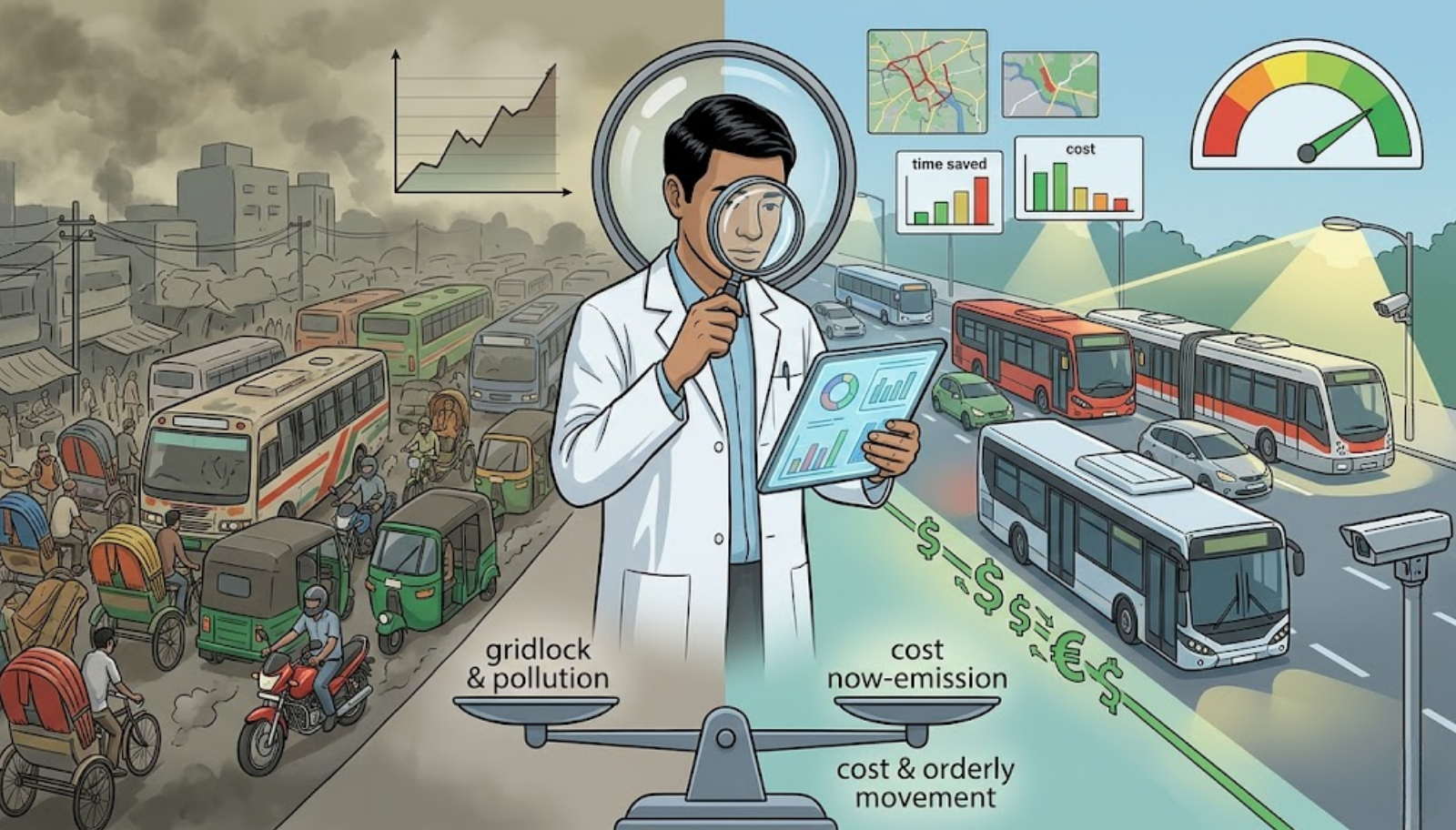
Dhaka is, by most objective measures, one of the most congested and polluted cities in the world. Average traffic speeds in the capital have fallen to levels that make meaningful economic activity across the city increasingly difficult, while air quality consistently ranks among the worst globally, imposing enormous costs on public health, productivity, and quality of life.
Against this backdrop, the idea of a congestion charge (a fee levied on vehicles entering defined urban zones, modelled on London’s Low Emission Zone and Ultra Low Emission Zone) is an obvious topic for a serious policy discussion. The question is not merely whether such a scheme is theoretically sound. It is whether it is institutionally feasible, socially equitable, and practically enforceable in the specific conditions of Dhaka.
Traffic, Environment, and Revenue
The economic logic underpinning congestion charging is well established. Traffic congestion is a classic market failure where individual drivers do not bear the full social cost of their decision to enter a crowded road network. They impose delays on other road users, contribute to air pollution affecting thousands, and consume public road space without paying for the privilege. A congestion charge corrects this market failure by pricing road use, incentivizing drivers to reconsider unnecessary journeys, shift to public transport, travel at off-peak times, or use fewer polluting vehicles.
London’s experience demonstrates this logic in practice. The introduction of the central London congestion charge in 2003 reduced traffic volumes significantly in the charging zone within the first year. The subsequent ULEZ, which targets the most polluting vehicles with a daily fee, has measurably improved air quality across large parts of the city, reducing nitrogen dioxide concentrations and particulate matter levels in ways that translate directly into reduced respiratory illness and premature death. Revenue generated has been reinvested into public transport improvements, cycling infrastructure, and bus fleet electrification creating a virtuous cycle where the charge both reduces harmful journeys and funds the alternatives.
Dhaka’s circumstances make the environmental and public health case for such intervention arguably even more compelling than London’s. Vehicle emissions, combined with industrial pollution and construction dust, create dangerous air quality year-round. Brick kilns on the city’s periphery and an ageing fleet of two-stroke auto-rickshaws, diesel buses, and poorly maintained trucks release pollutants at levels far exceeding safe thresholds. A well-designed emission-based charging zone, targeting the most polluting vehicle classes entering central Dhaka, could accelerate fleet modernization while generating substantial dedicated revenue for transport infrastructure investment.
Why Dhaka Is Not London
Yet the transplantation of London’s model to Dhaka faces profound structural obstacles that cannot be dismissed as implementation details. They are fundamental preconditions that do not currently exist.
London’s congestion charge works in part because a credible alternative exists. The Underground, buses, cycling lanes, and walking infrastructure give drivers a genuine choice. In Dhaka, public transport remains severely inadequate for most of the population. The Dhaka Metro Rail, while a welcome development, covers a limited corridor and serves a fraction of daily commuters. Buses are overcrowded, unreliable, and lack formal network integration. Imposing a congestion charge without first developing viable alternatives would not redirect journeys. It would simply be a tax necessity, falling hardest on lower-income workers who must travel to earn their livelihoods and have no other means of doing so.
Enforcement presents an equally serious challenge. London’s system is underpinned by a dense, reliable network of automatic number plate recognition cameras, a functioning vehicle registration database, and a legal and banking infrastructure that enables seamless payment and penalty collection. Dhaka’s vehicle registration data is notoriously incomplete, a significant proportion of vehicles on the road operate without valid documentation, and the institutional capacity for large-scale automated enforcement does not yet exist. Without enforcement, a congestion charge is not a policy, it is a suggestion.
Equity must also be central to any assessment. Dhaka is a city of profound economic inequality. A flat daily charge, insufficiently calibrated to income or journey purpose, risks functioning as a regressive tax (one that the wealthy absorb as a minor inconvenience while pricing out lower-income commuters, small traders, and essential workers). The political sustainability of any such scheme depends heavily on its perceived fairness.
A Mechanism That Could Work in Dhaka
None of these challenges renders congestion charging unworkable in Dhaka, but they define the conditions under which it could be effective, and the sequencing that must precede its introduction. The most viable approach for Dhaka in the near term is a phased, emissions-differentiated charging model rather than a blanket entry fee.
In the first phase, the heaviest and most polluting vehicle categories (diesel trucks, two-stroke three-wheelers, and ageing buses operating below minimum emission standards) should be subject to entry restrictions or graduated charges within a defined central zone during peak hours. This narrows the scope, simplifies enforcement, and builds institutional capacity without immediately confronting the full complexity of a city-wide scheme. Revenue collected must be legally ring-fenced and publicly accountable, dedicated exclusively to expanding bus rapid transit, accelerating Metro Rail extensions, and funding last-mile connectivity solutions.
In parallel, a mandatory vehicle inspection and emissions certification system must be established and rigorously enforced, creating the clean vehicle registry that any emission-based charge depends upon. Digital payment infrastructure (leveraging Bangladesh’s rapidly growing mobile financial services ecosystem) must be developed to enable frictionless charge collection without cash transaction bottlenecks. Low-income commuter exemptions or subsidized transit passes must be embedded in the scheme design from the outset to ensure social equity is structurally protected rather than rhetorically promised.
Policy Challenges and Political Will
The greatest barrier to congestion charging in Dhaka is not technical. Unfortunately, it is political. Restricting vehicle access and imposing charges on road use will face resistance from vehicle owners, transport operators, business associations, and a public with understandable skepticism toward government revenue initiatives. The political economy of urban transport reform in Bangladesh has historically favored inaction over difficult structural change. Overcoming this requires not only technical design but sustained political leadership, transparent public communication, independent oversight of revenue use, and genuine consultation with affected communities.
A congestion charge is neither a silver bullet nor an irrelevant foreign idea for Dhaka. It is a policy instrument of proven effectiveness that requires the right institutional foundations, the right sequencing, and the right political commitment to function as intended. Imported wholesale and prematurely, it risks becoming an inequitable and unenforceable burden. Developed carefully, as part of a coherent urban mobility strategy, it offers Dhaka a fiscally self-sustaining mechanism to simultaneously reduce congestion, clean its air, and fund the public transport transformation its citizens urgently deserve.