
Iqbal Mahmud
Khulna University
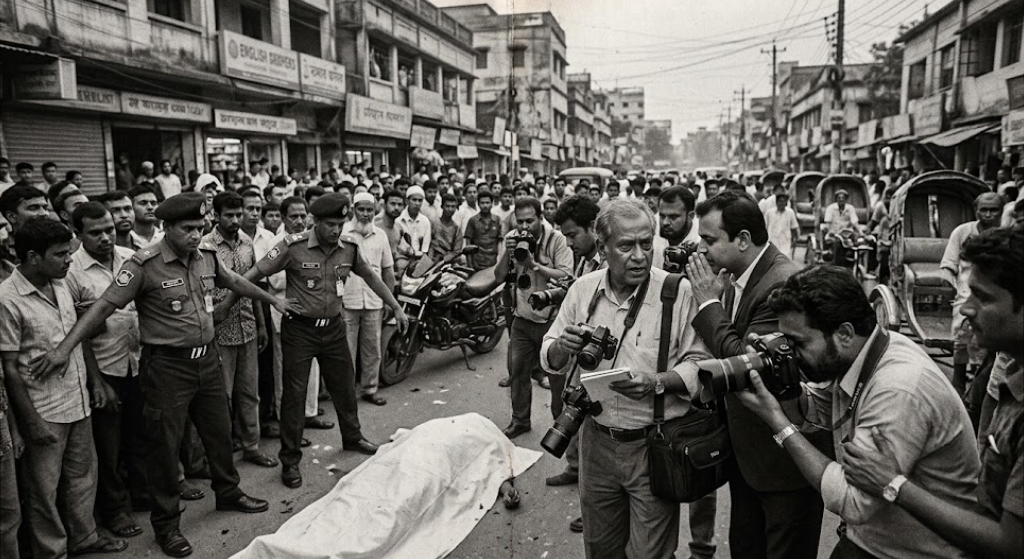
Crime reporting in Bangladesh occupies a peculiar and vulnerable position. It touches on police investigations, political interests, business rivalries, and personal reputations all at once, which makes it uniquely exposed to influence from parties who benefit from a particular version of events reaching the public. The result, increasingly visible in recent years, is a media environment where accuracy sometimes takes a back seat to whichever narrative serves the loudest or best-connected interest.
This article examines how lobbies and vested interests distort crime coverage in Bangladesh, what this means for accuracy and public trust, and what reforms in media culture, ethics, and government policy could restore the integrity of this vulnerable beat.
How Lobbies Shape What Gets Reported
Vested interests rarely announce themselves directly. Influence over crime coverage tends to arrive through selective police leaks protecting a preferred theory, pressure from local political figures whose associates may be implicated, or business interests seeking to bury or amplify stories about competitors. A single unverified tip, if it suits a powerful source, can reach a front-page headline within hours, without the independent verification responsible for reporting demands.
This is compounded by reliance on official sources. When police statements are treated as fact rather than one party’s account requiring corroboration, investigators and politically connected figures can shape public perception before any court weighs the evidence. Recent legal actions against journalists covering corruption, including criminal defamation and cyber security charges, show how this relationship can turn adversarial enough to discourage independent scrutiny altogether.
The Cost of Accuracy and Public Trust
The consequences of this dynamic fall most heavily on accuracy. Sensationalized crime coverage, built around unverified claims or a single source’s framing, can convict a suspect in public opinion long before any judicial process concludes. It can also protect genuine guilt when that person has sufficient influence to suppress or redirect coverage. Victims and their families are frequently the least powerful party in this equation, and their version of events is often the first to be dropped when a more politically convenient narrative is available.
Public trust erodes accordingly. Bangladesh’s press freedom standing has slipped in recent international assessments, and part of that decline reflects a public and professional recognition that crime and political reporting are increasingly shaped by who has access and leverage rather than by verified fact. Once audiences suspect that a story reflects someone’s interest rather than an honest accounting of events, they either disengage from news entirely or gravitate toward outlets that simply confirm what they already believe, deepening polarization rather than informing debate.
Propaganda Dressed as Journalism
A particularly corrosive outcome of lobby influence is the normalization of propaganda framed as reporting. Stories designed to discredit a political rival, distract from an unrelated controversy, or protect a business interest can be published with the visual and structural conventions of legitimate journalism, quotes, bylines, official sounding sources, while serving a purpose entirely disconnected from public interest. Readers, lacking the tools or time to interrogate sourcing, often cannot distinguish this from genuine reporting, which is precisely what makes it effective as a tool of influence.
Reforms Worth Pursuing in Media Culture
Fixing this problem calls for action on several fronts at once. Newsrooms should adopt internal rules requiring at least two independent sources before publishing any crime allegation and should draw a firm line between confirmed facts and claims made by police or prosecutors that courts have not yet tested. Making bylines and editorial sign off carry real weight would also help, so that when an unverified allegation later turns out to be false, the reporter and editor involved answer for it rather than outlets facing little to no fallout for damaging stories that do not hold up.
On the training side, press associations, universities, and international media development groups should jointly build programs that go deeper into how to verify sources and handle crime and court coverage responsibly, since this beat is so easily turned into a tool for outside interests.
Strengthening the Code of Conduct and Institutional Oversight
Bangladesh’s Press Council has long enforced a code emphasizing truthfulness and accuracy, but its mechanisms remain limited, and no equivalent binding code governs broadcast or online outlets.
A unified, enforceable code covering print, broadcast, and digital journalism, developed jointly by journalist associations, editors, and civil society rather than imposed by government, would give the profession a shared standard. Recent Editors’ Council efforts toward such a code are meaningful, provided the standard has real enforcement teeth rather than existing only on paper.
The Ministry of Information’s proper role is as facilitator, not regulator. Its most constructive contributions would be funding independent training, supporting a press complaints mechanism insulated from political pressure, and reforming legal provisions, including elements of cyber security legislation, used to criminalize legitimate reporting. A ministry protecting press independence, rather than enabling lobbies to pressure journalists into silence, would do far more to restore trust than added state control.