
Desk Report
Bangladesh heads toward the 2028 Summer Olympics in Los Angeles carrying a distinction no nation desires: it remains the most populous country on earth, exceeding 170 million people, that has never won an Olympic medal.
Since its debut as an independent nation at the 1984 Los Angeles Games, Bangladesh has sent approximately 49 athletes across ten editions of the Summer Olympics, competing in archery, athletics, swimming, shooting, golf, and artistic gymnastics. Not one has reached a final, let alone a podium. The question is no longer whether this record is disappointing but whether the government is willing to make the structural changes necessary to break it.
Current Preparations
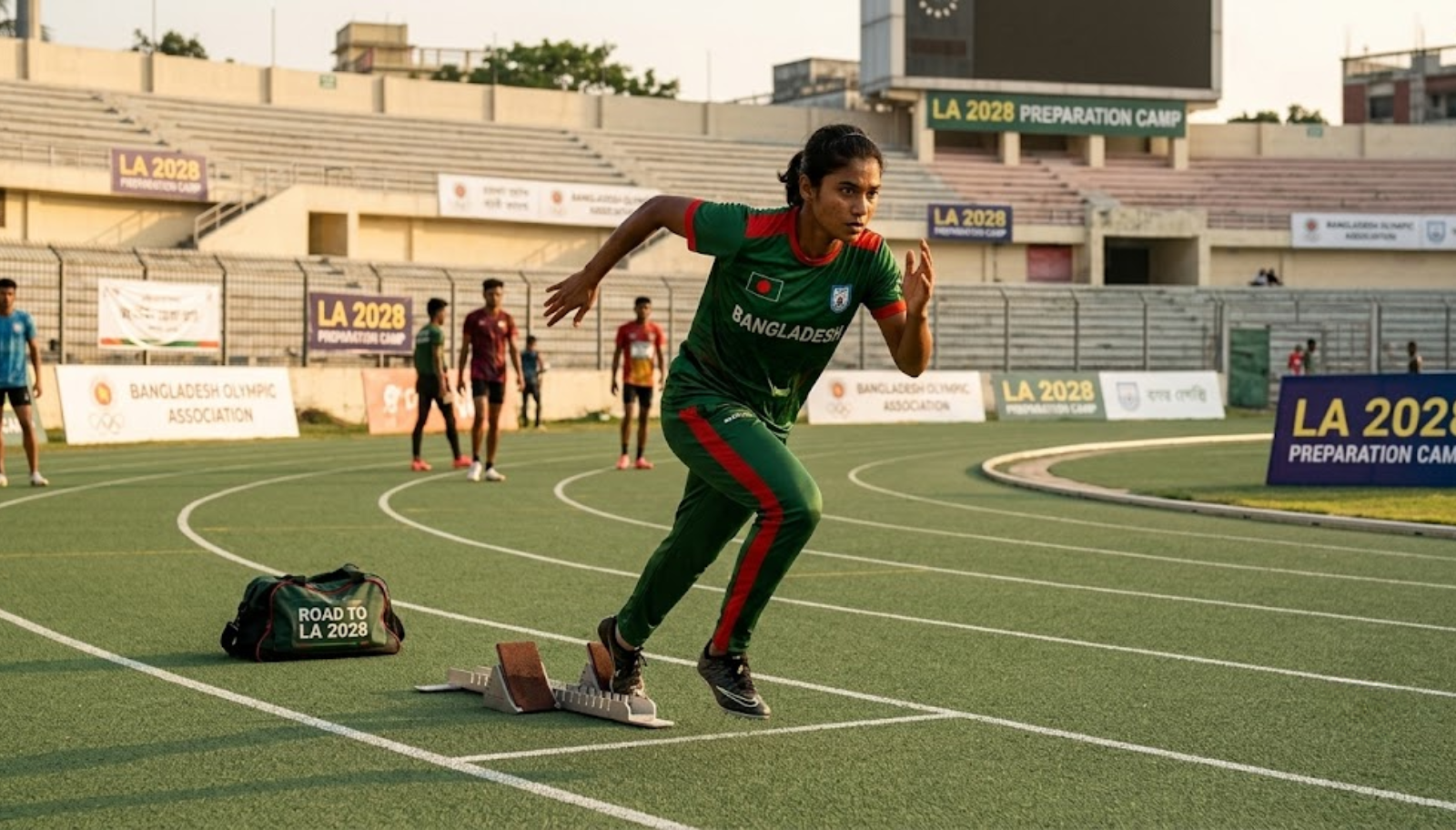
The Bangladesh Olympic Association has declared that its preparation program for Los Angeles 2028 is the most comprehensive in the nation’s history. In early 2026, the BOA created a special emergency fund of Tk 10 crore to eliminate the procedural delays that have historically crippled training timelines, allowing federations to launch camps without waiting for government budget approvals. The association is sending 202 athletes across 26 disciplines to the Asian Games in Japan; the largest such contingent Bangladesh has ever assembled.
Plans are advancing for a sprawling Olympic Complex on 173 acres of land, designed to accommodate facilities for 33 sporting disciplines and a 35,000-seat stadium. The government has also announced initiatives to establish sports villages in all 64 districts, while a Sports Card and Sports Allowance programme now covers 129 national level athletes with direct financial assistance, with plans to expand to several hundred more. These are positive signals, but they remain incomplete answers to a deeply structural problem.
The Scale of the Deficit
The Ministry of Youth and Sports received an allocation of Tk 2,423 crore, roughly 205 million dollars, in the proposed budget for fiscal year 2025 through 2026, most of which funds youth programmes, stipends, and basic infrastructure rather than high performance training. In the 2020 through 2021 period, the overall sports budget was approximately 5.7 million dollars, which is 23 times lower than India’s on a per capita basis. The result is visible in every Olympic cycle: athletes lack access to modern training facilities, international standard equipment, qualified coaching, sports science support, and sustained overseas exposure.
Archery remains the country’s most promising discipline, after Mohammed Ruman Shana and Diya Siddique placed ninth in the mixed team event at Tokyo 2020, yet even archers train without consistent access to elite level competition environments. The women’s football team withdrew from the 2024 Asian qualifiers explicitly due to financial constraints, revealing how shallow the commitment truly runs.
Essential Steps for Government Action
First, the sports budget must increase dramatically and be ring fenced for elite development. The current allocation cannot simultaneously fund grassroots participation and Olympic level preparation. A dedicated high-performance fund, insulated from general expenditure and governed by transparent disbursement mechanisms, is essential. Without it, every other reform collapses under fiscal pressure.
Second, governance reform within the BOA and national federations must be treated as nonnegotiable. Past allegations of financial mismanagement, politically aligned appointments, and nepotism in committee formation have diverted resources away from athletes and toward patronage networks. The Anti-Corruption Commission should maintain standing oversight of all sports bodies receiving public funds. Federation elections must adhere to international standards of transparency, with term limits and mandatory financial audits.
Third, Bangladesh must concentrate its limited resources on sports where it has a realistic path to competitiveness. Archery, shooting, and weightlifting offer the most viable routes to qualification and meaningful performance. A targeted medal programme that identifies twenty to thirty athletes across these disciplines and provides them with multiyear training contracts, foreign coaching, biomechanical analysis, nutritional support, and sustained international competition exposure would yield far greater returns than spreading thin resources across 26 disciplines.
Fourth, the talent pipeline must begin at the school level. Most Bangladeshi international athletes emerge from rural and district backgrounds, yet the school and college sports framework has largely collapsed. Reviving institution-based competitions, establishing district level talent identification centres linked to national training hubs, and creating scholarship pathways from school through university will expand the athlete pool dramatically. Simultaneously, addressing cultural barriers to female participation requires safe sporting environments for girls, dedicated accommodation at training camps, and family outreach programmes that reframe sports as a legitimate career path for women.
Fifth, the proposed Olympic Complex and district sports villages must be completed on schedule and to international standards, not as ceremonial projects that languish in delayed construction while athletes continue training on inadequate grounds. The complex must house sports science laboratories, physiological testing centres, rehabilitation facilities, and residential accommodation that allow athletes to train full time without external livelihood concerns.
Sixth, the Sports Card programme requires rapid expansion and legal permanence. Financial security allows athletes to commit fully to training rather than abandoning sport for survival income. Extending coverage to coaches, physiotherapists, and trainers builds the professional support ecosystem that every competitive Olympic nation takes for granted.
The Imperative
Los Angeles 2028 is not a distant abstraction. The qualification window for most Olympic disciplines has already opened. Bangladesh has four years to convert unprecedented intent into unprecedented outcomes. Competitive nations invest in sport as strategic national infrastructure. Until Bangladesh does the same, its Olympic delegations will continue to travel as participants rather than contenders, and the medal drought that defines its sporting identity will persist as a matter of choice rather than circumstance.