Iftekhar Rahman
Verdant Global
A Manufacturing Power Without Brand Power
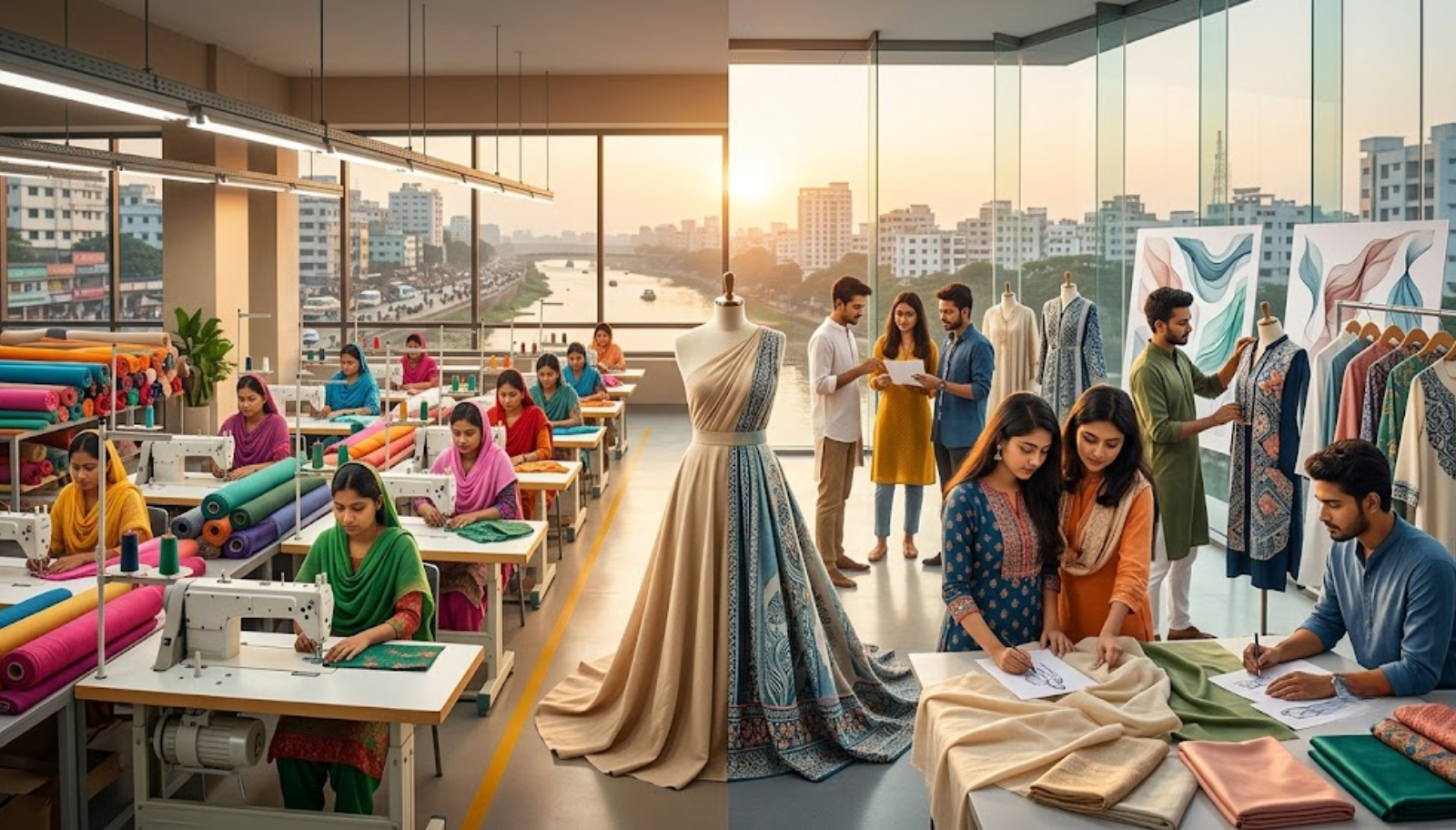
Bangladesh has built one of the world’s most important apparel manufacturing platforms. Its factories supply major international retailers and its ready-made garment sector anchors national exports. Yet a strategic paradox remains. Bangladesh is globally competitive in producing clothing for others, but Bangladeshi clothing brands have not achieved equivalent strength as consumer-facing brands at home or abroad. ¹
This is not a failure of capability. It is a value-chain issue. Bangladesh has mastered production, compliance response, cost discipline and large-volume delivery. However, higher-margin functions such as design ownership, consumer data, retail experience, pricing power and storytelling remain largely controlled by international buyers. The next stage requires a shift from manufacturing excellence to brand competence.
The Structural Legacy of Contract Manufacturing
The roots of the problem are structural. The garment industry developed mainly through contract manufacturing for foreign labels. This model generated employment, foreign exchange and industrial scale, but it did not require most firms to build design studios, consumer-research teams, retail networks or marketing platforms. Over time, the sector became highly effective at execution, but less experienced in creating original fashion identities.
This legacy still shapes industry behaviour. Production is often treated as the centre of strategy, while branding is treated as secondary. That approach was workable when preferential market access, labour-cost advantage and buyer-led sourcing defined competitiveness. It is less sufficient where consumers, regulators and retailers increasingly reward differentiation, sustainability and speed to market.
Domestic Brands and the Perception Gap
The domestic market shows both promise and limitation. Bangladesh already has credible local names such as Aarong, Yellow, Sailor, Ecstasy and Le Reve. These examples show that local brand-building is possible. However, many urban consumers still associate foreign labels with higher quality, prestige and aspiration.
That perception cannot be changed by patriotic messaging alone. It requires consistent design quality, disciplined merchandising, stronger retail presentation, reliable sizing, after-sales service and confident brand language. A local brand that sells a good product but lacks a credible lifestyle proposition will struggle against regional competitors.
Design, Digital Capability and Market Access
Design is an industrial priority, not a decorative function. Bangladesh has made progress through institutions such as BGMEA University of Fashion and Technology, which supports fashion education with industry links. ² However, the wider ecosystem remains underdeveloped compared with countries that treat design and branding as export capabilities.
Bangladesh needs stronger pipelines connecting fashion institutes, factories, retailers, artisans, e-commerce platforms and mentors. Design education should include consumer analytics, digital product development, sustainability, pricing, intellectual property and international retail management. Without this broader training base, many brands will remain reactive rather than trend responsive.
The digital gap is equally important. Global fashion is shaped by online discovery, social media aesthetics, influencer networks, data-led merchandising and direct-to-consumer sales. Many Bangladeshi brands still use digital platforms mainly as sales channels, not full brand ecosystems. A competitive brand needs content discipline, customer segmentation, payment trust and data analytics.
Market access adds urgency. Bangladesh remains a leading global apparel exporter, but LDC graduation will gradually reduce preferential trade advantages in key markets. ³ ⁴ This could increase margin pressure if the sector continues to compete mainly on cost. In that environment, brand equity becomes protection. A company that owns customer loyalty can defend price better than a manufacturer competing only for buyer orders.
Sustainability, Heritage and Intellectual Property
Sustainability is now a strategic requirement. Global apparel regulation is moving towards circularity, traceability, responsible sourcing and lower-waste production. UNEP has emphasised that sustainability in textiles requires changes across consumption, production practices and infrastructure. ⁵ For Bangladeshi brands, sustainability cannot remain a compliance slogan. It must shape design, sourcing, labelling, packaging and consumer communication.
Bangladesh also has a cultural advantage that remains under-commercialised. Maslin, jamdani, katha, natural fibres and artisanal techniques provide a basis for a distinctive fashion identity. Jamdani’s protection under Bangladesh’s geographical-indication framework shows that heritage can be treated as an economic asset, not only a cultural memory. ⁶
The objective should not be to imitate Indian, Turkish or Western fashion. It should be to build a contemporary Bangladeshi aesthetic that is authentic, exportable and commercially disciplined. This requires trademarks, design rights, geographical-indication protection where appropriate, artisan partnerships and safeguards against imitation.
A Policy Framework for Brand Competitiveness
Policy support must evolve. Existing incentives have largely supported export production. That remains important, but brand-building requires different instruments. Public support should not only finance factories. It should also finance design, branding, market entry and intellectual property protection. A Bangladesh Fashion Brand Development Fund could support design studios, international marketing, e-commerce infrastructure, product testing, IP registration and market-entry campaigns.
Support should be transparent and performance linked. Indicators could include export sales, employment quality, women-led design participation, artisan integration, sustainability compliance and digital-market expansion. This would reduce subsidy leakage and ensure that public support creates measurable national value.
Industry coordination is also required. BGMEA, BKMEA, fashion universities, chambers, export-promotion agencies and leading local brands should establish a Bangladesh Fashion Competitiveness Council. It should coordinate design education, market intelligence, retail standards, sustainability readiness, international fair participation and export pathways for local brands.
From Factory Strength to Fashion Identity
Bangladesh should develop a governed “Made in Bangladesh Fashion” platform. This should not be a loose slogan. It should operate through quality standards, ethical sourcing criteria, design integrity, traceability expectations and credible certification. Such a platform could support local brands, attract international collaborations and reposition the country as a credible fashion-origin economy.
Bangladesh does not need to abandon its manufacturing strength. It needs to convert that strength into higher-value ownership. The next challenge is not simply to export more garments. It is to own more design, consumer trust, brand equity and pricing power. Bangladesh’s next apparel competitiveness will depend not only on how much it exports, but how much value it owns.
References
- Bangladesh Garment Manufacturers and Exporters Association, Export Performance, Dhaka, BGMEA, available at BGMEA Export Performance.
- BGMEA University of Fashion and Technology, Department of Fashion Design and Technology, Dhaka, BUFT, available at BUFT Department of Fashion Design and Technology.
- Mohammad Abdur Razzaque, Deen Islam and Jillur Rahman, Can Bangladesh Absorb LDC Graduation-Induced Tariff Hikes? Evidence Using Product-Specific Price Elasticities of Demand and Markups for Apparel Exports to Europe, International Growth Centre and Research and Policy Integration for Development, 2024, available at International Growth Centre.
- World Trade Organization, Bangladesh Working Towards a Sustainable Export Future, Geneva, WTO, available at World Trade Organization.
- United Nations Environment Programme, Sustainability and Circularity in the Textile Value Chain. A Global Roadmap, Nairobi, UNEP, 2023, available at United Nations Environment Programme.
- Circle Economy Foundation, Chatham House and European Environmental Bureau, Impacts of EU Circular Textiles Policy on Trade Partners. A Case Study of Bangladesh, 2025, available at Circular Economy Earth.
- Mahua Zahur, Challenges for “Jamdani Saree” and “Bangladesh Ilish”, the Two Registered Geographical Indications from Bangladesh in the Post-Registration Epoch, WIPO-WTO Colloquium Papers, Geneva, World Trade Organization, 2018, available at World Trade Organization.