
Naima Onamika
Commissioning Editor, The Oniket Bulletin
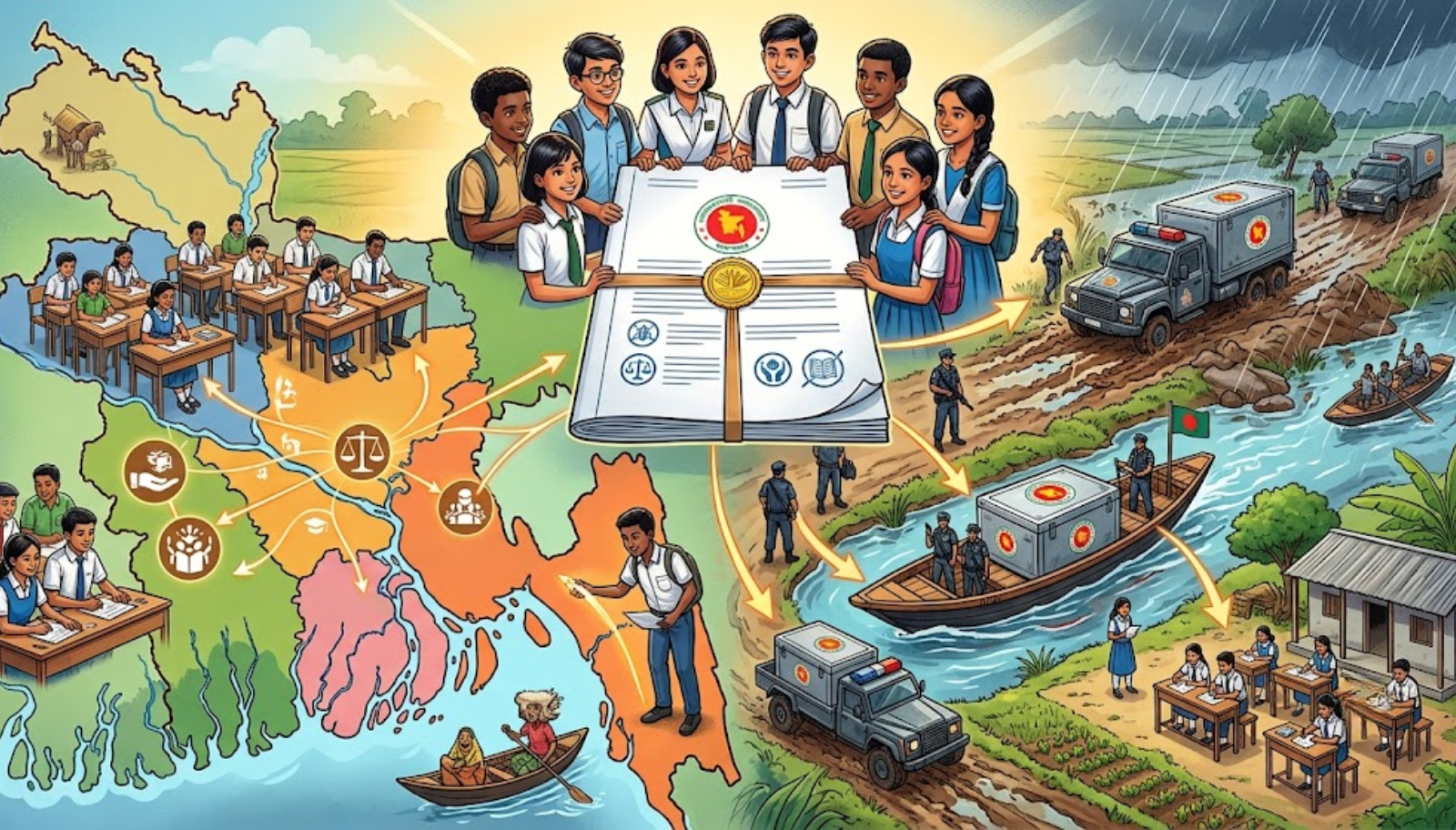
For many years, Bangladesh’s secondary and higher secondary education system has faced criticism over disparities in the standard and difficulty of examination papers prepared by different education boards. In response, the government has introduced the “One Nation, One Question Paper” policy, under which all general education boards administer the SSC and HSC examinations using a single, common question paper. The primary objective of this initiative is to ensure greater fairness and transparency in student assessment. While the policy has the potential to open new opportunities for educational reform, it also raises several important concerns and implementation challenges.
As one of the most significant education reforms currently under discussion, the policy deserves careful public consideration. A balanced understanding of both its strengths and limitations is essential. With that objective in mind, this article presents an analytical assessment of the “One Nation, One Question Paper” policy.
The Potential Benefits
The most significant advantage of a common question paper is that all students across the country will be assessed using the same academic standard. This is expected to reduce the long-standing inequalities created by variations in the difficulty of examination papers among different education boards. As a result, examination outcomes are likely to provide a more accurate reflection of a student’s ability and level of preparation.
A uniform examination system would also make competition for university admission and employment more equitable, as students from different education boards would be evaluated under identical conditions. In addition, a common question paper could help establish a national benchmark for educational assessment, making it easier to monitor curriculum implementation, evaluation methods, and the overall quality of education.
Centralised preparation of examination papers would also create an opportunity to involve the country’s most experienced academic experts, potentially improving the quality of question papers while strengthening quality assurance mechanisms. Furthermore, many countries already conduct national examinations through a unified assessment system. Adopting a similar approach could help Bangladesh move towards a more internationally recognised and credible assessment framework.
The Challenges
Despite its potential benefits, the policy also carries several significant risks. Under the previous system, an error in a question paper affected only one education board. With a unified examination, however, any mistake in the question paper or any compromise in quality would simultaneously affect every student across the country, significantly increasing the scale of potential consequences.
Bangladesh has also experienced incidents of examination paper leaks in the past. If such a breach were to occur under a unified question paper system, the impact would extend nationwide, potentially forcing examination cancellations or costly rescheduling. Protecting the integrity of the examination process would therefore become more critical than ever.
Maintaining high standards will also require extensive training for question setters and teachers, as many educators still lack sufficient expertise in preparing high-quality creative and competency-based examination questions. Without substantial professional development, achieving the desired standard may prove difficult.
Moreover, using the same question paper does not automatically guarantee equal educational opportunities. Significant disparities continue to exist between urban and rural educational institutions in terms of qualified teachers, infrastructure, technology, and academic resources. Unless those structural inequalities are addressed, students from disadvantaged areas may remain at a competitive disadvantage despite facing the same examination.
There is also concern that a unified question paper could encourage greater dependence on coaching centres and guidebooks, shifting students’ focus away from curriculum-based learning towards examination-oriented preparation. In addition, Bangladesh’s frequent floods, cyclones, and other natural disasters could create further complications. If examinations are postponed in one region because of an emergency, maintaining the security and effectiveness of a common question paper would become considerably more challenging. Strong contingency planning will therefore be essential.
Overall Assessment
The fundamental vision behind the “One Nation, One Question Paper” policy is to establish a more equitable system of student assessment. The objective is constructive and represents an important attempt to address a long-standing concern within Bangladesh’s education system. However, simply introducing a unified question paper will not be sufficient. The expected benefits will depend on parallel investments in teacher training, rigorous quality assurance, secure examination management, technological safeguards, and meaningful efforts to reduce educational inequality across the country.
Conclusion
The introduction of a common national question paper has the potential to become a landmark reform in Bangladesh’s education system. Its success, however, will depend entirely on the quality of implementation. If supported by careful planning, skilled human resources, robust administrative capacity, and effective security measures, the policy could become an important step towards ensuring greater fairness and consistency in educational assessment. Conversely, if these essential conditions are not adequately fulfilled, the reform could create new forms of complexity and inequality. For that reason, the initiative should be viewed not merely as an administrative decision, but as an integral component of a comprehensive and long-term strategy for education reform in Bangladesh.