
Desk Report
Bangladesh’s engineering research framework remains critically misaligned with the demands of sustainable construction and modern mechanical engineering. While the country aspires to graduate from least developed country status and achieve developed nation standing by 2041, its policy architecture for engineering innovation is fractured, underfunded, and poorly enforced. The construction sector alone contributes 8 per cent of GDP and employs 2.4 million people, yet operates with minimal research oversight, obsolete material standards, and virtually no accountability for carbon emissions. A candid assessment reveals systemic failures that demand urgent reform.
Policy Fragmentation and Enforcement Collapse
Bangladesh possesses a moderately comprehensive legislative framework governing the built environment. The Bangladesh National Building Code of 2020 mainstreams sustainability, resilience, energy efficiency, and accessibility requirements. The Nationally Determined Contributions updated in 2021 set emission reduction targets for brick production and residential appliances. The National Adaptation Plan 2023 to 2050 addresses climate resilient infrastructure. The Integrated Energy and Power Master Plan of 2023 targets a zero emissions economy by 2070. On paper, this architecture appears robust. In practice, it disintegrates entirely.
Weak enforcement remains the cardinal dysfunction. Coordination among the thirteen government organizations related to the building and construction sector is negligible. Horizontal coordination between policymakers fails at the strategic level, while vertical coordination between planners and ground level implementers collapses entirely. The nation currently lacks a National Urban Policy, and spatial planning covers a mere 10 per cent of the total land area. The NDCs do not consistently address the construction sector and lack an updated implementation plan. Marginalized communities and researchers are systematically excluded from decision making processes. Policies exist. Implementation does not.
Research Starvation and Innovation Paralysis
Bangladesh allocates only 0.2 per cent of GDP to research and development, compared with 2.2 per cent in China and 4.3 per cent in South Korea. Public university funding amounts to a mere 0.3 per cent of GDP, with research financing described as negligible. The Global Innovation Index ranks Bangladesh 116 out of 131 countries, placing it in the bottom 11 per cent globally. Only 11.2 per cent of tertiary enrollment is in science, technology, engineering, and mathematics subjects. The industrial sector experiences a 30 per cent skills gap. These figures describe a nation that cannot engineer its way out of a crisis it refuses to invest in understanding.
The Housing and Building Research Institute serves as the principal research body for construction innovation, yet its capacity is insufficient to drive national transformation. Research on low carbon materials remains confined primarily to burnt clay brick alternatives, while investigation into broader sustainable alternatives and mechanical engineering applications stagnates. There are no regulations mandating disclosure of the carbon footprint of construction materials beyond bricks. Traditional vernacular construction knowledge is vanishing as skilled workers emigrate or adopt imported techniques. Only 2 per cent of construction waste passes through official recycling channels. The institutional architecture for gathering, verifying, and disseminating engineering data barely functions.
Material Dependence and Environmental Cost
The brick industry emits 8.75 million tonnes of greenhouse gases annually, consuming 2.2 million tonnes of coal and 1.9 million tonnes of firewood. Approximately 7,000 brick kilns consume over 1.27 billion cubic feet of topsoil each year, causing 17 per cent of national land loss. The government introduced the brick to block transition policy in 2019, mandating adoption in public construction by 2025. Progress has been dismal. District level data collection on non-fired brick usage only began in 2022. Contractors remain unaware of the policy. Skilled workers for block construction are scarce. Large companies dominate the limited block market while small and medium enterprises cannot enter due to insufficient financial support and high certification costs.
Embodied carbon emissions from construction materials are projected to surge from 12.7 billion tonnes in 2020 to 46.7 billion by 2050. Operational carbon emissions from building energy use will escalate from 29.8 million to 109.8 million tonnes over the same period. Only 3.04 per cent of electricity generation comes from renewable sources. The construction supply chain depends overwhelmingly on high carbon materials like cement, concrete, bricks, and metal, while sustainable alternatives using local resources such as bamboo, mud, and jute remain commercially marginalized.
Essential Reform Directions
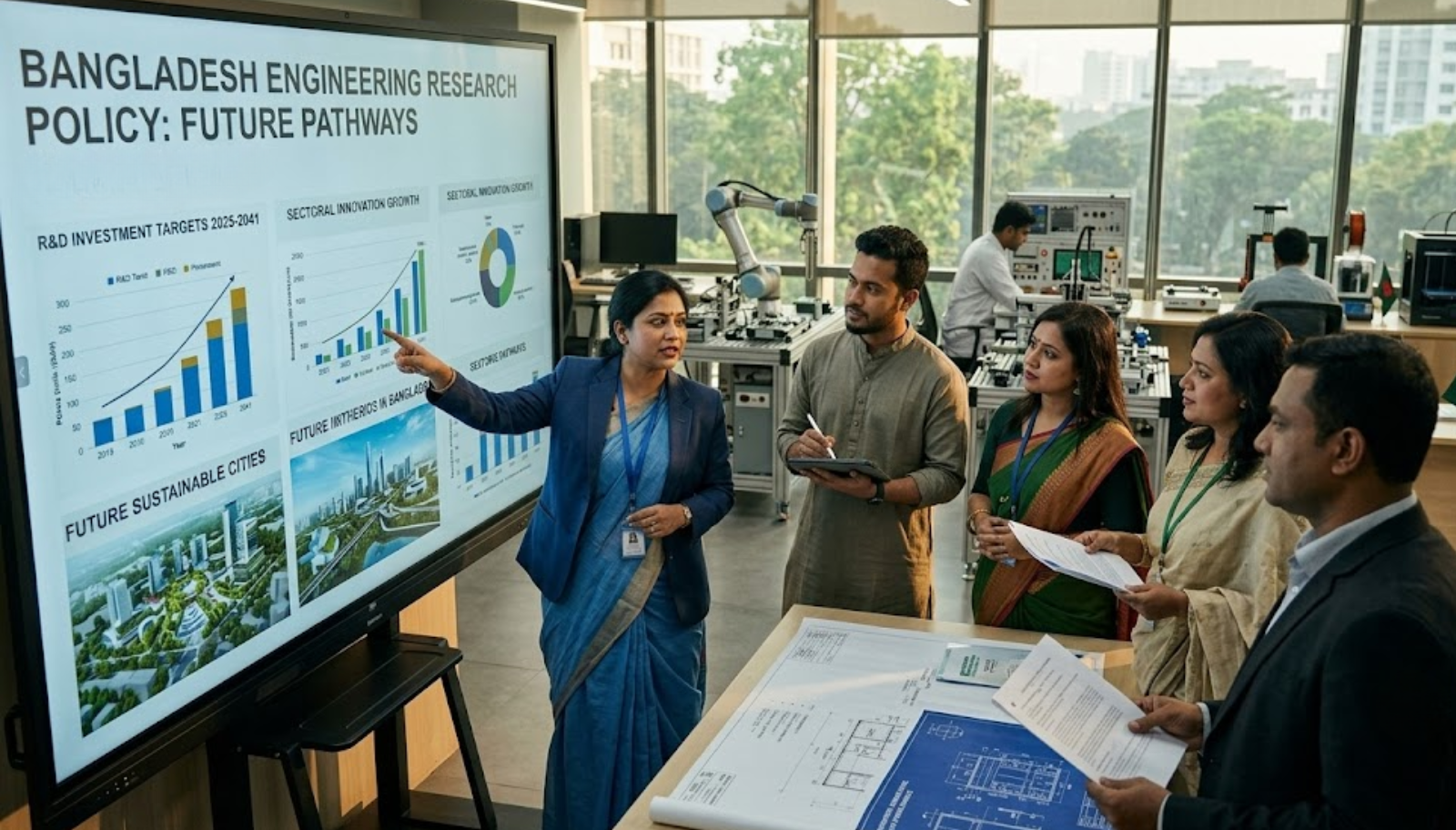
Resolving these interconnected failures requires five structural interventions. First, research funding must increase from 0.2 per cent to at least 1 per cent of GDP by 2025, with dedicated allocation for low carbon construction materials and mechanical engineering innovation. A national research and development strategy with clear sectoral priorities and competitive grant allocation mechanisms is overdue. Second, the enforcement architecture for existing building codes must be rebuilt with qualified personnel at local government institutions, clear compliance penalties, and a monitoring, reporting, and verification system that tracks carbon emissions across the construction sector. Third, industry and academia coordination must become institutional rather than occasional. University curricula in engineering and architecture must integrate climate change mitigation, sustainable materials science, and life cycle assessment methodologies. Vocational training infrastructure must scale to address both the skills gap and the shortage of workers proficient in alternative construction techniques.
Fourth, financial instruments must be redesigned. Green bonds, public private partnerships, low interest loans for small and medium enterprises transitioning to block production, carbon taxation on high carbon materials, and import duty exemptions for sustainable construction machinery are all necessary simultaneously. The current approach of relying on goodwill without financial incentive has demonstrably failed. Fifth, data infrastructure must be established. No centralized database exists for carbon emissions from construction materials, indigenous traditional building practices, or supply chain climate vulnerability. A digital platform integrating real time data on material extraction, building resilience, and climate risk is essential for evidence-based policy making.
Bangladesh possesses the legislative foundation, the demographic advantage, and the local material resources to lead in sustainable construction engineering. What it lacks is the institutional will to fund research, enforce compliance, bridge the industry academia divide, and treat engineering innovation as a national security priority rather than an afterthought. Without these reforms, the gap between policy ambition and construction reality will only widen as climate pressures intensify.