
Desk Report
Oniket Desk
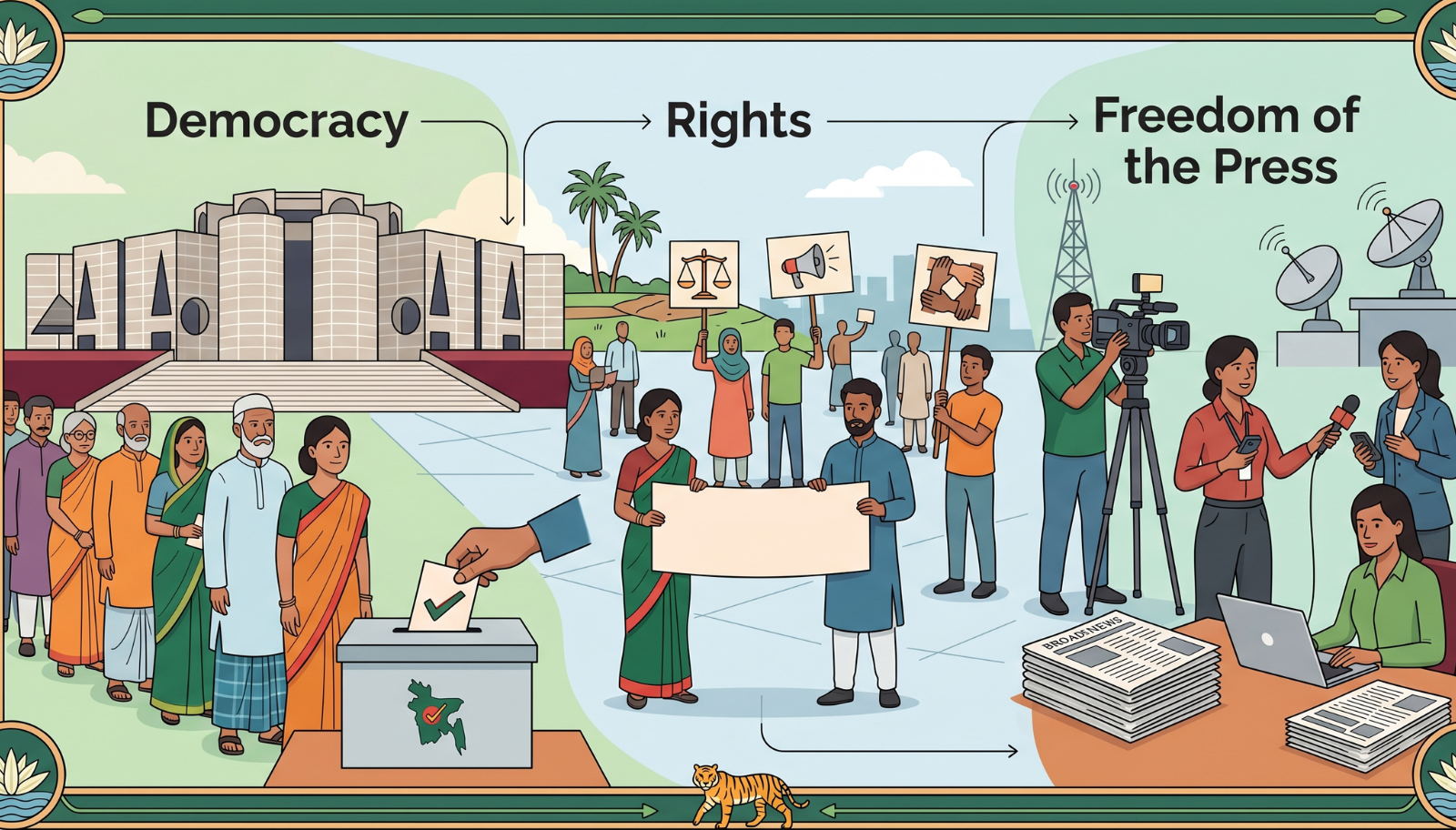
Bangladesh stands at a critical crossroads. The country’s democratic institutions, civic culture, and the rights of its citizens are being tested not by a single force, but by the convergence of several deeply entangled pressures. To understand the state of democracy and political culture in Bangladesh, one must look beyond government censorship or legal restrictions alone. The crisis runs deeper into the very fabric of how citizens engage with power, information, and one another. Based on a recent article published in the Daily Star, penned by SM Rezwan-Ul-Alam, we analyze the scenario and the relevant challenges.
A Democracy Built on Fragile Pillars
Democracy requires more than periodic elections. It demands a culture in which citizens are informed, institutions are transparent, and public discourse is free and honest. In Bangladesh, each of these conditions is under strain. The state has a constitutional obligation to protect the rights of its citizens, including the right to information, freedom of expression, and the right to hold those in power accountable. Yet in practice, these rights are frequently undermined through licensing restrictions, administrative complications, informal directives, and the selective application of law. When the mechanisms meant to protect citizens are instead used to constrain them, the social contract at the heart of democratic governance begins to erode.
The Right to Information Act (RTI), for instance, exists on paper as a powerful instrument of democratic participation. In practice, its use remains limited. Citizens who do not exercise the tools available to them in a democracy inevitably cede power to those who govern them. This is not merely a legal failure. It is a failure of political culture, one that has been cultivated over decades of governance that prioritised compliance over participation.
The Citizen’s Role in the Democratic Crisis
Perhaps the most overlooked dimension of Bangladesh’s democratic challenges is the role of citizens themselves. In the digital age, citizens are no longer passive recipients of information. They are active participants in the information ecosystem. What is shared on social media, what narratives gain traction, how dissent is tolerated or suppressed within communities, all of which shape the public sphere in ways that are just as consequential as government policy.
The spread of misinformation, the inability or unwillingness to verify facts, and an entrenched intolerance of dissenting views all corrode the conditions necessary for democratic life. When citizens distrust both the state and independent media, they become vulnerable to manipulation and disengaged from meaningful political participation. A democracy in which citizens are disengaged or misinformed is, in practice, a democracy only in name.
Concentrated Power and the Weakening of Pluralism
Political culture in Bangladesh has long been shaped by the centralisation of power. Whether in government institutions or in private hands, it has been the common scenario. In the media landscape, this concentration has meant that ownership has fallen into the hands of a small number of influential groups, whose financial and political interests inevitably shape public discourse. The result is a form of pluralism that is numerical but not substantive … more voices, but fewer independent ones.
This reflects a broader pattern in Bangladeshi political culture: the appearance of openness coexisting with structures that limit genuine accountability. Democratic health cannot be measured by the number of newspapers, television channels, or political parties alone. It must be measured by whether ordinary citizens can access reliable information, challenge power without fear, and participate meaningfully in the decisions that affect their lives.
Rebuilding a Culture of Democratic Accountability
Strengthening democracy in Bangladesh requires an honest reckoning with the responsibilities shared across government, civil society, and ordinary citizens alike. The state must move from control to facilitation. This is to ensure journalist safety, enforcing transparency in governance, and applying the law without partisan bias. Civil institutions must resist the pressures of ownership and political proximity. And citizens must reclaim their role as active agents of democratic life. It can only be accomplished by seeking credible information, tolerating dissent, and holding power to account.
The path toward a more democratic Bangladesh is not a matter of importing external standards, but of building institutions and civic habits that are grounded in the country’s own realities. Accountability, transparency, and the genuine protection of citizen rights are not Western ideals. They are the foundations of any society in which people aspire to govern themselves with dignity and purpose.
Source article: