
Tanzina Fardoush
Managing Editor – The Oniket Bulletin
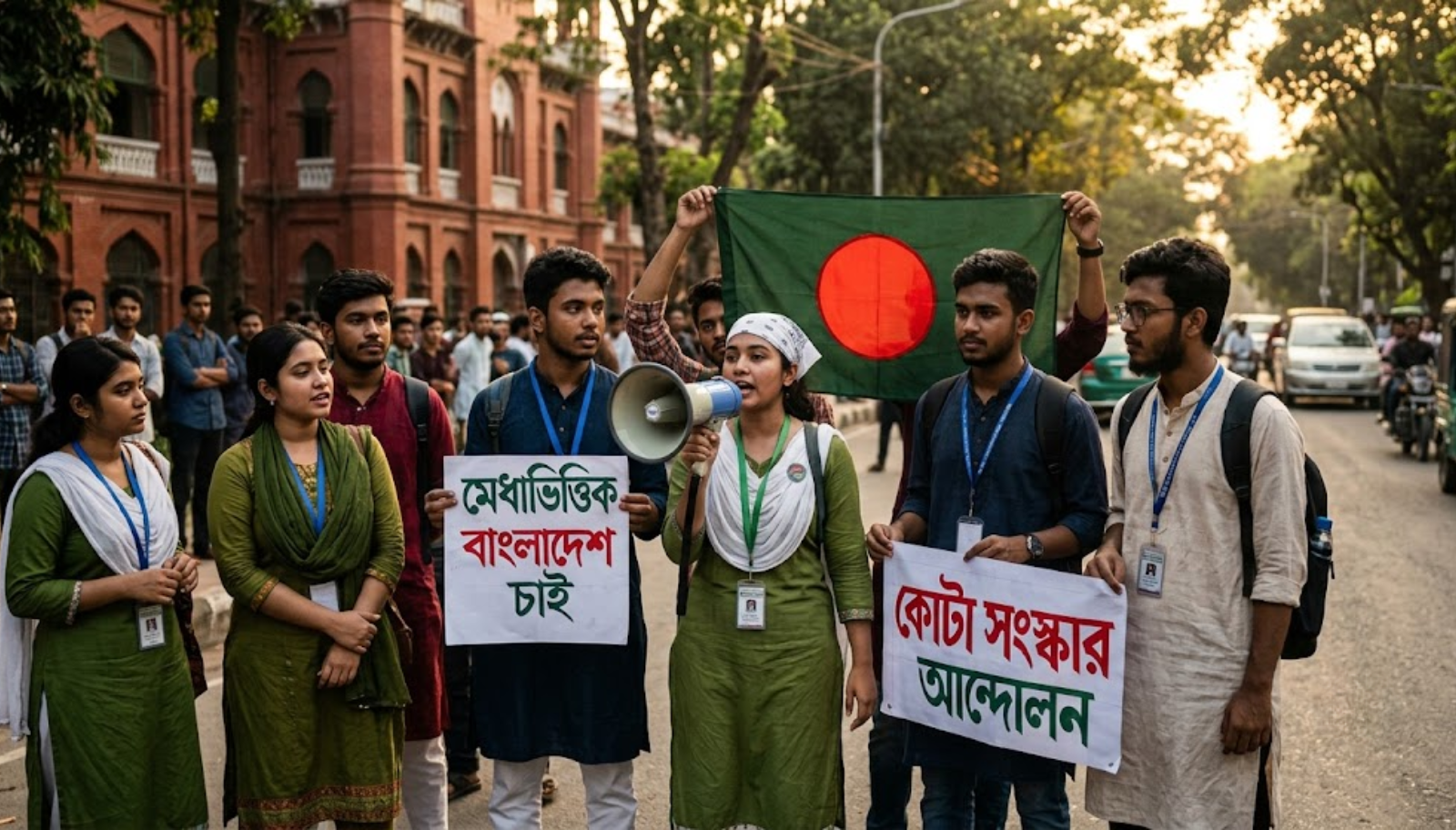
The anti-quota movement of 2024 did not erupt from silence. It was the culmination of decades of accumulated frustration over a system that reserved more than half of all civil service positions for specific categories, leaving merit as an afterthought in the nation’s largest employer. What began as a student protest in June 2024 ultimately toppled a government by August. No other mass movement in recent South Asian history has travelled that distance so quickly.
Origin of the Quota System
The quota system was introduced in 1972 by Sheikh Mujibur Rahman, who reserved 80 percent of government jobs for freedom fighters, war affected women, and people from disadvantaged districts. At independence, the policy carried moral weight: those who sacrificed for the nation deserved their first opportunities. Over subsequent decades, the merit quota crept upward, from 20 percent in the early years to 40 percent by 1976 and 55 percent by 1996. By 2018, the system set aside 30 percent for children and grandchildren of freedom fighters, 10 percent for women, 10 percent for candidates from backward districts, 5 percent for ethnic minorities, and 1 percent for persons with disabilities and third gender citizens.
Cumulatively, 56 percent of civil service jobs were reserved. Only 44 percent remained for open merit competition. The freedom fighter quota alone, originally meant for those who bore arms in 1971, had expanded across generations to encompass grandchildren, many of whom had no personal memory of the war. Students argued, with increasing urgency, that the quota functioned less as a tool of restorative justice and more as a mechanism of political patronage rewarding loyalty to the ruling Awami League.
June 2024: The Turning Point
The crisis reignited on 5 June 2024 when the High Court declared the government’s 2018 decision to abolish quotas unconstitutional, illegal, and ineffective. This ruling reinstated the full 30 percent freedom fighter quota and the broader reservation framework. The court verdict came in response to a writ petition filed by relatives of war veterans, and it was widely perceived as politically choreographed to serve the interests of the ruling establishment. Students responded immediately. Protests erupted across university campuses in early July, initially peaceful and confined to demands for quota reform. The government’s reaction transformed the movement’s character. On 14 July, Prime Minister Sheikh Hasina labelled the protesters “Razakars,” a term denoting collaborator with the Pakistani military during the 1971 genocide.
The remark detonated across a generation already suffocating under economic stagnation, rising inflation, and massive graduate unemployment. Students seized the insult and wore it sarcastically as a badge of defiance. On 7 July, protesters launched the “Bangla Blockade,” paralysing major roads and transport networks across the country. A simultaneous revelation that Bangladesh Civil Service examination questions had been systematically leaked for over twelve years further ignited public anger. The state escalated furiously. The Bangladesh Chhatra League, the ruling party’s student wing, attacked demonstrators with weapons. Police opened fire. The army was deployed with shoot on sight orders for curfew violations. Mobile internet was cut nationwide for ten days.
By late July, nearly 200 people had been killed and thousands injured. On 21 July, the Supreme Court intervened, reducing the freedom fighter quota from 30 percent to 5 percent and allocating 1 percent each for ethnic minorities and persons with disabilities, leaving 93 percent of jobs merit based. The government endorsed the ruling within two days. But the students had already moved beyond quotas. Their nine-point demand now included public apology from the Prime Minister for the killings, resignation of key ministers, investigation into the use of lethal force, compensation for victims’ families, and release of all detained protesters. By early August, the nine demands had collapsed into one: Sheikh Hasina must resign. On 5 August 2024, she fled the country.
What Was Achieved and What Remains
The movement’s concrete achievement is substantial. The quota system that reserved 56 percent of civil service jobs now reserves only 7 percent, with 93 percent open to merit. The political leadership that used quotas as instruments of patronage has been removed from power. The interim government under Muhammad Yunus has signed the International Convention for the Protection of All Persons from Enforced Disappearance and has begun releasing prisoners held in secret detention centres known as Aynaghar. These are not symbolic gestures. They represent a fundamental reordering of the relationship between citizen and state.
Yet critical work remains undone. The merit-based recruitment framework that replaced the quota system must be codified into legislation rather than left vulnerable to executive reversal, precisely the mechanism that undid the 2018 abolition. The judicial independence revealed as compromised by the June High Court ruling must be structurally insulated from political pressure through transparent appointment processes and fixed tenure protections. Bangladesh must legislate merit based hiring regulations aligned with the right to equal access to public service guaranteed under Article 21 of the Universal Declaration of Human Rights. The election system, discredited by the 2018 “night vote” ballot stuffing and the walkover election of 154 Awami League candidates without opposition, requires comprehensive reform ensuring that no citizen faces violence, detention, or death for exercising the right to vote.
The economy that drove students to the streets, characterised by jobless growth, garment sector dependency on cheap labour, and remittance reliance, demands diversification and the creation of quality employment for educated youth. The enforced disappearance apparatus must be permanently dismantled through legislation, not merely emptied of its current inmates. Most fundamentally, the constitution itself, forged under the old regime’s authority, must be revisited through a participatory process that reflects the people who rewrote their relationship with the state through their sacrifice in the streets of July and August.
The anti-quota movement began with a demand for fair jobs and ended by toppling an autocracy. Reforming the state that autocracy left behind is the harder task, and it has only just begun.