
Minhaz-Us-Salakeen Fahme
Game XR and SaaS
Every Dhaka kid of my generation remembers the sound before the darkness, a small click, and then nothing. Load-shedding didn’t warn you. It arrived mid-sentence, mid-boss-fight, mid-save. You lit a candle, and if you were lucky, your progress had been saved a few minutes earlier. If you weren’t, you replayed the whole level from memory, in the dark, cursing a grid you had no say in.
I think about that click every time someone tells me Bangladesh is about to become a green data center hub.
A data centre is, at its core, a promise about power: that the electricity feeding a wall of servers will not stop, will not spike, and increasingly, will not come from a diesel generator wheezing in tropical July. Call a facility “green” and you are making a specific claim that the power behind it is renewable, verified, and stable enough to survive a currency of trust larger than any batch job. Miss any part of that promise and the label is just paint. A candle is not renewable lighting because it looks pretty.
Bangladesh currently relies on two national data centers, split by both location and operator. The Tier III facility is run by the Bangladesh Computer Council in Agargaon, Dhaka. The Tier IV facility sits under the state-owned Bangladesh Data Center Company Limited, out in Bangabandhu Hi-Tech City, Kaliakair. In 2024, a joint venture between BDCCL and Gennext Technologies brought Meghna Cloud online inside that Kaliakair facility, the country’s first real cloud service infrastructure, built to keep more of our data, and more of our foreign currency spend, inside our own borders. The private colocation market is still thin, carried mostly by local players like Felicity IDC and Red.Digital.
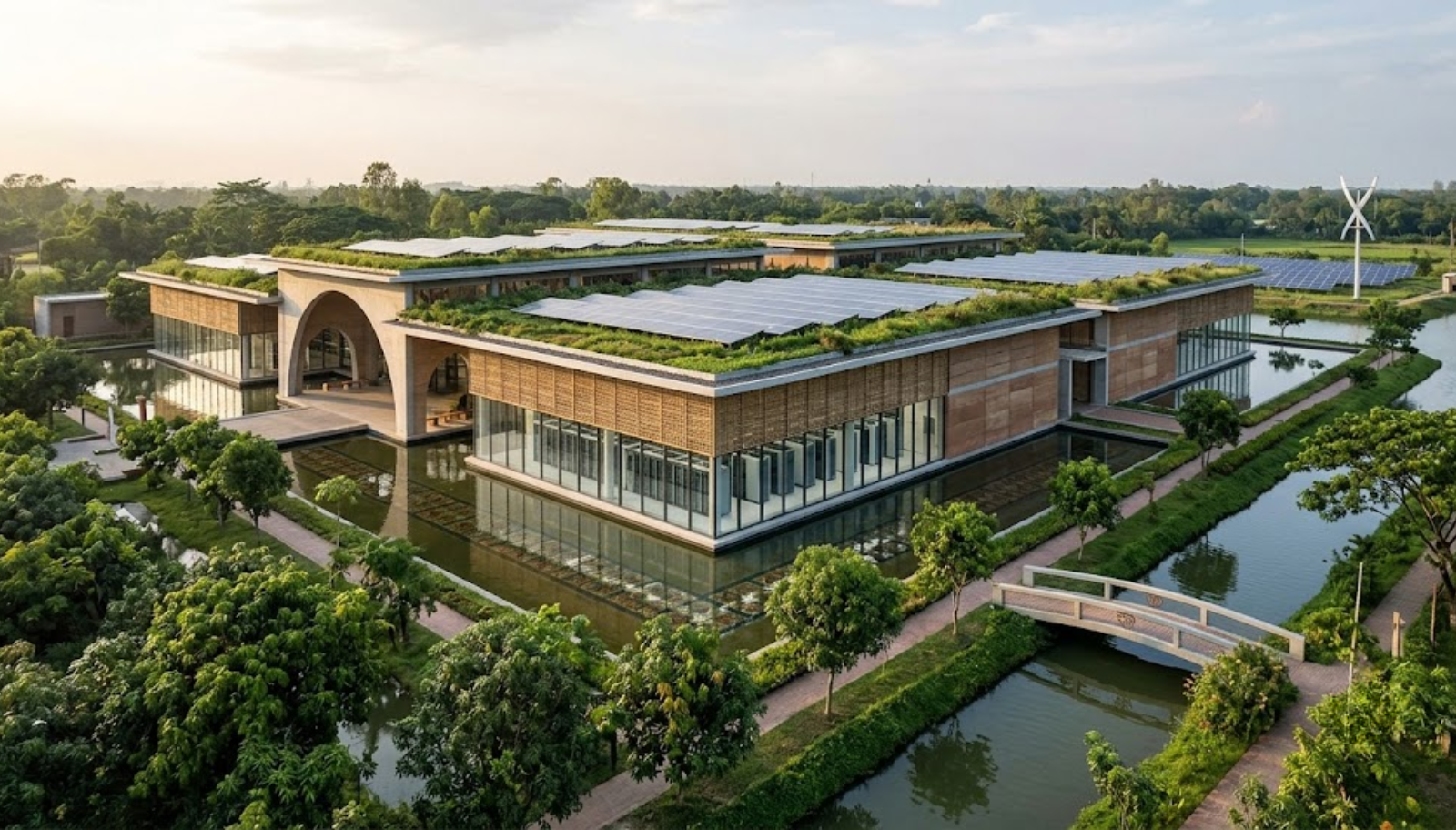
Then, in January 2025, came the signal that actually earns the word green: the Asian Development Bank signed an MOU with the Posts and Telecommunications Division, BTCL, and the Public-Private Partnership Authority to build the country’s first genuinely renewable-powered data center, on BTCL-owned land near Chattogram, under a public-private partnership model decided by international competitive bidding. Around the same time, Saudi firm DataVolt and Indian company Yotta both announced plans to enter the Bangladesh market. More recently, Summit Group, the country’s largest private power producer, confirmed it is building its own facility near Dhaka, seeking a global technology partner, aiming to open within roughly eighteen months.
Here is where I have to be precise, because precision is the entire argument of this piece: Summit’s planned data center will run on the company’s existing gas-fired generation, not renewable power. It is a legitimate, well-financed project, and Bangladesh needs the capacity. But it is not green and folding it into the same sentence as the ADB’s Chattogram facility, as easy as that is to do, is exactly the kind of quiet category error that lets a country call something green because it’s new, not because it’s clean.
That confusion should worry us more than any infrastructure gap, because infrastructure can be built. A grid stable enough to survive a Dhaka summer, fiber redundant enough to survive a single cut cable, cooling engineered for our humidity rather than borrowed from a Finnish datasheet, these are solvable with money and time. What’s harder to build is the discipline to keep “green” meaning something once the capital starts arriving and the incentive to just say the word becomes stronger than the incentive to earn it.
The investment case, at least, is real. Bangladesh offers a ten-year corporate income tax exemption for ICT and hi-tech park investments, and this year’s budget named data centers and AI infrastructure as one of four pillars of the country’s technology strategy, alongside connectivity, digital public infrastructure, and electronics manufacturing. The government has actively courted American firms to expand here. Capital is watching.
What Bangladesh negotiates now will decide whether that capital leaves anything behind. Every foreign contract signed for a data center here should require verified renewable sourcing before the word green appears in any marketing material, mandatory training of Bangladeshi engineers in cooling design and carbon accounting, and a real share of operating revenue routed into a fund that eventually builds a facility we own outright, not just host.
I grew up trusting a grid that gave me no reason to trust it, and learned young the difference between light that’s there and light you’re told is coming. Bangladesh’s data centre moment is the same lesson at industrial scale. We can build something that runs on real, verified, owned power, or we can build something that looks the part in a press release and goes dark the moment anyone checks the meter. The country has spent decades learning to tell the difference between the two. It should use that instinct now.

